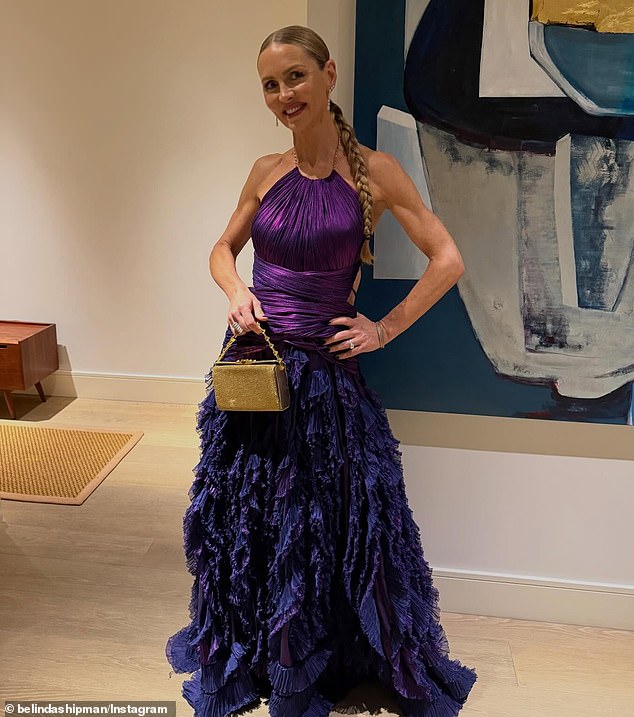
An Australian fitness coach has revealed the confronting reality of a preventative skin cancer treatment that left her face blistered, inflamed and painfully raw for weeks.
Belinda Shipman, 53, an Australian now living in London, decided to publicly document her 28-day course of topical chemotherapy after doctors discovered multiple pre-cancerous lesions on her face.
The graphic images have shocked many of her followers online, but Belinda says the reason for sharing them is to spread as much awareness as she can.
‘I’d gone from being completely unaware and oblivious to sitting in front of a dermatologist telling me I had active growing skin cancers,’ she told the Daily Mail.
‘My heart sunk. I was absolutely freaking out.’
Belinda said the ordeal began with what she thought would be a routine skin mapping appointment in the UK.
Initially, she admitted she was more interested in the clinic’s longevity testing than the skin check itself. But shortly afterwards, she received a call that changed everything.
Doctors had detected three suspicious lesions on her shoulder and asked her to return for further monitoring, which she promptly did.

Australian fitness coach, Belinda Shipman (pictured), has revealed the confronting reality of a preventative skin cancer treatment that left her face blistered, inflamed and painfully raw for weeks

Currently residing in London with her family, Belinda decided to publicly document her 28-day course of topical chemotherapy after doctors discovered multiple pre-cancerous lesions on her face
Over the following weeks the spots were photographed and analysed with specialised imaging equipment, until one of them began growing rapidly.
At a dermatology appointment the lesion was removed for biopsy, but during the full-body skin examination the specialist discovered additional damage across her face.
‘She said I had quite a few squamous cell carcinomas and a lot of actinic keratosis,’ she explained.
Actinic keratosis (otherwise known as solar keratosis) are rough patches caused by years of sun exposure and are considered pre-cancerous lesions that can eventually develop into squamous cell carcinoma if left untreated.
‘I’d gone from thinking everything was fine to being told there were fast-growing skin cancers. I was genuinely terrified of it getting out of hand.’
Her fears were amplified by family history ranging from her dad’s skin cancer scares to her niece in Australia who’d had to have a basal cell carcinoma cut out of her face.
Rather than removing each lesion individually, Belinda’s dermatologist recommended a more aggressive approach – a topical chemotherapy treatment designed to destroy damaged skin cells across the entire area.
The cream, called Tolak, contains four per cent fluorouracil and is used as a ‘field treatment’, meaning it targets large sections of sun-damaged skin.

The graphic images have shocked many of her followers online, but Belinda says the reason for sharing them is to spread as much awareness as she can. ‘I’d gone from being completely oblivious to sitting in front of a dermatologist telling me I had active growing skin cancers,’ she told Daily Mail
Belinda was given the option to treat sections of her face over several months, or to undergo the process all at once.
‘I just thought, you know what, let’s do it,’ she said.
‘I’ve gone from being a really healthy person – I’m in the fitness industry, I don’t even take Panadol – and suddenly I’m doing topical chemotherapy. It was a total head-spin.’
The treatment involved applying the cream every night for 28 days, but what followed, she said, was far more intense than she ever expected.
As the medication began attacking abnormal cells beneath the skin’s surface, Belinda’s face started to react dramatically, becoming ‘unbelievably painful.’
‘That’s when I started thinking, ‘How am I going to finish this?’
The cream works by destroying damaged and pre-cancerous cells, including those not yet visible on the skin.

Belinda’s dermatologist recommended a more aggressive approach – a topical chemotherapy cream called Tolak, containing four per cent fluorouracil, which targets large areas of sun-damaged skin rather than treating each lesion individually. (Pictured: Fully healed post treatment)
As a result, areas of hidden sun damage often become inflamed and blistered during treatment, but Belinda said her dermatologist encouraged her to continue despite the reaction.
‘She told me, ‘This is exactly why you’re doing this. I could see when you walked in that your skin was covered in sun damage,’ she recalled.
Belinda admitted that years of bad tanning habits, using sunbeds and never wearing sunscreen had all likely contributed to the damage.
The visible reaction in her skin also forced Belinda to put much of her normal life on pause when she noticed people would stare at her in the street in disbelief.
‘Some people would say, ‘Oh my God, have you had a chemical peel?’
She also had to cancel several social events, including a wedding, because of the severity of the reaction and said sun exposure also had to be entirely avoided, as the medication makes skin extremely photosensitive.

The treatment involved applying cytotoxic cream every night for 28 days. As the medication began attacking abnormal cells beneath the skin’s surface, Belinda’s face started to react dramatically, becoming ‘unbelievably painful.’ Australian media personality Brittany Hockley (pictured) also underwent the treatment in 2023
‘In Australia it would be really hard because you can’t go out in the sun at all,’ she said.
Despite the discomfort, both Brittany and Belinda said the treatment was recommended as a way to significantly reduce their future skin cancer risk, and without it, doctors warned they would likely face multiple surgical procedures in the future.
‘The chances are I would have ended up having parts of my face cut out, but this treatment hunts down the cancers you can’t even see yet.’
She said documenting her painful and invasive journey online was partly motivated by her children.
‘I have three daughters and one of them loves tanning in the sun, so I wanted them to see the reality of what sun damage can lead to.’
The response from followers has largely been supportive, though Belinda admits she has received some criticism.
‘You always get trolls saying things like, ‘She’s being dramatic’ or ‘She needs help’,’ she said.

Despite the discomfort, both Brittany and Belinda said the treatment was recommended as a way to significantly reduce their future skin cancer risk, and without it, doctors warned they would likely face multiple surgical procedures in the future
‘But I’ve also connected with so many people who have done this treatment or are about to.’
Belinda is not the only Australian who has spoken publicly about preventative skin cancer treatment – in 2023, radio host and television personality Brittany Hockley revealed she was undergoing cytotoxic cream treatment after noticing several unusual spots on her skin.
After seeing a specialist, the then-35-year-old was diagnosed with solar keratosis – the same as Belinda’s pre-cancerous sun damage.
‘I’m a week into my cytotoxic treatment and I feel it,’ she said at the time, documenting skin looking red-raw and blistering.
‘This cream pulls up all the bad spots and the areas that are inflamed, which is way more than three spots. It’s scary,’ she said.
Hockley said she had initially delayed getting her skin checked but was prompted to act after seeing a news report about a young person who died from melanoma.
Belinda said she would still recommend the treatment to others in a similar medical situation – but stresses that the process is confronting.
‘No one can prepare you for how intense it is. You just don’t think it can possibly be that bad – but it really is.’
‘Skin cancer is dangerous, so if this stops it getting to the point where something has to be cut out, then it’s worth it.’