There is little about rugby legend Lawrence Dallaglio’s current home that speaks to the life of a man who scaled the heights of sporting success.
He once lived in a sprawling, £2.7million pile bordering Richmond Park, with wisteria weaving up the facade – befitting someone who captained his country and formed part of the 2003 World Cup-winning squad.
While it’s been 18 years since Dallaglio, now 53, retired from international rugby – admittedly still with smudges of the almighty grey cloud that hung over him following an infamous red-top newspaper honeytrap drugs sting in 1999 – there are no visible trappings of his success today.
Home is a rented, modest, starkly modern redbrick property, with a strip of grass and concrete drive between his front door and the street, just outside St Albans in Hertfordshire.
There’s a wooden pallet and piles of cardboard boxes piled against the wall, and in the small front garden a chest of drawers stands abandoned.
How far this mighty powerhouse has fallen.
It had been hoped that the sale last year of his former south-west London home, which he once shared with ex-wife Alice and their three children, would stave off the creditors. It didn’t work.
Dallaglio, who had been director of his own eponymous company, was made bankrupt in May 2025 before the house could sell – an order which should have been lifted last month, bankruptcies ordinarily being discharged after a year.

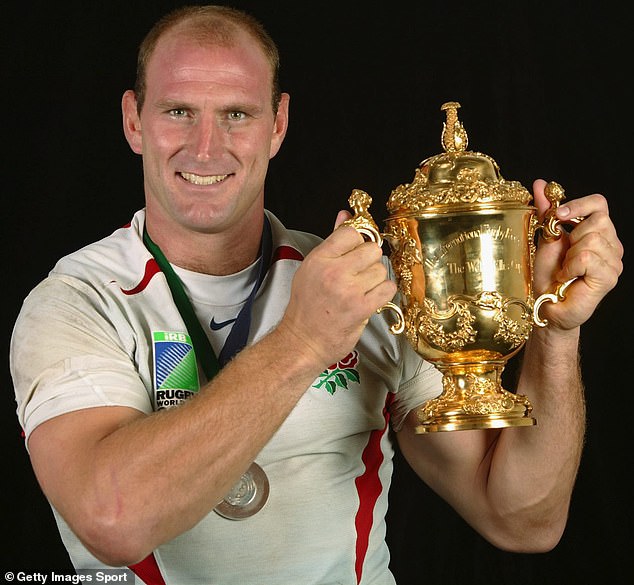
Lawrence Dallaglio was part of England’s team when they won the Rugby World Cup in 2003

Home is a rented redbrick property, with a strip of grass and concrete drive between his front door and the street, just outside St Albans in Hertfordshire
Not, it would seem, in the case of the former number eight, who made his debut for London Wasps in 1990 and whose career on the pitch was at times overshadowed by his decidedly colourful life away from it.
For, as was reported last week, Dallaglio’s bankruptcy has been extended amid allegations of ‘excessive spending’.
Indeed, despite having gone bankrupt with debts totalling more than £800,000 (to HMRC, other creditors and an overdrawn director’s loan account), it would appear Dallaglio has done little to mend his ways.
He has been accused by trustees of the bankruptcy of spending up to £1,000 a month on travel and transport, the same again on clothing and footwear, as well as £500 a month on alcohol.
‘Mr Dallaglio is not meeting his debts as they fall due,’ a skeleton argument on behalf of joint-trustee Nick Parsk states.
The sportsman, who first narrowly avoided going bust over a £700,000 unpaid tax bill in 2023, is said to be in arrears on court-ordered monthly spousal maintenance payments to his artist ex-wife, 52. His spending habits mean there is ‘nothing leftover to go towards the claims against his bankruptcy estate’.
The player, once an imposing 17-stone figure in a fearsome back row, has, it should be said, ‘strongly disputed’ the allegations made against him at the High Court about his co-operation with trustees and information provided about his finances.
But there is, among those who know – and love – the OBE recipient, a disheartening sense of ‘here we go again’.

Dallaglio was appointed an OBE by the late Queen in 2008 for his outstanding sporting achievements

Dallaglio celebrated his honour at Windsor Castle with his now ex-wife Alice
The Daily Mail spoke to friends and associates last week and found a well of affection and admiration, but also of exasperation.
‘Let’s not pretend this is anything new, his life has been a whole pile of stupid mistakes,’ says one former friend with dismay. ‘He was known as “Del Boy” at school, and his mother protected him when anything went wrong. He’s a grown man. He needs to get a grip.’
Still very much a household name, Dallaglio is popular both as a pundit, and for his charity work: his charity Dallaglio RugbyWorks supports disadvantaged young people, and those who have seen his charitable endeavours won’t hear a bad word said about him.
There’s sympathy, too, for the man who was 16 when his sister Francesca, 19, became the youngest victim of the Marchioness disaster, when two boats collided on the River Thames, in 1989.
Dallaglio has himself spoken of the devastating toll Francesca’s death wrought on his family.
But there is also, among those who know the charismatic sporting legend – who toured with the British Lions three times and is one of just a small group of players to have won both the World Cup Sevens and the World Cup – a feeling of patience being rapidly eroded.
Another friend, who works as a therapist and has known Dallaglio for decades, says: ‘It’s like he never grew up.
‘I wonder whether many sportspeople are like this – either not believing that they have to behave because of who they are, or just not getting the idea of responsibility at all?’

Dallaglio as an England player in the 1993/4 season. A friend who works as a therapist and has known Dallaglio for decades, says: ‘It’s like he never grew up’
‘A man whose life keeps proving to him that he gets away with it has little reason to believe in consequences.’
That there have been many occasions warranting consequences is in no doubt.
Many with longer memories will recall the infamous exposé 27 years ago, when Dallaglio had to resign his England rugby captaincy after he was caught boasting to a female undercover reporter of selling cocaine, as well as taking it, along with ecstasy, LSD and cannabis.
He also talked about ‘romping’ with prostitutes.
Dallaglio later admitted experimenting with drugs as a teenager, but said he lied to undercover reporters about taking them during his rugby career in an effort to impress.
He received a £15,000 fine for bringing the game into disrepute, but a drugs charge by the RFU was dropped and he bounced back.
His public reputation soared in the wake of England’s World Cup glory, four years later, but the rollercoaster of storms off the pitch just kept on coming.
The sportsman’s relationship with teenage sweetheart Alice, a former model and art student, is a case in point. Theirs was a rocky romance from the start.
They endured a public split in 2003 after she allegedly had a fling with millionaire property developer – and Dallaglio’s friend – Leon Butler.
But they reconciled and married in a romantic ceremony in Italy’s Lake Como two years later.
Almost two decades after that, Dallaglio found himself in the midst of another scandal when it was alleged he had used his own bank cards to spend £10,000 in a London brothel.
This particular off-pitch ruck became public knowledge in 2020 when a gang accused of running a brothel in Holborn, central London, faced court.
Customers had also been able to purchase cocaine.
Dallaglio paid with his own credit card and, when police raided the brothel, they found the slips kept hidden in the wall of a basement lavatory. Exactly what the rugby veteran had paid for was never established.
Quite what Alice and Dallaglio’s three children, the youngest of whom was still just 17, made of it all is unclear.
But by early last year the couple were locked in divorce proceedings.
Looking back at it all, and the predicament Dallaglio is in now, his therapist friend says: ‘It’s hard not to diagnose him, given my job. But even before I became a therapist, I thought of him as something of a victim.’
Why? In part because of the death of Francesca.
Dallaglio has spoken on more than one occasion of how he turned down an invitation to the party that took his sister out that fateful evening in August 1989.
Francesca was among 51 young people who died when the Marchioness pleasure boat was struck and sunk by a dredger on the River Thames.
He had an instinctive sense when she didn’t return home, and could hear the buzz of emergency helicopters whirring, that something terrible had happened.
‘It was a horrific event, one of those things that blows your life apart and that of your parents,’ he said on a podcast in 2021.
‘From that day on, life was never the same and still never has been the same.’
Such feelings are what Dallaglio’s therapist friend refers to.
‘It’s hard to see someone successful, tall and broad-shouldered as a victim,’ he says.
‘But he’s always cast as someone to whom things happen… his sister drowned when he was 16, a newspaper sting cost him the England captaincy on the eve of a World Cup. His wife had an affair. All of it is real, and all of it invites sympathy. But he’s had trouble on a 20-year loop. The death of his sister is truly shocking and awful, and he deserves sympathy in spades for that.

‘It’s hard to see someone successful, tall and broad-shouldered as a victim,’ says Dallaglio’s therapist friend
‘But he also is someone who doesn’t take accountability for his actions, and I would suggest that is because he never had to.
‘I would guess that he believes that he will always be fine, because he always has been.
‘He survived. He was forgiven. He lost the captaincy, sure. But he went on to win the World Cup, so he survived, and everyone loves him regardless.’
Another associate from the sportsman’s Wasps days agrees: ‘He’s a lovely guy with lots of friends, and there’s always someone there to pick him up.
‘Someone always steps in to look after him, so he’s never had to grow up.’
Dallaglio himself has been frank about the support system he found in rugby and the mistakes he has made
‘I’ve had the same struggles as everyone else,’ he said, six months ago on a podcast revealing his own vulnerabilities and how rugby had been an escape.
‘I’m 53 still working it out,’ he said. ‘But that’s OK because you realise that life is about working it out. You know what I mean? Some do it quicker than others.’
Brought up a staunchly Roman Catholic family, Dallaglio’s father Vincenzo and mother Eileen strove to get the very best education for their son. They sent him to King’s House prep school, in Richmond, where with the choir he sang backing vocals on Tina Turner’s hit track We Don’t Need Another Hero and performed at Andrew Lloyd Webber’s 1984 wedding to Sarah Brightman.
He went on to board at Ampleforth, in North Yorkshire, where his rugby career took shape – as did some slightly more ‘wayward’ habits. For example, he once got in big trouble for a sideline selling Zippo lighters.
In his 2007 autobiography, It’s In The Blood: My Life, he writes: ‘The balance between acting responsibly and irresponsibly was fragile and has remained so throughout my rugby career.
‘Anyone who saw how I conducted myself at Ampleforth would not have been too surprised that I got, and then lost, the England captaincy. That sums up a lot about my character.’
He has, it would seem, at least some self-awareness.
As for his finances, the £2,500 monthly rent on his modest new home is indeed steep.
He lives there with his new partner and dog, a golden retriever named Ziggy, which has its own TikTok account.
Those close to him say he is committed to the work of his charity, which uses rugby as a tool to help young people who have been excluded from school.
Sportswriter and novelist Alison Kervin says Dallaglio has always been incredibly generous.
‘I have asked him to help with a couple of charities I’m involved in, coming to large dinners as the star guest, to be interviewed by me on stage. He always comes, and he’s always great – very helpful and generous with his time.
‘On one occasion, he refused to have a free drink, and insisted on charging nothing to the charity, paying for his own cabs home and his own drinks. He’s an incredibly decent man with a real focus on charity and helping people.’
And there lies the curious dichotomy of Lawrence Dallaglio. As another friend adds: ‘He has helped raise millions for other people while going broke himself.
‘He was a disciplined athlete and an undisciplined man, but along the way he raised a lot of money for those less fortunate. Maybe that says something good about him, rather than bad.
‘And let’s not judge someone’s personal life when they are single, marriage broken up, career over. It was a tough time for him.’
Dallalgio’s solicitor, Sanjeev Punj, told the Daily Mail: ‘As this is ongoing before the court, it would not be appropriate to comment further at this stage.’
There have been further challenging times in his personal life. His mother, Eileen, died of cancer in 2008. And on Christmas Day last year, he announced on
Instagram that his father, Vincenzo, had passed away peacefully aged 91 following a long battle with dementia.
Dallaglio is understood to have been his father’s primary carer and to have told the court that ‘personal circumstances’, in particular his father’s failing health and death, had impacted his ‘level of engagement’.
Announcing Vincenzo’s death, Dallaglio shared a photograph of his parents next to the World Cup trophy.
It can only be hoped that the memories of those who loved and supported him through the highs and lows can help Lawrence Dallaglio get a grip on his personal finances.
Maybe he will also be able to find that elusive balance between responsibility and irresponsibility he once spoke of.