It was never a secret that my father was adopted by a Nazi.
Growing up in the suburbs of Boston, the youngest of my father’s 13 children, I’d heard snippets of his stories.
But as a child, I didn’t know many details about that time – I was always too afraid of him to ask.
During the first ten years of my life, I often hid in my bedroom once my father got home from work. From the safer side of my bedroom door, I’d hear my parents argue, screaming for hours, my father’s speech growing increasingly slurred as one glass of Jack Daniels became half a bottle.
I did my best to make him forget I existed by staying quiet and listening in case he appeared on my side of the door. I didn’t want to feel his fists on my face or hear him tell me I was fat, ugly and stupid again.
When he recounted his stories of his life with the Nazis, it was usually during Christmas or Easter. My older siblings – the eldest was 22 years older than me – had escaped our home as soon as they could and visited only on holidays.
He would be on his best behavior for his grandchildren, leave the cap on his handle of Jack and tell the family about what he’d survived.
He had been just ten years old when the Nazis invaded his home country of Belarus in 1941 and several hundred miles from family at summer camp.

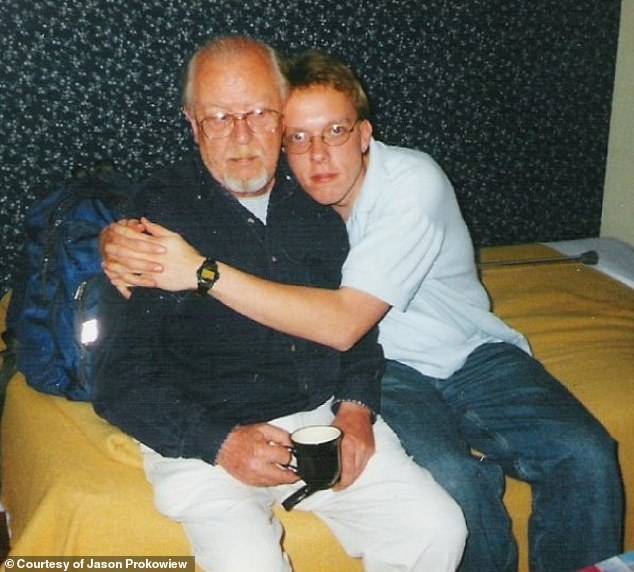
Prokowiew, seen with his father at home in 2000, lived in fear of his father

Prokowiew’s father (center with arms crossed) was adopted by a Nazi, Herr Kroutsick and lived with his family (photographed in Belarus 1942, when his father was around 11)
While walking in a field outside his cabin, a plane descended from the sky and shot at him. He ran for cover in the cabin and found the other dozen campers hiding under their beds; their counselors, young men not much older, were hiding there too.
When they were finally allowed to leave – their vehicles already confiscated by the Nazis – they had to get to Minsk on foot.
The grueling journey took two weeks. And once there, my father learned the awful truth. He was alone. His apartment was unlivable, its windows shattered, and his mother and sister were nowhere to be found.
He spent the next year of his life learning to steal or beg for food from the Nazis now controlling his city. On many nights, he curled up on the floor of an abandoned, burned-out apartment alongside other wartime orphans and fell asleep hungry.
The stories stuck in my head, and as a child, I assumed every kid I went to school with had a dad adopted by Nazis. It seemed normal and I filed away what little I knew while we dealt with more pressing matters.
When my dad was 58 and I was ten, he was hospitalized with cirrhosis of the liver. The doctors warned that if he had one more drink, he’d die.
He left the hospital after more than a month, looking withered and thirsty but never drank again. Still, a dry drunk can be verbally cruel too. My father could stun me into silence by lowering his voice, squinting his eyes and delivering a nasty verbal jab about my stupidity.
My nerves stayed on high alert. I was glad to go 300 miles away to college in Ohio.
During the first semester, my Russian politics professor showed us a film called Come and See, which brutally depicts the Nazi invasion of Belarus.
As I watched the main character enter his village for the first time after being away during the invasion, finding death all around him, it reminded me of my father’s stories. I was drawn like a magnet to my professor’s office afterwards to tell him the scenes in the movie felt familiar.

Prokowiew’s father photographed outside the slaughterhouse where he lived in Belarus
‘What happened to your dad’s mother?’ he asked. ‘What did your dad do when the Nazis retreated at the end of the war?’
He asked questions I didn’t have answers for and had never even pondered.
Spurred by his interest and wondering why my father had been so cruel, I spent my college’s winter term, a one-month period meant to encourage independent study, interviewing my dad about his past.
As a handheld tape recorder sat between us, my father detailed the true horrors he had witnessed.
After a year living on the streets, he begged for some scraps at a slaughterhouse. It was a choice that changed his life. The Nazi in charge gave him a job tending the fires in the kitchens. More importantly, he gave Dad access to food and a place to sleep in the attic.
Dad told me it felt like winning the lottery.
As he worked beside the Germans, he learned their language, the second of four languages he would become fluent in, and his boss, a man my father only remembered as Herr Kroutsick, gave him a promotion.
My dad, now aged 11, spent the next three years as the Nazi’s courier, collecting deliveries of schnapps or other imports for his men and delivering his mail.
He was eventually given a proper room and ate meals with Kroutsick, his wife and children.
But Kroutsick was cruel and often violent. If other Belarusian workers at the slaughterhouse got out of line, Kroutsick would grab a rifle from one of his men and slam it into the back of the offender, hitting him until he fell.
Dad recounted one occasion when he stole some candies from Kroutsick’s desk. He’d denied stealing the candies but Kroutsick found them buried at the bottom of my father’s jacket pocket.
After commanding my father to lean over a chair in his office, Kroutsick whipped my father with the swagger stick he always carried with him until my father’s rear bled through his pants.
My heart sank, imagining this beaten little boy version of my father.
Kroutsick growled: ‘Tell me when you’ve had enough,’ as the stick came down on my father over and over.
My father refused to show weakness and eventually Kroutsick stopped himself. That night the two had dinner with the rest of the family as though nothing had ever happened.
When he repeated what Kroutsick had said to him at the end of the beating, my father’s voice lowered and grew focused, just as it often did when his children or wife did something to anger him.
‘What upsets me is that you lie.’
That voice sent shivers down my spine. It always meant I’d done something he didn’t like and there would be a violent price to pay.

Prokowiew and his father tell their story to his niece’s second grade class in 2001

As an adult, Prokowiew interviewed his father about his wartime experience – what he learned changed the way he saw him

As I listened to my father’s descriptions of his life with Kroutsick – a man who idolized Hitler and kept framed photos of him around the home he’d taken for himself in Minsk – the brutality I’d experienced at his hands all started to make sense.
He’d lived with Kroutsick from ages 11 to 14, witnessing how a father figure could control his family through terror and violence. My father did his best to stay in line, to avoid the beatings, and so would my father’s children.
Over the course of 50 hours of recordings, my father never admitted that he’d hurt his own children with his fists and his venomous words.
But about two weeks into interviewing him, a monumental shift occurred.
I kept asking the man I’d feared for so many years the same question: ‘How did that feel?’ until one night he sat at our dining table and sobbed.
‘Don’t you feel bad for me? Don’t you?’ he asked.
‘Of course I do, Papa,’ I said, and hugged him.
I never sought to forgive my father by interviewing him, but I wanted to understand how he’d become the terrifying father I knew. We learn from the people who raise us how to raise our own children.
My father’s greatest teacher – his surrogate father – was a Nazi who abused him horribly. Unfortunately, my father followed his example.
We finished recording my father’s stories in late 2001, three years after we’d started.
He died three months later.
The tapes we created together gave me a means to tell a complicated story, one that tries to make sense of the father the Nazis helped build, and they became the foundation for my book War Boys: A Father and Son Memoir.
Understanding doesn’t erase the abuse my father inflicted on his own family, but the sense-making gave me a powerful tool to use as I heal from that abuse, as I try to build a life that exemplifies that the abuse ends with me.
War Boys: A Father and Son Memoir by Jason Prokowiew is published by Trio House Press, July 1.