
Anyone considering inviting me to a dinner party or summer drinks gathering in the coming weeks should probably be aware that there’s a topic of conversation I am likely to bring up that might make fellow guests uncomfortable.
No, it’s not politics, religion, or children’s university place offers – it’s my bowels.
At the slightest prompting, I’ll enthusiastically describe my innards and the workings of my bespoke new plumbing to anyone gutsy enough to listen.
You’d be surprised: people tend to stick around a lot longer than they do for a dreary discussion on immigration or climate change.
As a very lucky, and proud, survivor of Stage 1 bowel cancer, which I valiantly saw off in 2023, aided in no small part by the excellent consultant colorectal surgeon Jonathan Wilson and his brilliant team at UCLH in London, I feel it is my public duty to shine a light into this shady corner of our anatomy and, well, get a conversation going.
I do not have any public following – I’m not famous and quite lazy on social media – but when I posted news of my diagnosis on Facebook, I received a blizzard of detailed, often macabre, responses and follow-up questions.
Everything was discussed: from my symptoms (sporadic stomach cramps akin to bad wind coupled with anaemia, which was only picked up when I went to give blood). Stomas (no, I don’t have one, owing to the positioning of the tumour, in the upper section of my colon, but it was an option at one point to aid the healing process).
Then, of course, there’s the dreaded ‘poo test’ – or faecal immunochemical test (FIT) to give it its proper name – which screens for invisible traces of blood in a stool sample and is instrumental in early detection.

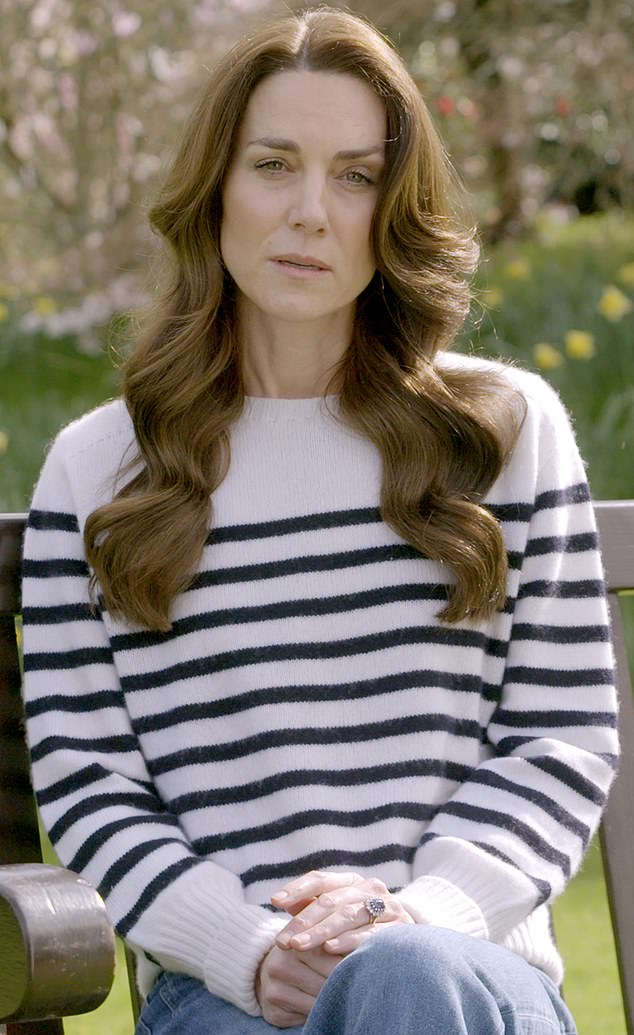
The Princess of Wales revealed she was being treated for cancer in March 2024

Julia Lawrence had Stage 1 bowel cancer in 2023 and wants more people to discuss their cancer stories
I’ve done multiple tests and have a tried and tested technique, involving an empty takeaway curry container, which I’m happy to share – usually after the plates have been cleared away, at a dinner party.
If you’re really lucky, after a few glasses of wine, I might even show you my surgery scars.
Vulgar, unseemly, embarrassing, that’s for you to decide, but I know dozens of people who ordered a FIT test and got themselves checked out as a result of my candour. One very good friend went on to have preventative surgery himself. In this case my loose talk saved lives.
Which is why I was somewhat bemused by the approach adopted by my fellow cancer sufferers, Kate, the Princess of Wales, and King Charles, with their heavily edited, nebulous announcements of their own diagnoses shortly afterwards.
Kate’s was scripted as ‘major abdominal surgery’ when it was first disclosed in January 2024, and only confirmed as cancer, in a heartfelt, but still confusing, video she released at the end of March that year.
The months in between saw a contagion of wild conspiracy theories and speculation: at one point people were questioning whether Kate was in a coma, or actually dead, and we were all being duped by a body double.
Kate went on to have ‘preventative chemotherapy’ which concluded, successfully, in September 2024, but left us none the wiser as to what she had been treated for.
Likewise, King Charles is said still to be receiving treatment for an unspecified form of cancer. The diagnosis came a month after Kate’s, in February 2024, during a procedure for a benign enlarged prostate, though the palace confirmed it is not prostate cancer.

Kate underwent successful treatment, but she has not disclosed exactly what type of cancer she had
We still don’t know what type of cancer either Kate or Charles actually had – or has – and I doubt we ever will. Buckingham Palace has previously said that the King decided, on the advice of cancer experts, not to reveal the specific type he had so he could ‘speak to those affected by all forms of the disease’.
Of course, it’s everyone’s right to keep intimate details about their medical history private, and not everyone is a natural born sharer, but what a lost opportunity this has represented for the monarchy.
Instead of all those keyboard warriors flooding the internet with their mad musings, they could have been prompting people to check out their symptoms.
Countless conversations just didn’t happen, or were diverted down pointless paths, and from that we can perhaps rightfully assume lives were needlessly lost.
A job and moral compass were lost too: a former healthcare worker at The London Clinic, where Kate was treated, was caught trying to sell the Princess’s private medical records. An appalling breach of trust, but one directly prompted by this vacuum of credible information.
Currently, the monarchy is fighting to stay relevant in a country where public support has fallen to its lowest levels in three decades – not helped, admittedly by the disgraceful shenanigans of Andrew Mountbatten-Windsor (in rude health, as far as we know).
Wayward uncles/brothers aside, with its rapidly shrinking support base, the Royal Family faces a daily, uphill struggle to justify its cultural and financial value.
Well, here was an open goal. Going public and putting your name to a public health campaign is a tried and tested formula, and one that does more than just win approval. It helps keep subjects, and their loved ones, alive.
One of the first to see the good you can do by being open was former US First Lady Betty Ford. In 1974, before she bravely revealed her struggles with alcohol addiction, she was diagnosed with breast cancer and underwent a mastectomy. By speaking openly about the disease – which was largely taboo at the time – she prompted a massive surge in breast self-examinations and mammograms, a phenomenon widely cited in medical history as the ‘Betty Ford blip’.
Then there was Jade Goody. The British reality TV star was just 27 when she was diagnosed with cervical cancer in 2008, and openly documented her illness before her death in 2009. Her highly publicised journey was said to have led to nearly half a million more women in England attending routine smear tests.
Most recently, there has been Jeremy Clarkson, with his prostate cancer diagnosis and TV journalist Jon Snow who has revealed he has Alzheimer’s.
And one close to my heart, the brilliant and courageous Dame Deborah James, whose tireless campaigning led to a massive surge in public awareness about bowel cancer, which eventually claimed her life in June 2022.
Her final message – ‘check your poo – it could save your life’ – led to a record-breaking spike in NHS cancer referrals and saved countless lives. Mine among them – probably. I doubt I would have been so quick to go to the doctor, in August 2023, if I hadn’t heard her message so clearly.
In the end, it all happened very quickly. My GP ordered a FIT test which revealed I was bleeding somewhere. An urgent colonoscopy was ordered – an awkward but painless procedure where a camera travels through your intestines looking for abnormalities.
I actually saw the 4cm tumour myself on camera; it looked like a lump of coal. Luckily, I was sedated at the time, so didn’t realise its significance. Days later, I was in surgery where a quarter of my pipework, along with the horrible lump, were removed in a four-hour operation.
I was one of the lucky ones. The cancer hadn’t spread, so after a week in hospital, and three months recovery (and an awful lot of tinned custard and jelly), I was good as new. The care I received, all on the NHS, was incredible.
But, sadly, while the NHS applauds every campaign, the spikes in testing they prompt are exactly that: a spike, a dramatic upwards surge that falls again as the conversation goes quiet.
I have no idea what either the King or the Princess of Wales have, but just imagine the reaction to a campaign on, say, bowel cancer, headed by Kate, the most demure, feminine person imaginable – or the King detailing the early symptoms of bladder cancer to older men – it would be extraordinary.
They have the platform; they have the following. All they need is the guts to speak out.