An influencer was shocked to discover a horrifying, little-known side effect after undergoing a nose job – but according to plastic surgeons, it’s not as scary as it may seem.
Olivia Dayton, who has over one million followers on social media, recently went viral after she revealed the alarming byproduct of her rhinoplasty.
The content creator made a video documenting the side effect, as she shared a close-up of her nose dripping clear liquid as she was getting ready for the day.
‘Just a PSA if you ever get a nose job your nose will decide it wants to drip 24/7,’ she wrote in the caption, adding that when you get sick it’s even worse.
In the comments section, many users voiced their concerns, sounding some alarm bells.
‘No girl it’s NOT supposed to do that!’ one person wrote.
Another commented, ‘I had a nose job 10 years ago, it’s not supposed to do that. Please get it checked out.’
‘This doesn’t happen to me babes,’ someone else typed.

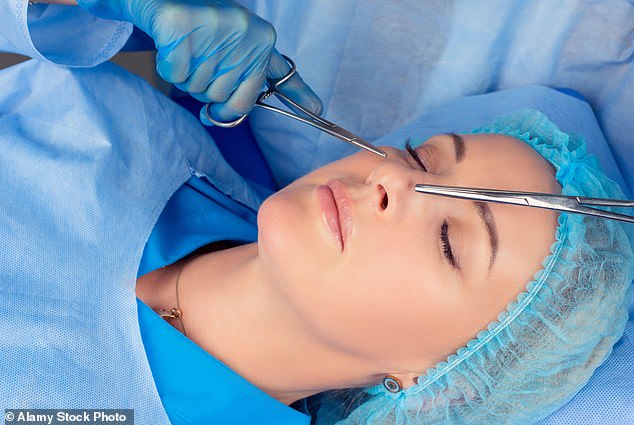
An influencer was shocked to discover a horrifying, little-known side effect after undergoing a nose job – but according to plastic surgeons, it’s not as scary as it may seem (stock image)
But according to plastic surgeons, a runny nose is actually quite common a few months or even years after undergoing a rhinoplasty.
‘This is actually a pretty common symptom right after a rhinoplasty, and I tell patients to expect some degree of it, and it will vary from patient to patient,’ board-certified plastic surgeon Dr Frank Agullo told the Daily Mail.
‘Most patients will notice this occur in the first couple of weeks after surgery, and it does improve as the swelling goes down,’ he said.
Dr Agullo said that most patients see relief from the dripping in about four to six weeks, but others may have the symptom for up to three months.
According to her YouTube channel, Dayton underwent the procedure in September 2024 and posted the TikTok about her runny nose last February.
‘There are a few patients that do experience this leaking for longer periods of time, and that would be a sign to evaluate further for other causes like rhinitis or ongoing inflammation,’ the Texas-based doctor explained.
He told the Daily Mail that this leakage can occur due to the fact that during the surgery they have to remove the nasal mucosa, which is a ‘thin layer that covers the bone and cartilage on the inside of the nose.’
This layer has a lot of blood vessels and nerves, and is ‘essentially’ the part of the nose that produces mucus.

Dr Agullo said that most patients see relief from the dripping in about four to six weeks but others may have the symptom for up to three months (stock image)
‘When the nerves and blood vessels to this layer are disturbed, the nose overproduces this thin, watery fluid,’ Dr Agullo said.
‘The nose also has a lot of tiny hairs called cilia that sweep the mucus backwards into the throat. And right after the surgery, this briefly disrupts their function, and the fluid pools and drips forward instead of going backwards,’ he continued.
Plus, swelling after surgery can also affect the airflow and fluid in your nose.
The plastic surgeon said that there is no way to stop leakage from happening after surgery, but using gentle saline rinses can help ‘flush out’ the nose and keep the area moist.

‘This is actually a pretty common symptom right after a rhinoplasty,’ board-certified plastic surgeon Dr Frank Agullo told the Daily Mail
‘Sleeping with your head elevated, even with some extra pillows, will help limit the fluid from pooling and draining,’ he said.
‘It’s important to avoid irritants and allergens like smoke and strong fragrances,’ Dr Agullo said.
‘For some patients, we start a course of antihistamines or steroid nasal sprays to decrease the inflammation and swelling.’
However, while a runny nose can absolutely be a common symptom right after getting a rhinoplasty, there are some serious instances where you may need to seek medical care immediately.
‘If there’s any bright red bleeding, any large blood clots, if the drainage is foul-smelling yellow or green, if there’s any fever over 100.4 degrees, or if there’s any increased pain, redness, or swelling instead of gradual improvement, these are all signs that you need to be seen by your doctor to rule out any other major causes,’ Dr Agullo said.
He also added that there is one more potential but ‘uncommon’ complication that can arise after a rhinoplasty, and that’s a cerebrospinal fluid leak.
‘If you experience a persistent, completely clear, watery drip from one side of the nose, especially when leaning forward, this could be a sign of a cerebrospinal fluid leak,’ Dr Agullo warned.
‘This is rare after cosmetic rhinoplasty, but it should be evaluated urgently. It is usually associated with headaches.’