The files in psychologist Philip Cozzolino’s office are full of puzzles. There is the three-year-old girl who suddenly started performing perfect CPR on one of her dolls, instructing others with a preternatural accuracy on the exact timing and method.
Then there was the boy who woke with night terrors and had an unfathomable fear of tractors. ‘Most boys like things like trucks, it’s just pretty standard, and this young boy had a terrible phobia of anything related to tractors and farm equipment,’ said Cozzolino.
A particularly mystifying file landed on Cozzolino’s desk a few years ago. A researcher in Japan had met a boy, Yu, who suddenly started speaking American-accented English.
‘He started using phrases and idioms that only Americans would use, and no one in the family spoke English,’ Cozzolino told The Daily Mail.
Many people would dismiss these strange occurrences as normal childhood fears and imaginative play – or too much time spent watching American films.
But for Cozzolino and his colleague Marieta Pehlivanova, who both work at the Division of Perceptual Studies (DOPS) at the University of Virginia’s School of Medicine, these children could provide vital insight into one of the most persistent puzzles of human existence. Does our consciousness continue beyond death? And, if so, is it possible that we have lived past lives?
The answer, according to Cozzolino, is ‘Yes’ and the persuasive cases keep piling up. In the decades since the department’s inception, DOPS researchers have amassed files which detail the experiences of 2,255 children from all over the world who claim to remember past lives. In around 70% of the cases, they have been able to identify the person the child recalls being in a past life – their ‘past personality.’
‘No matter how we explain it, it is a real phenomenon that happens – whether it’s past life memories or near-death experiences,’ said Pehlivanova, a research assistant professor of psychiatry and neurobehavioral sciences. ‘We think of it as gathering evidence from phenomena suggesting some continuity of consciousness beyond death.’

Researchers have amassed files which detail the experiences of 2,255 children from all over the world who claim to remember past lives
DOPS is a faculty of neurologists, psychiatrists, psychologists and academic researchers whose studies include phenomena such as near-death experiences and purported psychic abilities – and children who appear to remember having lived as another human being.
The department was founded in 1967 by Ian Stevenson, a respected Canadian American psychiatrist who devoted much of his career to areas of study that other medical and scientific professionals dismissed and ridiculed.
He began the process of meticulously investigating and documenting cases of children who appear to remember past lives, a quest that took him all over the world.
Upon his retirement – he died in 2007 – his work at DOPS was continued by Jim Tucker, a child psychiatrist who has written bestselling books about his work.
Tucker, in turn, retired last year and now an expanded team including Cozzolino and Pehlivanova are taking the work into a new realm, hoping not just to document the cases of children who remember past lives but see if there is any scientific evidence to back those claims up.
Most cases come from direct approaches from parents who find them through Internet searches. DOPS receives an average of 120 submissions a year. These are triaged by a researcher who will see which ones warrant further investigation.
DOPS will only investigate where there is a level of detail which suggests the team may be able to identify the past personality. This means that most reports don’t get investigated.
In the case of the little girl who performed CPR on her doll, after that incident and another when she used a term for the human anatomy that she had never been taught, she stopped talking about anything unusual so there was not enough information for DOPS to pursue.
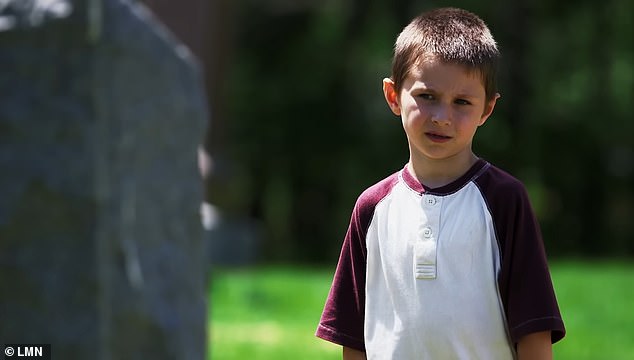
The boy who had a phobia of tractors, however, turned out to be one of Jim Tucker’s most storied cases, making it into one of his books and a documentary.
The child kept talking about Hollywood and telling his parents that he had to go there because he had to go to work. He had night terrors and told his parents that he had been crushed to death. His parents and DOPS deduced that his past personality was Sidney Coe Howard, the screenwriter of Gone with the Wind, who had died tragically on his farm.
‘He was in a barn, and a tractor somehow got out of neutral and crushed him against a wall,’ said Cozzolino.

The boy who had a phobia of tractors turned out to be one of the most storied cases, making it into a documentary

His parents and DOPS deduced that his past personality was Sidney Coe Howard, the screenwriter of Gone with the Wind
As for that little Japanese boy, Yu, speaking American English wasn’t the only unusual behavior he exhibited. When the family went to shopping malls, he showed an unusual interest in the security measures, shouting ‘fire alarms’ and ‘cameras.’
In his first year of kindergarten, there was a fire drill. Yu was so terrified that the teachers asked his mother, Kimi, if he had had a traumatic experience with fire. He had not.
His case took a revealing turn when he was around three. On a walk with Kimi, he casually mentioned ‘my life before my last.’
Kimi asked him to tell her more, and Yu replied that he was working using a computer in ‘two tall similar-looking buildings’ when ‘an accident broke out, and the fire alarm went off… A big accident or something broke out in the next building, and firefighters appeared to be coming. I tried to escape, but there was a huge bang in our building and I died.’
Yu said he was on the 100th floor when this ‘accident’ happened, which puzzled Kimi because Yu had only learned to count to 10. But the two tall buildings he mentioned sounded like the Twin Towers in New York, and when Kimi got home and looked it up, she discovered one of the buildings did indeed have 110 floors.
Yu also acted strangely at school: He struggled to relate to the other children and would gather papers into his ‘business bag’ and say: ‘I have no time to play with kids; I have to go to work.’ He also wanted to attend school in a suit and tie and even requested a bowler hat.
When Yu was six, Kimi reached out to a Japanese researcher affiliated with DOPS after seeing him speaking on TV. He investigated Yu’s case and traveled to New York with him and a Japanese documentary film crew in 2024 when Yu was 10.
Visiting the 9/11 memorial and the site of the Twin Towers, Yu correctly recalled that a sculpture which stood between the towers was once surrounded by water. When the researcher read the names of the victims engraved at the memorial, Yu recognized 13 – eight were related to a company that occupied the 100th floor of the South Tower.
When they looked at photos of those people, Yu was drawn to a victim in his 40s who worked in management. They tracked down the address of his wife and sister and, astonishingly, his sister invited the Japanese team in and warmly welcomed them.
They discovered similarities between the dead man and Yu, including a love of Ray Ban sunglasses and a preference for very formal clothing in the workplace, including a bowler hat originally owned by the dead man’s father.
Cozzolino and Pehlivanova are keen to stress that by documenting cases like Yu’s, they are not trying to prove reincarnation is real. But they believe that there are occurrences of a phenomenon that has not yet been explained by science and they warrant investigation.
‘People are talking about it because their kids say the darndest things, and whether that means it’s reincarnation or not, that’s not for me to determine,’ said Cozzolino.
‘I can only tell you that it is a unique, interesting phenomenon that is not like other childhood and imagination phenomena.’
Indeed, many of the papers and cases documented by Stevenson, Tucker and the DOPS team have been vigorously challenged, with rebuttals published of specific cases and questions raised about research methods which rely on human memory and recollection.
But Pehlivanova, who has been with DOPS for nine years, sees increasing openness among both young people and the scientific establishment to spiritual matters. She thinks this has been spurred by the COVID pandemic, when large numbers of people had to confront their own mortality and the mainstream acceptance of psychedelics.
There are also now numerous TikTok and Instagram accounts dedicated to the phenomenon, including one run by Michael Armstrong Love, who has 1.1 million followers. DOPS has reached out to him to in the hope of identifying more cases.
‘I’m not saying that the entirety of the academic enterprise now views us favorably, but I’m seeing more openness among individual members and maybe people feel more emboldened to actually engage with us,’ said Pehlivanova.

Visiting the 9/11 memorial and the site of the Twin Towers, Yu recognized 13 names of victims engraved at the memorial


Psychologists Philip Cozzolino and Marieta Pehlivanova work at the Division of Perceptual Studies (DOPS) at the University of Virginia ’s School of Medicine
As part of their new research, which has nearly $580,000 in funding, the team will conduct the first large-scale survey of children who report past lives to try and establish commonalities among the cases, which DOPS has observed anecdotally.
For example, more children show signs of past life memories around 2 or 3, and they start to fade at around 7. Most of the children grow up to lead perfectly normal lives and do not have higher-than-average prevalence of mental illness in adulthood.
They also propose giving participants brain scans during which they will receive a test which Cozzolino dubs ‘the unicorn test.’ Children will be asked to think about their own past, then think about a completely imagined scenario, like riding a unicorn around the moon. Children with past life memories will then be asked to recall events from that purported past life.
DOPS researchers will study the neural markers to see if the memories about the past life resemble their own memories or imaginary thoughts.
If it is the former, ‘It would essentially show that they’re experiencing these purported memories of the past life as real memories,’ said Pehlivanova.
As for their personal beliefs about reincarnation, the researchers are cautious. Pehlivanova told the Daily Mail that she strives to keep her professional and personal lives separate.
But based on all the research he has seen at DOPS and elsewhere, Cozzolino is willing to take a punt: ‘I lean more towards saying right now that I think the data are more compelling for me to think that consciousness may actually continue.’