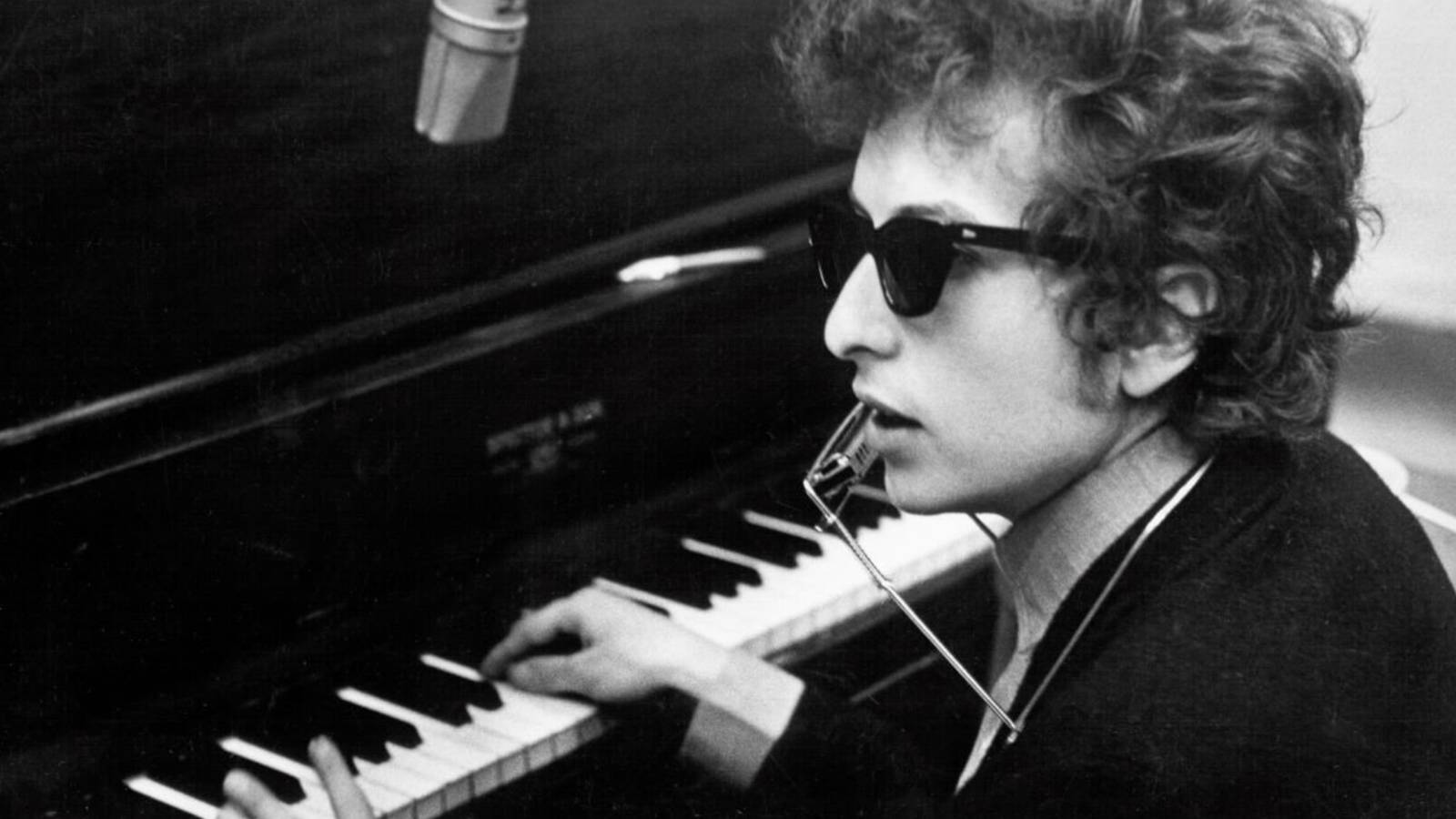
Bob Dylan has written some incredibly long songs over the years, with his longest being the nearly 17-minute “Murder Most Foul” released in 2020. But when it comes to his best earlier works, nothing quite compares to “Desolation Row” from Highway 61 Revisited. Stretching to a staggering 11 and a half minutes, the song is what happens when Dylan completely lets loose, allowing his thoughts, characters, and surreal imagery to spill freely without being tethered to expectations.
The album itself proved what Dylan could do when he was no longer boxed into a single genre. “Desolation Row” is the clearest example of that freedom. While the song still stays true to his acoustic playing, its lyricism feels boundless, offering a glimpse inside Dylan’s restless imagination and how he translates his observations into sounds. The result is an arduously long track that somehow earns every minute of its runtime.
Bob Dylan’s “Desolation Row” Is Influenced by Beat Poet Allen Ginsberg
Released on Highway 61 Revisited in 1965, “Desolation Row” shows more of Dylan’s abstract, literary-inspired songwriting compared to the more straightforward style of his earlier projects. Diction-wise, Dylan doesn’t use complicated or flowery language, but there is something unique about how the song’s narrative plays out from beginning to end. For one, the lines seem disjointed, jumping from one image to another, where one verse describes a “beauty parlor filled with sailors,” before shifting into a Romeo and Juliet reference in another. Though these images seem random on the surface, they are all supposedly describing a sort of dystopia filled with oddities — perhaps the best way to describe the state of the world at the time, which itself felt difficult to decipher.
Who’s Your Perfect Classic Rock Band?
The so-called incoherence of “Desolation Row” is no accident. As Dylan recounts, “Desolation Row,” along with many of the songs written during his New York period — much of which he considered “city songs” — was influenced by his friend, famed Beat poet Allen Ginsberg. Dylan noted that Ginsberg’s poetry sounded like the city itself. Although he never fully elaborated on what he meant by that, it insinuates that “Desolation Row” is meant to be told through a stream-of-consciousness style, one of the defining traits of Beat poetry. It feels raw and spontaneous, where the lack of structure or coherence becomes part of the poetry itself, which explains why “Desolation Row” seems to go on and on for a good 11 minutes without ever fully settling into a clear-cut conclusion.
“Desolation Row” Is the Only Folk-Acoustic Fixture on the Rock-Heavy ‘Highway 61 Revisited’
Highway 61 Revisited was an important chapter in Dylan’s career. Released approximately a month after his infamous “going electric” performance at the Newport Folk Festival, the backlash from the show apparently did not get to him. For context, Dylan had traditionally played acoustic folk music, and his decision to switch to an electric guitar was seen by many as a betrayal of the genre’s roots. In an era when rock ’n’ roll was often viewed as a capitalistic expression of hedonism and excess, acoustic folk was considered the more genuine and “real” voice of counterculture — a stripped-back expression not just of ordinary people, but also of protest itself.
The 10 Best Alternative Rock Albums of the 1990s, Ranked
“Here we are now, entertain us.”
Instead of backing down, Dylan doubled down on the blues-rock sound in Highway 61 Revisited, an album filled with some of Dylan’s most emotionally expressive vocals, snazzy harmonicas, and lots and lots of drums. It is also the same album that features the now-famous “Like a Rolling Stone”, the upbeat staple that became a legendary part of Dylan’s discography thanks to his full-on confessional style of singing. However, Desolation Row was something special. Out of all nine tracks on the album, “Desolation Row” is the only song that stayed true to Dylan’s acoustic roots — and probably for good reason. A song built around a long stream of thoughts works best when stripped of excess instrumentation, allowing listeners to focus entirely on the lyrics.
My Chemical Romance Covers “Desolation Row” for the ‘Watchmen’ Soundtrack
Some of Dylan’s songs have become memorable parts of famous movie soundtracks over the years. Well-known examples include “Hurricane” in Dazed and Confused, “Shelter From the Storm” in Jerry Maguire, and “The Man in Me” in The Big Lebowski. “Desolation Row” also found its way onto a movie soundtrack, though not with Dylan himself behind the mic. Instead, My Chemical Romance recorded a cover for the soundtrack of Watchmen.
With harder-hitting guitars and a more punk-driven edge, the band gave the song an entirely different energy. MCR frontman Gerard Way even thanked Dylan, joking, “Special thanks to Bob Dylan for letting us cover the song and for not getting really mad at us for hacking out some of the best lyrics ever written.” Other bands that have taken “Desolation Row” for a spin include The Grateful Dead, who covered “Desolation Row” for their 2002 release Postcards of the Hanging — the title of the album itself is a reference to the very first line of the song.