
Brendan Fraser is helping bring to life an untold chapter in World War II history with Pressure.
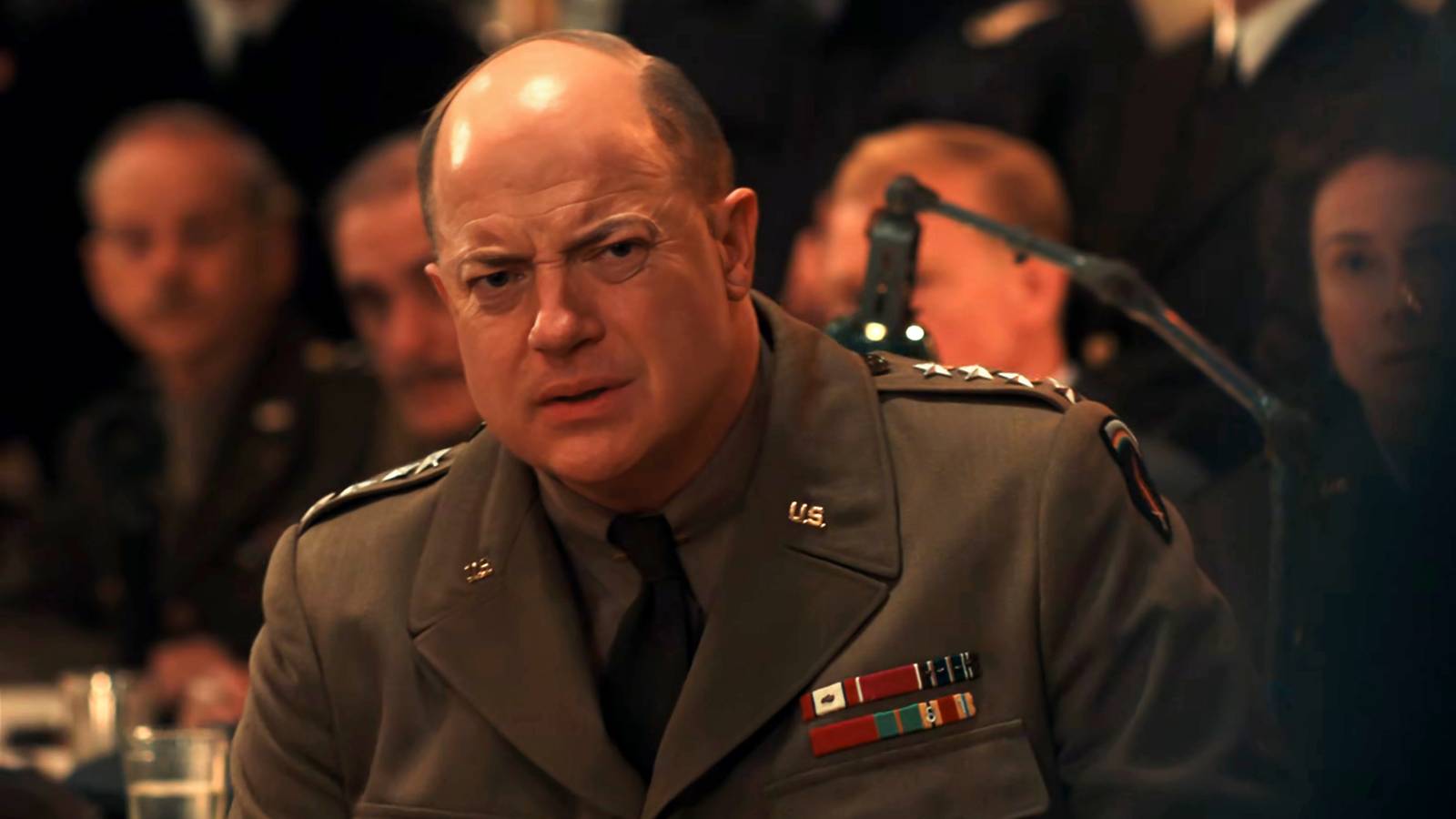
Based on the David Haig play of the same name, Fraser leads the new war drama as Dwight D. Eisenhower during his time as a U.S. Army General during WWII, preparing for the dynamic-shifting invasion of Normandy, better known as D-Day. Finalizing plans for the invasion, the military brings in Group Captain James Stagg, a Scottish Met Office meteorologist, to ensure the weather will be safe for the mission, creating a tense 72-hour race.
Alongside Fraser, the film’s ensemble cast includes Ripley‘s Andrew Scott as Stagg, F1‘s Kerry Condon, Based on a True Story‘s Chris Messina, Fackham Hall‘s Damian Lewis, A Knight of the Seven Kingdoms‘ Henry Ashton and The Batman‘s Con O’Neill. Helmed by Hotel Mumbai‘s Anthony Maras, Pressure is garnering highly positive reviews from critics, currently holding an 85% approval rating on Rotten Tomatoes.
Ahead of the film’s release, ScreenRant‘s Ash Crossan interviewed Brendan Fraser, Andrew Scott, Kerry Condon and Anthony Maras to discuss Pressure. When asked about what surprised them the most from the movie’s true-story roots, Fraser began by pointing to the nature of weather prediction in the 1940s, which often came down to “looking out the window to see what was going on” as meteorology “was a science that was still in its nascency“:
Brendan Fraser: Readings, data, science, that kind of thing. It was up against common thinking, which was farmer’s almanac, and analog records. That’s the premise of this movie, and consider that there’s going to be an invasion, and it’s set for June 5th, a Monday, 1944. The weekend before, the meteorologist approaches leadership and says, “There’s a storm inbound. You really can’t go now. All will be lost, or [will be] a calamity if you do.” How do you think they’ll receive that, considering this is the D-Day invasion of 300,000 men, the largest amphibious assault in human history.
The Oscar winner was both brimming with curiosity and was “boggled” at considering “the conversations if you were a fly on the wall” during the D-Day planning, given “the stakes they have before them.” Further acknowledging that the invasion has been “depicted in films many times too realistically” — likening the battle to “a bare-knuckle fight with a chainsaw” — to the point that audiences might feel like they know everything, Fraser further shared that things that are “innocuous” to modern viewers were big to the real figures:
Brendan Fraser: What do you think the weather or the sky carries if you shake your fist at it? Zero. [Chuckles] We’re the visitors on the planet when it comes down to these decisions. So, to pivot and make a choice like this is no small feat, and that’s where the energy and the pressure of this film live.
Maras humorously admitted he was turning to “a cheat answer” and cited the entirety of Pressure‘s plot as being what surprised him the most from the real history, feeling he could “never have imagined that a weather forecast could help decide the fate of the 20th century.” As he dove deeper into both Haig’s play, the script and the real facts, the director “became obsessed with this tiny little corner of history that affects so many lives.” He concluded by denoting how thinking about “the weather guy on the evening news, you would never think that prediction could result in how the free world exists afterward.”
Scott concurred with Maras and Fraser that “the idea that weather played such a huge part in the D-Day landings” is what took him aback when learning about the true story, but agreeing that it’s an important one as a skilled military plan isn’t going to just “put 300,000 soldiers in a position without checking what the weather’s going to be like.” As such, experts like Stagg are vital for strategizing a military invasion, though putting such a figure into a room full of seasoned veterans is what further intrigued the Emmy nominee:
Andrew Scott: What was so extraordinary to me was this guy had no war experience himself, but that he stood his ground and he was able to have this sort of humility to listen to what nature was saying to him, and also have the strength not to be intimidated by these very, very intimidating people. I found that very inspiring about him, because I wanted him to — obviously, I don’t really know exactly what the real man was like in a room like that, but I imagined that he would be somebody who would be formidable, and somebody who would be interested in hearing what he had to say rather than how he said it. So, I kind of wanted to create somebody in some ways who wasn’t overly concerned with being liked.
The Pressure Team Wanted To Shed Proper Light On Little-Known Historical Figures
ScreenRant: I want to ask you, because I am such a big fan of yours. You saw me light up when you walked down the hallway, but so many people when I’m like, “I’m talking to Brendan Fraser today,” are like, “Oh my God!” I’m just curious for you, how do you feel about the term Brenaissance, and just how many people just love you and support you?
Brendan Fraser: It is funny. I’m grateful. I hope I earned it, and I hope that you believe me when I say that I show that gratitude in the performance that I wanted to give in this otherwise little-known historical figure, who is Ike Eisenhower, to our pop culture, and depict him as really a human who cared about these troops, who cared about their wellbeing, just as he would do his own sons. He saw 20-something-year-old young men who were also aware of the grim statistic of their survival. It was not looking good, but still they persisted. And I asked why. Well, of course, we’re at war, and they’re under orders, but I want to know even more. And I think the answer is that they had profound respect for that leadership, so much so that that respect was mutual, and that kind of became a secret weapon in the grand scheme of things. He was a historical figure that I grew to admire. Yes, he was a product of his time, granted that, but he also was the one who ushered in NASA, NATO, civil rights, the list goes on. So count me among his admirers for those reasons.
ScreenRant: I want to ask, you have an amazing ensemble cast, but I am a big fan of the Brenaissance. I love Brendan Fraser. What did you see in him as Dwight Eisenhower?
Anthony Maras: With Eisenhower, he’s known as a monumental figure in American history, but he’s known mainly as a President. I was really interested in Ike the general before he became the President. I was interested in the general who was smoking 4–6 packs a day, who was drinking 20 cups of coffee, whose body was breaking down, and who had to put on this front of strength, of confidence, of poise in front of his men and different people. But in these quiet moments, he’s constantly second guessing himself. He’s constantly wondering, “Am I about to make the biggest mistake in this war?” And I thought that duality was interesting to explore. And in Brendan, we found someone with the courage to acces that vulnerability, and to show a human side of a general who audiences remember in a different way. I think he nailed it. It’s not an impersonation. He’s not trying to get the accent exactly right. We’re going for a deeper truth. What did it feel like to be in the room when, based on your word, hundreds of thousands of people could die, and what does that do to someone psychologically? And Kerry Condon was key to that, because her dynamic with Eisenhower is one of behind closed doors. You get a sense of trust between them, and he’s willing to be himself, and she’s willing to speak her mind very freely. She wasn’t a shrinking violet, this character. The real-life case, Summersby’s husband died in the war. She was a widow. She was driving around ambulances with dead bodies, and taking them to the morgue during the blitz. In one instance, she spoke about the morgues being full, so she had a cinema that she had to store them in. In her book, she talks about remembering the front row full of headless corpses sitting in front of the cinema screen. And you put that woman into a room full of men, and she’s not afraid to speak her mind. She’s hyper intelligent. All that comes from history. So, that dynamic was interesting to explore and to play with too.

ScreenRant: I think one of my favorite things when I’m watching a historical movie is you go online afterward, and you’re like, “No way.” And you’re like, “Oh my gosh, this all happened. It was so fascinating.” Was there a challenge for you in just when you’re approaching this going, “How am I going to make this weather thing so gripping and interesting?”
Anthony Maras: Well, to be honest, it was one of the main challenges that attracted me to the story. I’d made a film before this called Hotel Mumbai, where it was a thriller. You had people running down corridors as people were stalking them with machine guns and whatever. That threat is very obvious. It’s a monster chasing you. Whereas with Pressure, you’ve got an amorphous weather system happening, coming across an ocean far away, and it’s going to hit a country that your protagonists aren’t [at yet]. So, it’s how do you dramatize that, and how do you have the audience feel the unspeakable pressure that these characters were under? I think that it is building the characters. It’s establishing them as people who inherently care. In Ike’s case, for his men, in Stagg’s case, for the truth. And pretty much in the case of all of the characters, they all want to do the right thing. They all want to succeed. They’ve just got very different ideas of how to get there, and very different philosophies of what they should be doing, and watching that clash of these very brilliant people and their very firmly held opinions. Watching those clashes over the three days leading up to D-Day is what I found fascinating. They’re all going nuts. They don’t know what the answer is. There’s uncertainty all around, “How do you bring your best self to the table?” And the film tries to answer that.
ScreenRant: What was your best source? Because obviously, this is somebody you really can’t do a true impression of.
Andrew Scott: I guess it’s people that I’ve known, maybe a few directors [that] are quite authoritative. I like those people who aren’t more concerned with being a good person rather than being a nice person. You know what I mean? Because charm is one thing, but it only goes a certain amount when you’ve got stakes as high as this is. You’re like, “We don’t need a charming person. We need somebody that we can trust.”
ScreenRant: Were you a weather nerd before or have you become one now?
Andrew Scott: I’ve become much more of a weather nerd, and I suppose just understanding the culture of weather, that the way we forecast weather in America is going to be very different to the way that we forecast weather in Ireland, or in England, because we have very changeable weather over there. So, just the way we predict weather is entirely different, and the way that they would have had to do it, which is all so analog. And calling places up, and writing things down, and scribbling them out and putting them in. Now, we just look at our phones. So these people were incredible, they were just amazing experts, and they had this real want to do the right thing, so that’s why they had to be so applauded. Because Eisenhower, even though the final decision of when D-Day would happen was down to him, he really sought advice from his experts, and I think Brendan plays that very beautifully.
ScreenRant: In the theme of Pressure, what is the most pressure you’ve ever felt in a role?
Andrew Scott: Wow. Well, sometimes it’s a weird one, because I always imagine with real characters, they’re going to be more pressurizing, because you have to have a certain likeness or whatever to the real people. But actually, imaginary characters I find pressurizing, as well. Going on stage can be pressurizing, because it’s live, so everybody’s there sitting down. You can hear over the tannoy, you’re in your dressing room, and you hear 1100 people waiting to be entertained, and you think, “Wow. “Whereas on a movie set, that’s delayed. [Laughs] And also, when you’re going to see a screening of the movie, you’ve already made it. You’ve made your mistakes, whereas it’s all the pressures on you when you’re acting in the theater. I think it’s the impetus to be bold, to really try and do something rather than play it safe. That’s what audiences, I think, respond to a little bit.
Pressure is now in theaters!

- Release Date
-
May 29, 2026
- Runtime
-
90 Minutes
- Director
-
Anthony Maras
- Producers
-
Eric Fellner, Tim Bevan, Lucas Webb, Cass Marks