
Humans are composed of a series of ideologies that exist in conflict with each other. We’re afraid of death and dying, but we can passively scroll past horrific memefied gore without so much as batting an eye. Since the advent of social media, we have been inundated with heinous imagery — from the aftermath of school shootings to beheadings to cannibalistic snuff films — and somehow, we’ve all kept running the same day-to-day rat race without being haunted by those sights. Humans may be afraid of what comes after death, but we’re not afraid to watch a train wreck on autoplay. This is the phenomenon that Daniel Goldhaber’s Faces of Death redux seizes upon and exploits, with mixed success.
When John Alan Schwartz’s Faces of Death first circulated in 1978, it occupied a far more transgressive space within the cultural imagination than Goldhaber’s soft-remake. For many, the disingenuously marketed “documentary” was their first brush with witnessing someone dying in such horrific and graphic ways. The film blurred the line between staged footage and real acts of death, presenting a series of gruesome vignettes that audiences were encouraged to believe to be authentic. At a time when so-called “snuff films” existed more as urban legends traded under the bleachers at football games and in the backrooms of seedy video stores along barren highways, Faces of Death was unprecedented. In an era before the internet — before viral videos and algorithmic feeds — such imagery was difficult to access, cloaked in taboo, and therefore uniquely traumatizing. There’s a reason why Faces of Death remains such a triggering and haunting film for those who were present for its advent.
‘Faces of Death’ Just Reheats the OG’s Greatest Hits

Goldhaber’s redux, by contrast, arrives in a world where graphic violence is no longer rarefied or even (unfortunately) truly taboo. It circulates freely across platforms, often encountered passively rather than sought out, and often framed in a humorous way. As a result, what once felt like a boundary-pushing confrontation with mortality now registers as something closer to mimicry. The shock has been diluted not because the imagery is less extreme, but because our cultural threshold for it has fundamentally shifted. Goldhaber tries to harness this dichotomy in framing his killer as a Faces of Death fanboy trying to reheat the cult classic’s nachos, but it pales in comparison. The film gestures toward something incisive about our collective fixation on death: not just that we consume it, but that we — most damningly — enjoy it. There’s a clear awareness here that modern audiences are not passive observers. We are participants in a feedback loop of desensitization.
And yet, for all its stylistic confidence, Goldhaber’s Faces of Death ultimately stops short of saying anything new. For a film so interested in interrogating our relationship to violence, it rarely moves beyond simply presenting it. It understands the language of contemporary horror but not necessarily how to evolve its thesis and transform it into something new. The film recognizes the problem but just doesn’t interrogate it deeply enough to transform it. That’s what is so infuriating about the film, it stops just shy of following through on the complete thought of what it’s trying to say. Perhaps it’s intentional that it wants the audience to soul search as the credits roll, but it doesn’t stick the landing with its voyeuristic commentary.
‘Faces of Death’s Strength Is In Its Performances
Where this Faces of Death redux does meaningfully evolve, however, is in its performances. Barbie Ferreira is the audiences’ proxy, Margot. She works for Kino, a TikTok-style video platform, where she is tasked with reviewing flagged content. Unsurprisingly, the platform doesn’t care about flagging “DIY horror” — it cares more about moderating safe sex advice and how to safely administer NARCAN. Margot is uniquely equipped with life experiences that make her both immune to and deeply troubled by the horrific violence she stumbles upon on the app.
Ferreira emerges as a genuinely compelling and refreshingly complex final girl. Horror has historically been unkind to bodies that fall outside the genre’s narrow aesthetic ideals, often relegating overweight characters to punchlines or early casualties in a killer’s pursuit for easy victims. Ferreira disrupts that pattern with a performance that isn’t sanitized. Her character is flawed, reactive, and sometimes frustratingly entirely human. There’s something deeply satisfying about watching her not only survive, but also earn that survival. She doesn’t exist to be pitied or punished. In a genre that has long treated women’s bodies as expendable, that alone feels quietly radical.
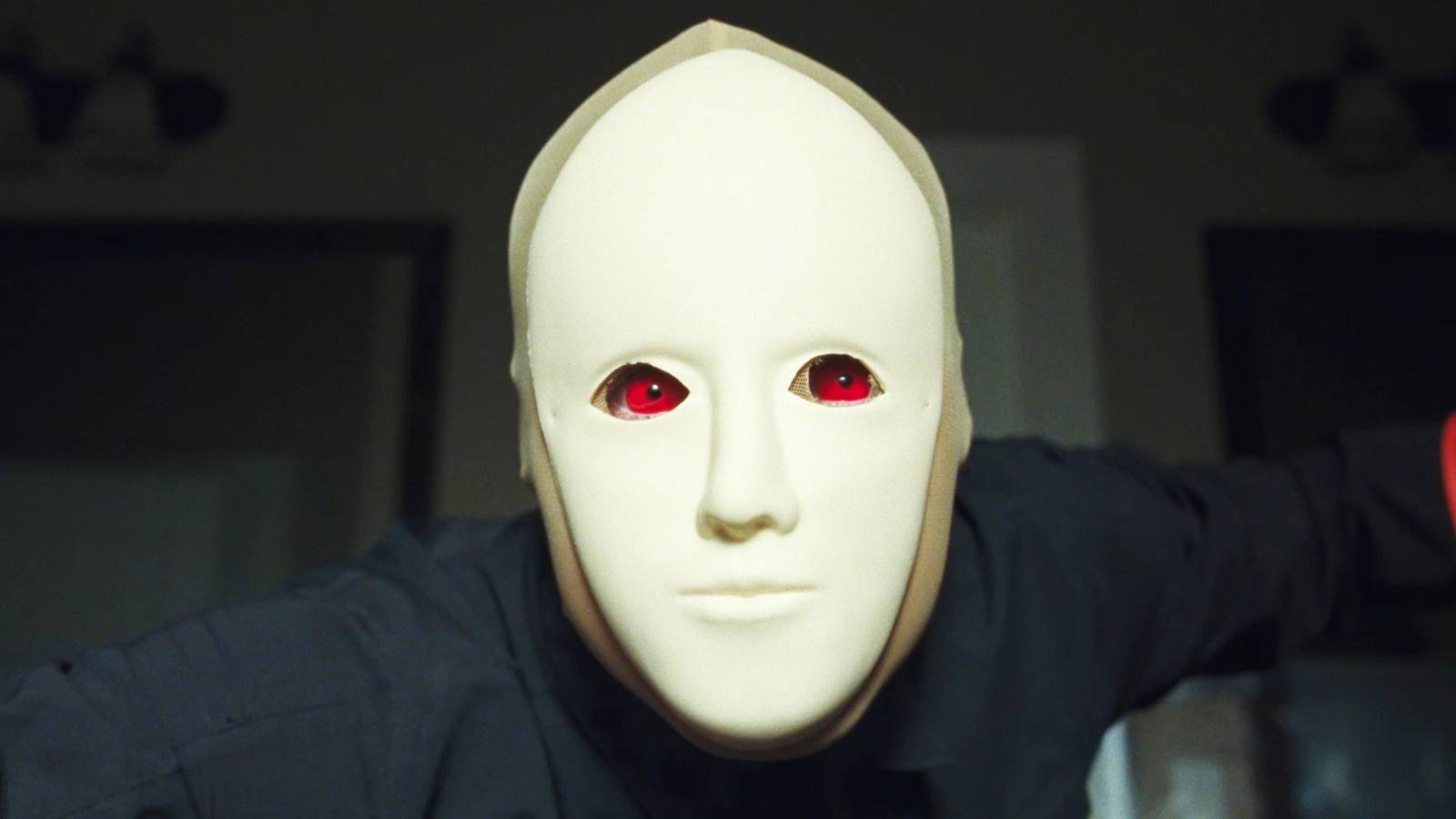
Still, the film’s most magnetic (and most unsettling) presence is Dacre Montgomery. As Arthur, Montgomery delivers a performance that thrives on instability, oscillating between disarming boy-next-door normalcy and something far more insidious when he slips a pair of pantyhose over his head and dons a pair of grotesque blood-red contacts. There’s a deliberate slipperiness to his portrayal, a sense that the “real” version of Arthur is always just out of reach, flickering between personas depending on who he needs to be to lure in his victims. One moment, he’s charming, almost banal in his ordinariness; then something fractures, and what emerges is deeply, viscerally wrong.
Montgomery has long had the kind of face Hollywood loves (and Stranger Things knew how to commodify it), but Faces of Death makes a compelling case for him as something far more interesting than becoming just another conventional leading man. There are shades here of Dan Stevens’ post-Downton Abbey pivot into genre here. A willingness to weaponize charisma and use its disarming qualities to become a true bona fide character actor.
Faces of Death‘s supporting cast is fantastic, as well, even if they most exist within the confines of horror stereotypes. Margot’s co-workers, like Gabby (Charli XCX) and her friend-turned-boss Josh (Jermaine Fowler), underscore the weaponized complacency of people who are hegemonized by the algorithm. While others, like Ryan (Aaron Holliday), Margot’s GBF and roommate; rising Kino-star Samantha (Josie Totah); and Drew (Ash Maeda), the son of one of Arthur’s targets, are just there to serve Margot’s arc.
For all its visual polish and strong performances, Faces of Death remains caught between commentary and replication. It wants to critique our obsession with violence, but it can’t quite resist indulging in it, too. The result is a film that feels acutely aware of the cultural moment it inhabits, yet strangely hesitant to push beyond it. In an era where reality is already far more disturbing than fiction, simply holding up a mirror to it isn’t quite enough to push the envelope.
Faces of Death is in theaters on April 10, 2026.

Faces of Death
Faces of Death smartly taps into our algorithm-fed obsession with gore, but stops short of true reinvention.
- Release Date
-
April 10, 2026
- Runtime
-
98 Minutes
- Director
-
Daniel Goldhaber
Pros & Cons
- Faces of Death delivers a sharp, stylistically modern take on digital-age violence, capturing the fractured, algorithm-driven way we consume gore in an era of social media desensitization.
- Barbie Ferreira reinvents the final girl with a grounded, complex performance that challenges horror’s treatment of overweight women by allowing her character to be flawed, human, and ultimately endure.
- Dacre Montgomery gives a deeply unsettling, career-defining performance, balancing charm and menace with precision as he cements himself as a compelling horror character actor.
- Despite its modern framing, the film fails to evolve beyond the original’s premise, essentially reheating its shock tactics without adding meaningful innovation.
- The film’s commentary lacks depth and follow-through, gesturing toward a critique of desensitization without fully interrogating or developing its ideas.
- Caught between critique and complicity, Faces of Death attempts to condemn our obsession with violence while still indulging in it, creating unresolved tonal and thematic tension.


![Scott Adkins Is No Ordinary ‘Prisoner of War’ in Thrilling New WWII Action Trailer [Exclusive]](https://citigist.com/wp-content/uploads/2025/07/Scott-Adkins-Is-No-Ordinary-‘Prisoner-of-War-in-Thrilling-380x200.jpg)