
Raph Koster is a legend in the gaming industry. As the lead designer of Ultima Online and the creative director on Star Wars Galaxies, they know a thing or two about online worlds. Ultima Online, in particular, was one of the formative MMOs of our time, allowing an unprecedented degree of freedom compared to most RPGs on the market.
That philosophy of player freedom led Koster to work on Stars Reach all these years later, which is one of the most ambitious titles I’ve played in a long while. Described as a “living galaxy,” this persistent world not only employs some seriously impressive tech, but it’s also backed by one of the greatest minds in the industry today.
We had the chance to talk with Koster to see what Stars Reach was all about at Summer Game Fest (SGF), and we got an MMO history lesson in the process.
Stars Reach Is A Persistent Sci-Fi World

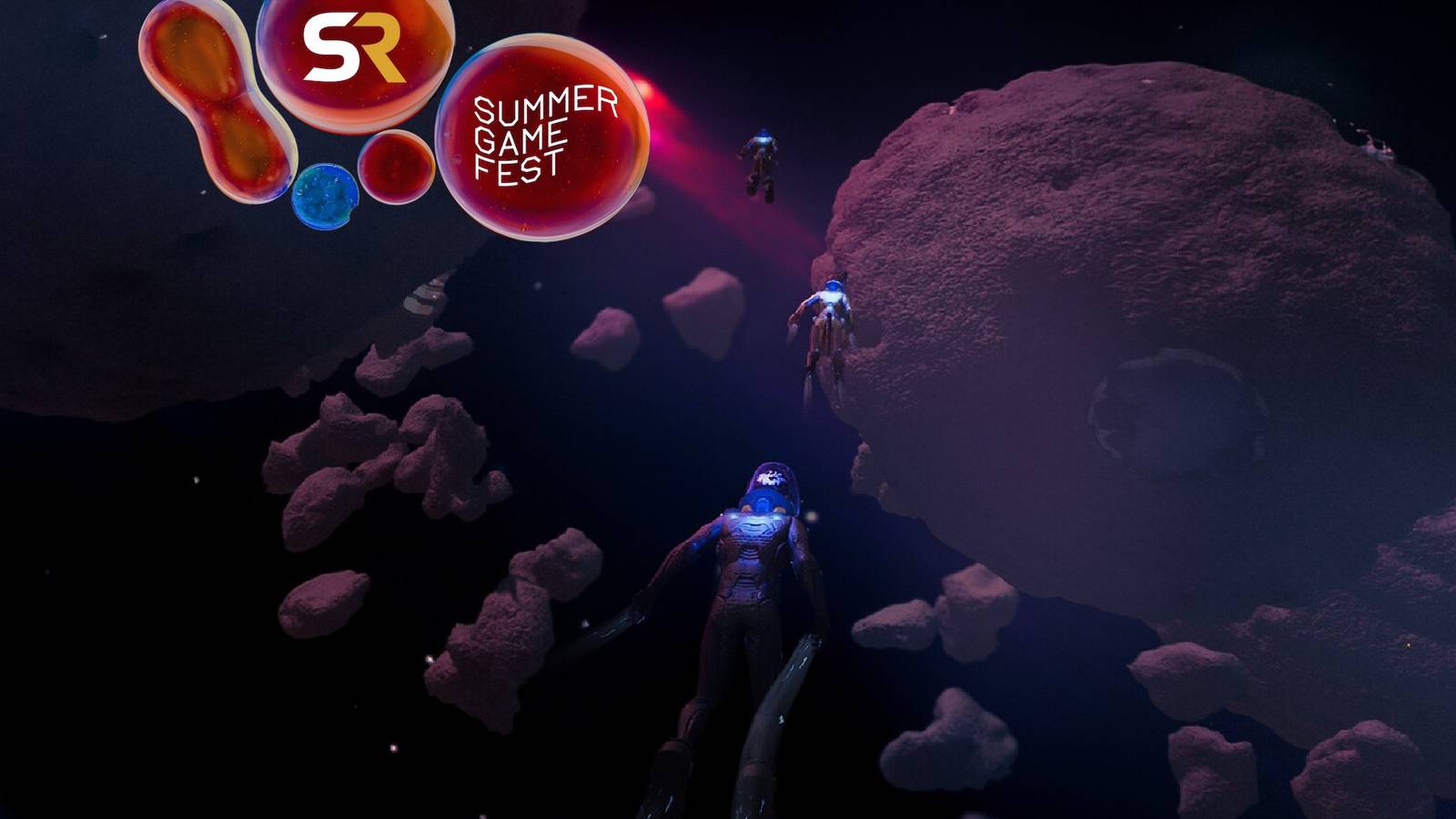
Stars Reach describes planets as “living systems,” including opportunities for climate change, animal migration, and disasters. It’s just as ambitious as it sounds. When we set up to play a demo of the game, Koster was quick to give us a rundown of what to expect as we started mining an asteroid.
“Our simulation also covers states of matter. So you’re heating up this rock,” he notes, as I’m using an in-game tool to cook terrain. “You’re melting it into lava, and it flows as liquid. We actually know the temperature of every cubic meter in the game. You notice how it flowed like liquid because it was liquid, and you might also notice it may have come back as a different kind of rock, because after all, you just put it through a volcano, right? That’s how you get obsidian. If you did that to sand, you would be left with patches of glass. Everything in the game is simulated to that level.”
It’s that level of detail that really had me looking at every square inch of the game, slowly buying into the idea of a persistent world within the confines of Stars Reach. “Blocks don’t float in mid-air,” Koster notes, as we approach a cave. “If this cave is not supported, it will collapse and kill you. Every single material knows its fragility, knows its melt points, knows how it reacts, and that is true of everything in the entire game. Even what you’re doing now, you’re dumping out the material from your hopper. Give it time, that will turn into dirt, and then grow grass.”

Subsequently, I got into a small skirmish with some local creatures, accidentally burning down part of the nearby forest. Of course, Koster says this plays into the persistent world: “That forest fire could result in this whole area burning down, and the forest would grow back later, or not, depending on how much you left, because every tree is essentially a mob that doesn’t move, so none of this is static, it’s all dynamic.”
It’s not just the environments that feel open, as one of the crown jewels of Stars Reach is the skill system. Born out of old-school MMO freedom like Galaxies and Ultima Online, Koster wants to allow players to do basically whatever they want, including becoming a reporter or a pacifist type role. “Every single one of these ways to play has economic value to other players,” he explains, showing us the absolutely massive skill tree, consisting of many combat and non-combat roles.
What if we essentially go back, question every assumption about MMOs, and say, if we were designing them from scratch with modern tech, how would we do it?”
“They all play slightly differently, of course. You don’t have to be a combatant if you don’t want to be. You don’t have to engage with crafting if you don’t want to. You can learn all the skills, but you can only have so many of them active at a time, right? Think of it like Magic: The Gathering. You can buy all the cards, but it doesn’t mean you get them all in your deck at once.”
“There’s a journalist [profession] too. For writers, a writing profession that lets people write in-game news and earn XP. You can earn things like drone cameras or screen chyrons, so that if they stream, their streams get cooler because they can get camera angles nobody else can. All of those things have value relative to the other ways to play, so everything’s tied together through an economic kind of dependency, but it’s mostly an asynchronous dependency. You don’t have to party with people or have your tight group of friends available in order to have fun.”
“I’m not a fan of the whole…’well, you can have combat first, then professions and skills [on the side].’ That still means combat is the point, and that skills feel more relegated. If there’s something the history of online games has shown us, it’s that just having a pet is a whole genre, just decorating a house is a whole genre, and just farming is a whole genre. I could go on.”
Why Now? Raph Koster Explains

“I’ve been dreaming about doing a sci-fi game like this for 30 years,” Koster says. “Actually, at one point, the follow-up to Ultima Online was going to be Privateer Online, where many of the ideas in this were going to be; we had procedural planets working, and things like that. Even back then, it was while I was at Sony Online, after working on Galaxies, I did an R&D group there, and we developed their early versions of that kind of simulation, but we were only testing back then. So, yeah, I see this as a kind of spiritual sequel, and continuing to progress down the path of pushing what’s possible, right, because MMOs aren’t just a game type, they’re more like a place that you put games in, and over the years, especially post WoW, they kind of narrowed down theme parks to kill 10 rats…and play as a tank nuke, or healer…you know, and that game is quite old.”
“I’ve been dreaming about doing a sci-fi game like this for 30 years.”
“We had this expansion of possibility that was going on in the late 90s, early 2000s, and it feels like there was a very obvious path to take with the road of EverQuest to WoW to most others, and it crowded out a lot of, I guess, the potential of what an online world could do and be what an MMO can mean, and this project was very much a moment where around 2018 I looked around, and I said the tech is here now to do these things, the audience is clearly here now, because we are in a post Animal Crossing, post Minecraft, post survival, survival craft, and all of that, and you know, the time just felt right to say, what if we essentially go back, question every assumption about MMOs, and say, if we were designing them from scratch with modern tech, how would we do it?”

Koster doesn’t want the game to be impenetrable, which is a noble goal for something ostensibly so complex. Solo play is viable, and while there are hundreds of skills and talents, only a certain number can be equipped at a time in your current loadout. Koster explains: “It’s a soloable MMO that respects your time. [MMOs] don’t have to be giant time sinks unless you want them to be, right, I mean, if you’re sitting and building a city like that, you’re probably sitting and sinking a bunch of hours, but that’s up to you. It’s not because the game is forcing it.”
“It’s so clear that, if MMOs are alternate worlds, reducing alternate life down to killing orcs is a pretty narrow portrayal of human existence. I guess when there are so many ways for players to be creative, for them to have fun together, you know, the mileage players got out of just dancing in [Star Wars] Galaxies. Players were holding beauty pageants! And I mean Galaxies was like ground zero for making in-game music video Machinima. We said, ‘look, it doesn’t have to just be shoot, shoot, shoot, right, or chop, chop, chop.’ So I think that’s one of the biggest things. It still feels like a lesson that isn’t all the way there, right?”
Right now, Stars Reach sounds incredible on paper, but it doesn’t have an announced release date yet. Expect more news on its Early Access period soon, as it’s coming this summer.

Systems

- Released
-
September 24, 1997
- ESRB
-
m
- Developer(s)
-
Origin Systems
- Publisher(s)
-
Electronic Arts
- Multiplayer
-
Local Multiplayer
- Franchise
-
Ultima