
We had just celebrated my daughter Gracie’s birthday when we received the diagnosis.
It was January 2014, and I had insisted that our doctor carry out bloodwork tests after a huge purple bruise – the kind you get from a major trauma, not a little bump – appeared on her body.
Now my husband and I were pressed against the phone, listening to the doctor deliver the worst possible news. Our high-energy little girl was desperately sick with a rare form of leukemia called Ph+ALL. We struggled to take in the words.
The cancer, we would learn, was so aggressive that she needed ten times the average amount of chemotherapy used in children with ‘regular’ leukemia. Her gorgeous curly hair would fall out, and at four years old, she would become addicted to morphine.
Gracie’s doctors emphasized how rare childhood cancer is. I learned in the parent education courses at the Children’s Hospital Los Angeles, where she was treated, that out of a population of 72 million children in the United States, 15,000 are diagnosed with some form of cancer every year. That equates to just 0.02 percent of the population.
So why, I wondered, did I keep bumping into neighbors in the halls of the hospital that had become our home?
I met Julia and her two-year-old daughter, Bailey, who lived within three miles of us and became instant friends with Gracie. Eleven months after being diagnosed, Bailey died in her father’s arms.
I met Lauren and her daughter Hazel. They also lived just a few miles from us. Hazel, age seven, fought Neuroblastoma, an aggressive cancer of the nervous system, three times before succumbing to her illness.

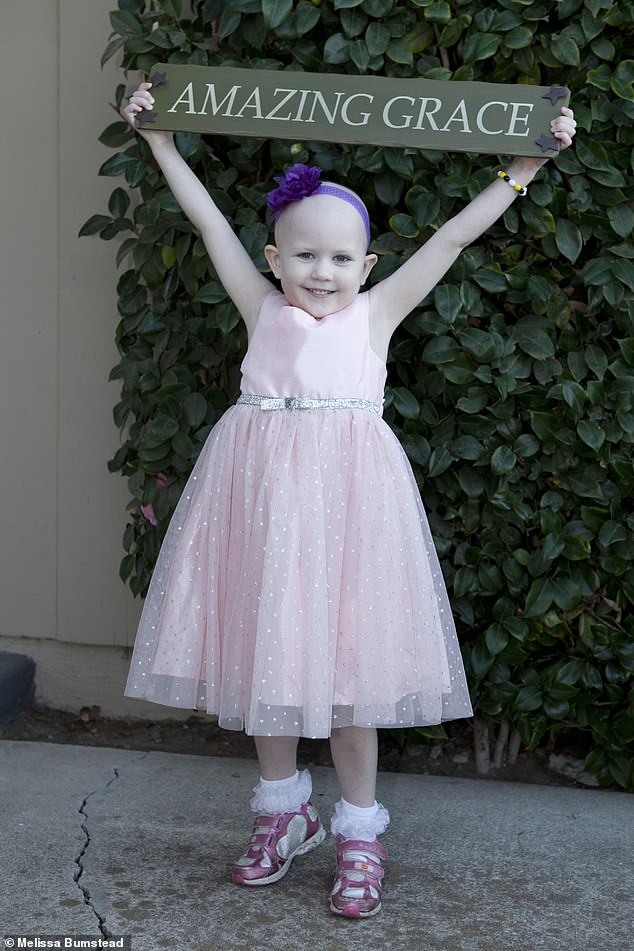
We had just celebrated my daughter Gracie’s birthday when we received the diagnosis in January 2014

Our high-energy little girl was desperately sick with a rare form of leukemia called Ph+ALL

The cancer was so aggressive that she needed ten times the average amount of chemotherapy used in children with cancer
Again and again, I would learn from the mother of a child fighting cancer that they lived just down the road, behind the local high school, in the same zip code.
‘What a coincidence,’ they would say. But the more I heard that, the more I struggled to believe that the word explained away what I was witnessing.
Then one day, one of the ‘cancer moms’ as we came to know ourselves pointed something out: ‘Did you notice that we all live in a big circle?’
I first learned about the Santa Susana Field Laboratory (SSFL), a 2,849-acre site approximately 30 miles northwest of downtown Los Angeles, in the fall of 2015. A friend told me about a public hearing about it nearby.
Some of the moms who had lost their children came along. I later came to learn that the site, now owned by Boeing Co, NASA and the US Department of Energy, was used for rocket and nuclear testing from the 1940s until the early 2000s.
In the process of putting men on the moon, scientists burned liquid rocket fuel, released chemicals onto the ground that contaminated the soil and water nearby and created a partial nuclear meltdown that needed a release of radioactive fission gases to prevent an explosion — exposing hundreds of thousands of people to radiation as the area became more residential.
A 2007 federal study found a higher incidence of cancer within two miles of the site and noted that activity at the property has contaminated ‘surface and subsurface environmental media by various hazardous substances.’
But when I went along to that first meeting, I didn’t know any of this. I listened while the federal Department of Toxic Substances Control and two other agencies tried to reassure us that there was no risk from the site.
I was intimidated. One half of the room was filled with people screaming and shouting at the other half. The more I listened, the more it seemed to me that the government scientists were speaking in hypotheticals rather than sharing concrete data.
When I mustered up the courage to ask why, I was told ‘you wouldn’t understand’ the real research. That answer made me feel sick – and convinced me we weren’t being given the full picture.

The Santa Susana Field Laboratory (SSFL) was used for rocket and nuclear testing from the 1940s until the early 2000s

The 2,849-acre site, owned by Boeing Co, NASA and the US Department of Energy, is approximately 30 miles northwest of downtown Los Angeles

Millions were exposed to radiation as the area became more residential. A 2007 federal study found a higher incidence of cancer within two miles of the site
At first, I tried to forget about that meeting. But then I was approached by Denise Duffield, the associate director of Physicians for Social Responsibility, Los Angeles.
No one wanted to hear me talking about a threat, but Denise wanted to get the word out. She would drive four hours round-trip to sit with me at these public hearings so that I wouldn’t feel scared and intimidated.
Alongside the late Dan Hirsch of the Committee to Bridge the Gap, an environmental non-profit, Denise began mentoring me in how to advocate for my community.
In 2017, as I was getting more informed about the issues and more involved in campaigning, Gracie’s cancer came back. The doctors wouldn’t even give us the odds of her survival – they told us they were too slim and that we would just lose hope.
When my daughter was first diagnosed, we were very optimistic. This time it hit harder. We’d already buried too many of her friends.
Childhood cancer is horrific – we knew that optimism alone is not enough to fight it. Gracie was one of just two or three out of the families we met in the hospital wards who survived and each of them and their families had been hopeful at one point.
Boeing says the pollution is not a health hazard to our community, but I’ve seen enough of our children die to believe otherwise. We, cancer moms, have independently documented over 100 cases of childhood cancer.
In 2018, the Woolsey Fire burned part of the SSFL, further spreading contamination to nearby parks and neighborhoods.
After the fire, we grasped the magnitude of the contamination and how it spread. Our organization was part of an independent study that found radionuclides – an unstable particle that releases radiation as it breaks down and stabilizes – from the ash of SSFL nine miles away from the site.
The only reason the furthest point we found them was nine miles away was because that’s as far as we could look before we ran out of money to carry on testing. Some of these radioactive elements, like plutonium 239, have a 24,000-year half-life.

In 2017, Gracie’s cancer came back

The doctors wouldn’t even give us the odds of her survival – they told us they were too slim and that we would just lose hope

When my daughter was first diagnosed, we were very optimistic. This time it hit harder
There have been times when I’ve wanted to leave all this behind, but I’ve long since faced that I’m never going to get away from this issue. Even if we move away, all my friends and family are still in the area. That’s why I founded Parents Against Santa Susana Field Lab along with Jeni Knack.
Jeni had moved into Simi Valley looking for a family-oriented community for her daughter. When she got here, she learned that her drinking water was at risk of being polluted by the SSFL. She has an anthropology degree from UCLA, which makes us a great team – she has a more scientific brain than I do.
Although Boeing, NASA, the US Department of Energy (DOE) and the California Department of Toxic Substances Control (DTSC) signed a cleanup agreement in 2007, the complete cleanup hasn’t begun. The initial agreement stated that the land would have to be cleaned up to rigorous standards, removing all man-made contamination.
But legislation drafted to set those standards was overturned.
After securing a conservation easement with a land trust in 2017 that Boeing has billed as environmental preservation, the company now plans to build a park on the site. The loophole? Boeing argues that the easement agreement bans it from removing much of the pollution. That type of easement is usually used to preserve nature, scenic sites, not a radioactive one.
Boeing argues that legally, the cleanup should only meet a recreational standard if it builds a park on it.
It’s what’s called a ‘risk-based cleanup’ in which they try to guess how much contamination a person can be exposed to before they get cancer. If these plans go ahead, it means that Boeing is going to leave over 90 percent of the contamination on site.
How can this satisfy anyone?
There needs to be a new attitude all the way from the state government to the national Environmental Protection Agency (EPA) that doesn’t accept anything less than a total cleanup.
I was recently in Washington, DC, with the Alliance for Nuclear Accountability, a non-profit that advocates for nuclear cleanup. I was speaking with elected officials about the SSFL, and we made the argument that it is financially wise to spend the money now to clean up the sites rather than wait for it to become more expensive and have more people exposed.
My daughter’s cancer treatment cost $2 million to treat. This problem is bankrupting our community, destroying our families and killing our children.
Gracie is now 16, and her brother is 14. Occasionally, I’m able to convince them both to come to protest with me, but they’re typical teens – when I dance with my poster, they get embarrassed.
Gracie is going into her junior year of high school and is very involved in her school’s veterinary program. She loves the ocean and wants to be a marine biologist. She is now considered a cancer survivor because it’s been past five years since remission, a huge deal for our family.
But I can’t turn away from this issue. Just two months ago, a local teenager was diagnosed with thyroid cancer. There are lots of possible contributing factors to developing this illness, but one of them – the one I can’t ignore – is childhood exposure to radiation.

Gracie is now 16, and her brother is 14

Occasionally, I’m able to convince Gracie and her brother both to come to protest with me, but they’re typical teens

Gracie is going into her junior year of high school and is very involved in her school’s veterinary program

Gracie is now considered a cancer survivor because it’s been past five years since remission, a huge deal for our family
As told to Andrea Blanco
The Daily Mail has reached out to Boeing for comment.
The field’s toxicity is contentious. Boeing claims it is planning a ‘comprehensive’ risk-based cleanup of ‘soil and groundwater contaminated by chemicals, applying standards that are in-line with other cleanup sites throughout California.’
Boeing has previously said it plans to use the site as an ‘open land space’ and plans to clean it up to residential standards, but activists argue that Boeing has corroded the calculations and it is actually preparing for a recreational cleanup, which entails weaker standards.
Boeing, which acquired its portion of the property in 1996, says it plans to clean up radioactive material. The company has described the cleaning standards mentioned in a 2022 CalEPA and DTSC settlement agreement as ‘strict.’