
Cade Larsen can’t lose weight – but not because he doesn’t want to.
The Provo, Utah, native, 27, developed a rare tumor when he was just 13 years old that damaged the parts of his brain used to control hunger, meaning he never feels full and tracks everything he consumes.
Still, his weight has soared to over 300lbs.
The weight gain is just one of the harrowing side effects he has lived with over the last 14 years.
While speaking with the Daily Mail, Larsen explained that his first symptom was subtle: he developed a ‘very slight headache’ that wouldn’t go away.
He initially brushed it off, thinking it was caused by the tight swimming goggles – which restrict blood flow and cause pressure – he always wore while on his school’s team.
But when the teenager woke up one morning about a month later and noticed that he was cross-eyed, his parents decided to take him to a doctor.
‘The doctor told us that there was something pushing on my optic nerve,’ Larsen recalled. ‘So he referred me to get an MRI of my brain.’

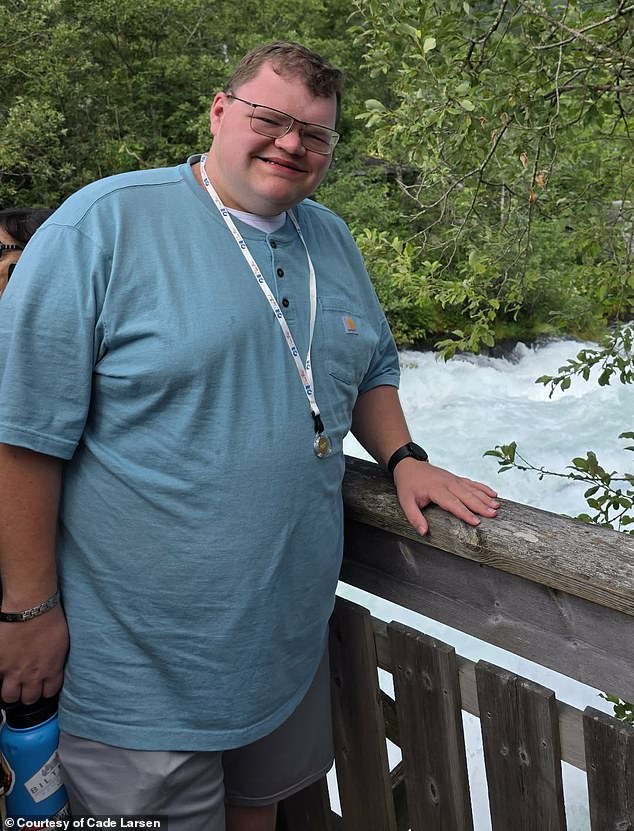
Cade Larsen poses on a recent trip. He had a brain tumor that damaged his ability to control hunger and now he weighs over 300lbs because he can’t stop eating
The optic nerve connects the eye to the brain, helping the brain interpret visual signals into images.
An MRI scan revealed Larsen had craniopharyngioma, a non-cancerous brain tumor that grows near the pituitary gland, which is a pea-sized area that regulates metabolism, with growth and reproduction.
It’s unclear what causes this type of tumor, but experts believe it occurs when cell DNA becomes hijacked and tells cells to multiply uncontrollably, forming a benign mass.
‘These tumors are thought to arise from remnants of embryonic tissue – small clusters of cells left over from fetal development that never fully disappeared,’ Dr Walavan Sivakumar, neurosurgeon and director of neurovascular surgery at Pacific Neuroscience Institute in California, told the Daily Mail. ‘This explains why craniopharyngiomas follow a bimodal age distribution, with one peak in children between ages five and 14 and a second peak in adults over 50.’
Sivakumar clarified that there are no known modifiable risk factors, including lifestyle, environment or inherited genetics ‘in the traditional sense.’ In many patients, it can lead to headaches, vision changes, nausea and vomiting, and urinating more often.
‘In children specifically, a red flag that is often missed is unexplained short stature or failure to grow at a normal rate,’ he continued. ‘In adults, a new and persistent headache combined with any visual change should be considered a neurological urgent issue until proven otherwise.’
Craniopharyngioma grows slowly, so it is possible it was lurking in Larsen’s brain for years before his diagnosis.
‘Craniopharyngiomas are notoriously subtle in their early stages, which is part of what makes them so dangerous,’ Sivakumar explained. ‘Because they grow slowly and in a region of the brain not immediately obvious on routine examination, symptoms can be present for months or even years before a diagnosis is made.’

Larsen at age 13, when he developed a tumor that damaged the area of his brain that impacts his ability to control hunger
The American Brain Tumor Association estimates just 600 Americans are diagnosed with craniopharyngioma every year, making it one of the rarest types of brain tumor.
At only 13 years old, it was hard for Larsen to understand just how life-altering the news was.
‘My parents both started crying and hugging me,’ he recalled. ‘I didn’t cry though. I think it was because: one, I was in shock a bit and, two, I didn’t really realize what it would mean for me and my life.
‘I was only 13 after all. My thinking was that I would have surgery to remove the tumor, recover for a month or two, and then go back to living the exact same life I had before.’
Unfortunately, his life was never the same again.
Larsen ultimately had to have three surgeries in quick succession. During the first procedure, which took nine hours, doctors removed the tumor. But in doing so, they damaged his hypothalamus – an almond-sized structure just above the pituitary gland that controls appetite, telling the body when it’s time to eat or drink.
‘Hypothalamic injury can lead to a variety of long-term complications,’ Dr Noa Tal, endocrinologist at the Pituitary Disorders Center at Pacific Neuroscience Institute, told the Daily Mail.
Doctors also had to remove Larsen’s pituitary gland, which works in tandem with the hypothalamus to produce hormones like ghrelin and prolactin, which are in charge of regulating glucose and metabolism.
Several days after the first procedure, Larsen was rushed back into emergency surgery after doctors discovered he had ‘cerebrospinal fluids leaking into my brain from a hole made that either wasn’t closed up properly or didn’t heal properly.’
Cerebrospinal fluid (CSF) acts as a shock absorber for the brain and spinal cord, cushioning the central nervous system against damage and helping to clear toxins out of the brain. But when there’s a hole in the membrane surrounding the brain or spinal cord, called the dura mater, CSF escapes, often leaking out of the nose, ears or throat.
The tear from the leak creates a direct pathway for harmful bacteria to get into the central nervous system, resulting in deadly infections like meningitis if left untreated with surgery.

Larsen lays in a hospital bed while recovering from surgery, during which they removed the tumor. But in doing so, they damaged his hypothalamus
‘In the second surgery, they planned to open me up, find where the CSF leak was, and then take a fat graft from my thigh to plug the hole with,’ Larsen explained. ‘Sadly, they ended up not being able to find the hole.’
He then went under the knife for a third time to finally fix the leak, but effects from the surgeries still plague him 14 years later.
‘Despite being classified as benign, meaning they do not spread to other parts of the body, craniopharyngiomas can cause profound and lasting harm simply by their location and the pressure they exert on surrounding structures,’ Sivakumar said.
Larsen now suffers from a range of problems, including chronic fatigue, low stamina and narcolepsy. The latter may be because Larsen’s damaged hypothalamus can no longer produce enough orexin, a neurotransmitter that controls wakefulness.
‘I can and will fall asleep anytime and anywhere,’ he said. ‘Except, sometimes, at night when I want to.’
His body temperature is permanently ‘dysregulated’ – he is often running warm – since the hypothalamus acts as the brain’s thermostat.
‘I’ll hear people wearing jackets and warm long pants say, “It’s freezing out here!” And I’ll be standing next to them in shorts and a T-shirt thinking, “Man! It’s the perfect temperature today!”‘
But the hardest part is that Larsen constantly feels hungry.
‘My brain thinks I am starving,’ he said. ‘It makes it hard to focus on anything and it wears on me mentally.’
This is known as hyperphagia or polyphagia. The extreme or insatiable hunger can occur with damage to the hypothalamus, as well as genetic disorders like Prader-Willi syndrome. The injury to the hypothalamus disrupts the brain’s ability to process hunger and fullness signals, so the body never gets a cue to stop eating.
Larsen said he has to take ‘safe guards’ to ensure he doesn’t overeat since his body won’t tell him when he’s full. Still, his weight has soared.
‘I have been counting calories for 14 years straight now,’ he explained. ‘Before my brain surgery, I was a perfectly healthy and very athletic 13-year-old boy.

Larsen lays in a hospital bed following the surgery accompanied by his sister. The tumor was successfully removed, but he still suffers long-term effects

Larsen stands in his hospital room on the morning of his surgery. He told the Daily Mail that he was athletic and at a healthy weight before the procedure
‘I had the record for the mile run in my school, I was on a soccer team, a competitive swimming team and I loved running around outside with my friends.
‘In the month I was in the hospital after my surgeries, my body weight doubled. I got type 2 diabetes from gaining so much weight so fast. I now weigh over 300lbs, and I have weighed that much since the age of 13.’
With his pituitary gland gone, Larsen doesn’t produce many essential hormones like adrenaline, oxytocin, cortisol or testosterone.
‘[The lack of oxytocin] causes changes in my social bonding, differences in emotional processing, altered trust and attachment behaviors,’ he explained.
‘This also makes it so that I don’t feel that good feeling everyone else does when they hug someone. That feeling is a distant memory for me.’
Larsen said he takes synthetic hormone replacements, which he will have to stay on for life, but still struggles daily with the effects.
‘Each replacement comes with side effects,’ he explained. ‘For example, the replacement for cortisol causes your bones to weaken and become brittle.
‘Because of that, I have broken my hip three times, each requiring surgery to fix.’

Larsen on a recent trip. He now has type 2 diabetes among other health issues
Larsen said he is ‘unable to work full time’ because of his ailments, but has a part-time job as a substitute teacher. He believes he won’t live past his 60s.
‘[These things] carry long-term metabolic and cardiac risk,’ he told the Daily Mail. ‘Then there’s the impact of being overweight with type 2 diabetes, which both independently increase the risk of heart disease, stroke and other complications over time.’
Tal told the Daily Mail that in ‘patients with craniopharyngioma, symptoms such as severe weight gain, loss of satiety, excessive sleepiness and narcolepsy-like symptoms are often related not only to pituitary hormone deficiencies but also to associated hypothalamic damage.’
‘Even when hormone levels are carefully replaced,’ she said, ‘some patients continue to struggle with fatigue, sleep disorders, and weight management because these functions are regulated directly by the hypothalamus.’
Ultimately, Larsen said he wants to remind others that being healthy and losing weight ‘isn’t always a simple matter of choices or discipline.’
Despite all of the hardships, he tries to stay positive.
‘I have had a hard life,’ he said. ‘Harder than most at the age of 27 I would say. I have spent years in the hospital. I had multiple surgeries. I have to take over 14 pills a day 1782021266.
‘Yet, if I had a chance to make it so I never had [the tumor] I’m not sure I would take it. Because of it, I’ve met amazing people.
‘And best of all, I got to see something many people don’t get to. I got to see a community rally around me. I got to see people come out of the woodworks and step up for me. Hundreds of people all over the world.’