
This morning’s Gospel reading is John 6:51–58:
Jesus said to the Jewish crowds:
“I am the living bread that came down from heaven; whoever eats this bread will live forever; and the bread that I will give is my flesh for the life of the world.”
The Jews quarreled among themselves, saying, “How can this man give us his flesh to eat?” Jesus said to them, “Amen, amen, I say to you, unless you eat the flesh of the Son of Man and drink his blood, you do not have life within you. Whoever eats my flesh and drinks my blood has eternal life, and I will raise him on the last day. For my flesh is true food, and my blood is true drink. Whoever eats my flesh and drinks my blood remains in me and I in him. Just as the living Father sent me and I have life because of the Father, so also the one who feeds on me will have life because of me. This is the bread that came down from heaven. Unlike your ancestors who ate and still died, whoever eats this bread will live forever.”
A couple of years ago, Larry O’Connor and I got into a debate over the film Evan Almighty, the sequel to Jim Carrey’s hilarious-if-uneven Bruce Almighty. Larry gave the film more credit than I did, especially given the ignorance of its chosen setting of Congress and Washington DC more generally. The Goofs page at IMDb lists most of the errors made in the film, but it also lost some of its charm by marrying itself to ideological politics, an error the first film avoided.
Nonetheless, it has its moments, and perhaps more so than the original, a moment of keen theological insight that caught my attention from the first time I saw Evan Almighty. Lauren Graham (Joan) has left Steve Carell (Evan) with their three sons after Evan goes public with his ark project and generally acts like a lunatic. Morgan Freeman, who reprised his role as the Lord, manifests Himself as a server (nice touch) in an all-you-can-eat diner where Joan has stopped for lunch. He gently coaches her into a discussion of the news story that Evan has become, and Joan opens up about how she feels that she can’t remain with Evan and watch their lives fall apart.
God then reminds Joan of how faith and prayer work, referencing her own prayer seen at the beginning of the movie:
Let me ask you something. If someone prays for patience, you think God gives them patience? Or does he give them the opportunity to be patient? If he prayed for courage, does God give him courage, or does he give him opportunities to be courageous? If someone prayed for the family to be closer, do you think God zaps them with warm fuzzy feelings, or does he give them opportunities to love each other?
This scene makes the entire film worth watching. (Well, that and Carell’s performance, and the absurd but fun sequence with the ark at the end. Suffice it to say that there aren’t any mountains around the Potomac or the National Mall.)
Today’s readings relate closely to this brief monologue from Freeman, in two of the most profound tests provided by the Lord. What does it mean to become children of the Lord? What does it mean to pray for His love and guidance? It does not mean that the Lord will simply sate our appetites for material wealth, comfort, or power. Instead, it means that He will give us opportunities to know His will and His Word, opportunities that may involve suffering and hardship.
We do not hear any readings today from the Book of Job on this topic, although that would otherwise be the most obvious reference to the topic. Today, we observe the solemnity of Corpus Christi, and our readings focus on the Eucharist and the challenges to God’s people to consume the Word as true food in faith. We begin with Moses’ speech to the Israelites at the edge of the Promised Land, when Moses reminds them of their suffering during the forty years of wandering in the desert. The Israelites clamored for release from slavery, but then chafed at liberty with the Lord under His Word, Moses reminded them:
Remember how for forty years now the LORD, your God, has directed all your journeying in the desert, so as to test you by affliction and find out whether or not it was your intention to keep his commandments. He therefore let you be afflicted with hunger, and then fed you with manna, a food unknown to you and your fathers, in order to show you that not by bread alone does one live, but by every word that comes forth from the mouth of the LORD.
The Israelites came out of Egypt singing hosannas to the Lord for their freedom until the first sign of hardship appeared at the edge of the Red Sea, and then again while Moses communed with the Lord on Mount Sinai. Repeatedly, the Israelites rejected the Lord, balked at His commandments, and rebelled against Moses as His prophet. They expected their prayers to be answered directly and in line with their material desires, while the Lord intended to forge them into a nation of priests to convert the entire world.
How did He sustain them during this long period of testing and formation? With manna from heaven, a form of divine bread that would last only long enough to be consumed in the moment, but would fuel them sufficiently each day that they remained faithful to His mission.
They had asked for freedom and the Promised Land, and the Lord delivered it to them when they understood that prayer is an invitation into communion with Him, not a wish list to be magically fulfilled.
Today’s Gospel reading offers an even more difficult moment of understanding for the people of the Lord. Jesus tells crowds of disciples, who had flocked to Him by this point of His ministry. Jesus chooses this time to teach them what the true nature of the Lord’s call would be, which is to enter into His life through the body and blood of Christ in a very real manner. This puts the manna in proper perspective as a formative passage for the Israelites, reflecting on the divine nature of that sustenance in the desert, and how true communion requires that union of the divine and material in our lives as formation for those who choose to love and serve the Lord.
This is, after all, the desire and hope expressed by those crowds that followed Jesus at that time. Once again, though, they appear to have believed that merely following Jesus and obeying His teachings would be enough for the Lord to simply grant them not just divinity but also temporal power and wealth as well. To enter into the eternal life, Jesus strongly foreshadows here that He will have to die first and be transformed into the manna for the sustenance of His church through both His body and blood.
No one understands this teaching at the time, according to John’s Gospel, not even the Twelve. Jesus does not try to turn this into a parable that would make it easier to accept, nor does He soften it in private with his closest disciples. Jesus allowed those who refused to trust Him to leave, and then offered that to the Twelve as well. Simon Peter spoke for them when he answered, “Lord, to whom shall we go? You have the words of eternal life. 69 We have come to believe and to know that you are the Holy One of God.”
Just as in this scene from Evan Almighty, it is not necessary for Simon Peter to fully grasp the meaning of Jesus’ teaching. What matters is that Simon Peter remains faithful to Jesus and keeps his trust in Jesus even during his lack of understanding. This passage, as well as Freeman’s monologue, demonstrates the difference between knowledge and faith, and the difference between wish lists and prayer. The former feeds our own appetites, while the latter is our request to the Lord to enter into His divine and eternal presence without anything other than faith and trust in His goodness.
The Lord does not test us just for testing’s sake, but to strengthen us for the challenges ahead. We live in a fallen world, one in which we cannot and should not trust our own appetites and impulses but rather the will of the Lord who loves us. The body and blood of Christ, like the manna from heaven during the Israelites’ wandering in the desert, is the food that the Lord provides for divine sustenance and formation for eternal life with Him. When we pray for our souls to be saved, the Lord does not just “zap” us with feelings of salvation, but instead invites us into His divinity to form us for that salvation through the body and blood of Christ.
Prayer is our call to the Lord. We need to listen closely for that invitation and respond when it comes.
Previous reflections on these readings:
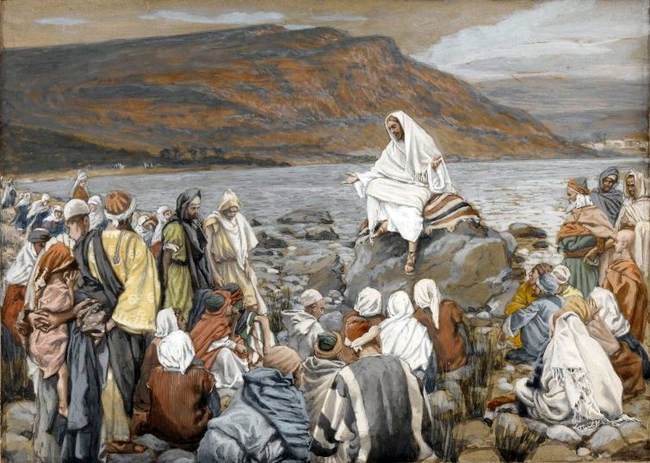
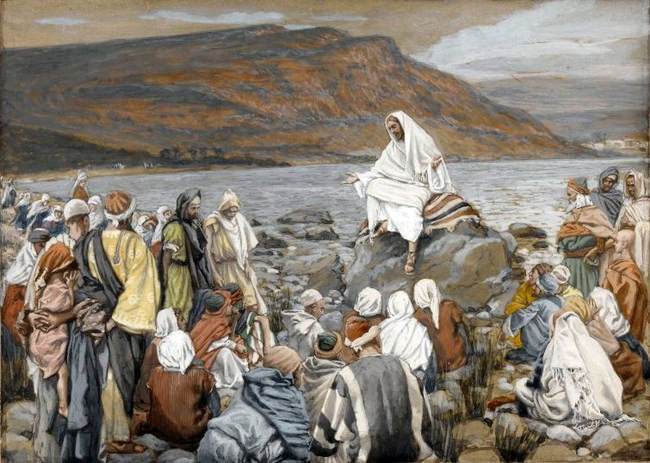
The front page image is “Jesus Teaches People By the Sea” by James Tissot, c. 1886-94. On display at the Brooklyn Museum. Via Wikimedia Commons.
“Sunday Reflection” is a regular feature that looks at the specific readings used in today’s Mass in Catholic parishes around the world. The reflection represents only my own point of view, intended to help prepare myself for the Lord’s day and perhaps spark a meaningful discussion. Previous Sunday Reflections can be found here.
Editor’s Note: Our Sunday Reflections are free to all readers, but our VIP members help keep this platform going for everyone. Join the effort by using the promo code FIGHT to get 60% off new memberships and upgrades to VIP Gold and VIP Platinum!