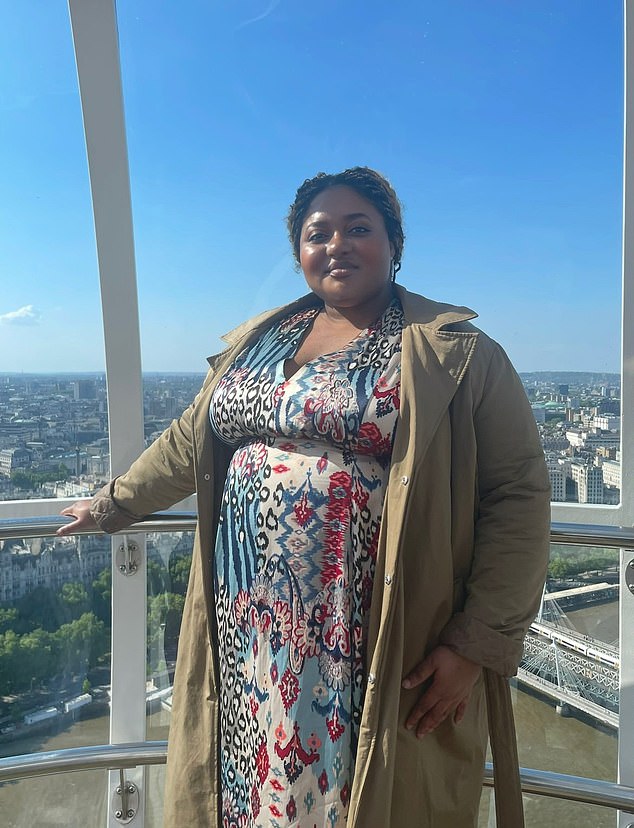

At 23 stone, Michelle Akpata felt like she was watching life from the sidelines. The 30-year-old from Islington, north London, says she had become withdrawn, exhausted and deeply unhappy as her weight ‘spiralled out of control’ during her twenties due to undiagnosed polycystic ovary syndrome (PCOS), now referred to as PMOS.
Today, Michelle is preparing to step onto the stage as a contestant in Miss Cosmo Great Britain after losing nine stone through a combination of Mounjaro weight-loss injections, bariatric surgery and major lifestyle changes. But behind the transformation is a long and emotional journey marked by years of fatigue, frustration and low confidence.
Michelle was diagnosed with PMOS in her mid-twenties after a lengthy process involving repeated scans and appointments. Reflecting on that time, she explains that she was ‘quite lethargic, tired, and was putting on weight a lot.’

Michelle gained weight during her twenties due to undiagnosed polycystic ovary syndrome (PCOS), now known as PMOS
Like many women with the condition, Michelle found getting a diagnosis difficult. The process took a long time, involving lots of ‘back and forth with scans,’ she recalls, and although her GP was trying to help, she believes more awareness is needed around the condition.
Common symptoms of PMOS include irregular or no periods, excessive hair growth on the body, thinning hair on the head, oily skin and weight gain. At her heaviest, Michelle says she no longer recognised herself. ‘I just felt a bit invisible,’ she says. ‘At 23 stone, I really wasn’t living my best life.’
She describes how her confidence plummeted as her weight increased. ‘I used to cover up a lot to hide my size,’ she says. ‘I wouldn’t want to take off my coat, no matter how warm it was.’ Social situations became increasingly difficult. ‘I would always shy away from seeing people too, making excuses or putting off,’ she says. ‘It was always “maybe next time” or “when I’m slimmer”. Part of me felt like I just wasn’t good enough.’

Michelle says her weight impacted every area of her life, including her confidence
Michelle’s symptoms affected every aspect of daily life. She struggled with low energy and poor mental health, often finding it difficult just to get out of bed in the morning. ‘Before, when the alarm went off, it was snooze, snooze, snooze because I just felt so lethargic,’ she says. ‘I must have hit that snooze button three or four times every morning. It felt like life was going past me.’
Blood tests later revealed she was deficient in vitamin D, B12 and iron, all of which contributed to her exhaustion and low mood. ‘They encouraged me to take vitamins, which I think really helped in terms of improving my mood, improving my skin, improving my overall mental wellbeing and health,’ she says.
Determined to regain control of her health, Michelle was placed by her GP on the waiting list for bariatric surgery. While waiting for the operation, she was prescribed Mounjaro, which helped her achieve a three stone weight loss. Michelle said she was open to trying the medication after researching other people’s experiences online. ‘I had heard good reviews,’ she said. ‘I had really researched and saw a lot of people had taken it and had great results, so that quietened my fears.’
The only side effect she experienced was mild nausea in the beginning, which later subsided.
After waiting more than a year, Michelle underwent bariatric surgery in October last year at the age of 29. While surgery can feel daunting for many patients, Michelle said she felt ready. ‘I had waited a long time for the surgery, so it was good to finally get to that point,’ she says. ‘I felt well prepared because I’d done my research.’
She spent time watching YouTube videos documenting other patients’ journeys before her operation. ‘I’d watch a lot of journeys on YouTube, and they all seemed to be quite successful,’ she explains. ‘So I was looking forward to the process.’

Michelle says she felt well-prepared for surgery after researching the procedure online
Recovery involved pain and nausea initially, alongside strict dietary stages beginning with liquids before moving onto soft foods and eventually normal meals. But Michelle adapted well and soon began noticing major changes, not only in her weight but in her overall health.
‘My hormones and my periods became more regular,’ she said. “It also helped with the excess hair, as well as the weight loss.
A few months after surgery, Michelle returned to Mounjaro after it was recommended to help reduce ‘food noise’. This term refers to persistent, intrusive thoughts about food – including constant cravings, thinking about eating, or feeling mentally preoccupied with what to eat next, even when not physically hungry.
‘I was constantly thinking about food,’ Michelle explains. ‘I was craving chocolate and anything high in carbs.’ Now, she says those cravings have significantly reduced. ‘When I’m hungry, I just eat a small portion of something healthy,’ she said. ‘Prior to this, I would be craving something heavy. Now I’ll eat more fruit and veg, and have smaller portions of carbohydrates.’

Michelle has seen a dramatic weight loss as the result of her surgery and Mounjaro. ‘I feel like outfits fit me better now,’ she says
Exercise has also become a regular part of her routine. Michelle now attends circuit training classes involving plenty of ‘weight lifting, running and jumping around’. Before losing weight, she struggled to stay consistent with the gym, but says increased mobility has made a huge difference. ‘As the weight is dropping, I’m more able to move about,’ she says.
The emotional changes have been just as significant as the physical ones. ‘I feel a lot more confident,’ Michelle says. ‘Before I would hide away and shy away from going to events with my friends and things, but now if my friends say “Let’s go to that place” I’m ready to go.’

Fitness has become a key part of Michelle’s lifestyle – with circuit training classes involving plenty of ‘weight lifting, running and jumping around’
Getting dressed up is another area where she’s gained confidence. ‘I feel like outfits fit me better now, so I’m a lot more confident within myself to do things and put myself out there,’ she says.
Her newfound confidence inspired her to apply for Miss Cosmo Great Britain after seeing an advert online. ‘I saw on Instagram,’ she says. ‘So I thought “Oh wow, let me put myself out there,” because I’m feeling so much more confident in myself.’
The competition has become part of a wider ambition to empower other women, particularly those struggling with mental health and self-esteem. ‘I’d love to create a space for those suffering from mental health and help support them and empower them to believe in themselves,’ she said.

Michelle’s modelling work for Getty images (photographer: Catherine Falls)
Michelle has also started modelling, including work for Getty Images, and hopes to pursue a career in television and acting. She recently secured a place at the National Youth Theatre and currently works as a presenter at a community radio station.
Looking back, Michelle hopes her experience will encourage other women with PMOS or weight-related struggles not to lose hope.
‘Don’t let it be like a death sentence,’ she said. ‘Don’t let it be something that is going to stop you from living life. It’s something that you can manage with different methods. Keep trying until you find the best course of action for you.’
Patients in the UK should only access weight-loss medication through regulated pharmacies or clinics, where treatment is overseen by a registered healthcare professional and includes appropriate screening, monitoring and ongoing support. You can find out more about Well Pharmacy’s pharmacy-led weight management service at www.well.co.uk/weight-management.