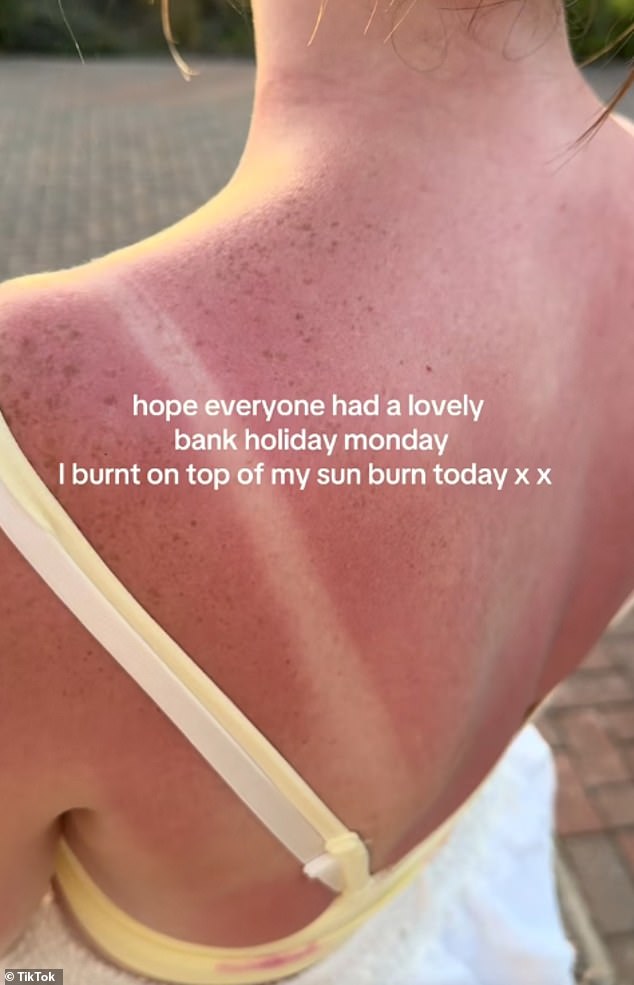
The long weekend was a scorcher across the UK, and the heatwave has continued today with temperatures expected to hit 36C.
But some Britons were ill-prepared for the hot weather and clearly forgot to lather on the sunscreen before enjoying their bank holiday.
Taking to social media to share their photos as a warning to others, dozens of people who had felt the burn revealed their epic tanning fails, from charred arms to awkward strap marks, as well as painful red skin.
Some documented the process of trying to soothe their frazzled bodies, with one man putting shaving cream on his back to try and ease the pain.
But while these images are amusing to look at, the consequences of sunburn can be very serious.
‘In my experience, the majority of people still don’t wear high factor suncream when they’re in this country,’ Justine Hextall, a consultant dermatologist at the Tarrant Street Clinic in Arundel, West Sussex, previously told the Daily Mail.
‘However, I’ve seen plenty of patients with skin cancer who’ve been abroad infrequently, or in some cases have never left the UK. Even if you don’t burn easily – or have darker skin – you still need to protect yourself.’
It comes after rates of melanoma – the deadliest form of skin cancer – reached an all-time high in the UK, with nearly 21,000 Britons diagnosed each year, according to data from Cancer Research UK.

The long weekend was a scorcher across the UK, and the heatwave has continued today with temperatures expected to hit 36C. But some Britons were ill-prepared for the hot weather and clearly forgot to lather on the sunscreen before enjoying their bank holiday
Cases of the disease, which kills around 2,500 each year, are set to continue to soar – increasing to 26,500 new cases a year by 2040 – says the charity.
Primarily caused by sun exposure, more than 80 per cent of melanoma cases are preventable.
Women are more likely than men to be diagnosed with the disease at a younger age. In later life, however, rates are higher in men.
Amid the heatwave, the charity is urging people to cover up and use sunscreen to minimise their risk.
Cancer Research UK’s chief executive, Michelle Mitchell, said it was ‘concerning’ to see the number of people being diagnosed with the deadly disease.
‘The fact that most of these cases are preventable underlines the importance of people taking sun safety seriously,’ she said.
The latest figures mark the first time that melanoma cases in the UK have risen above 20,000. Research shows that as many as 18,000 of these are preventable.
Almost 90 per cent of melanoma is caused by too much exposure to ultra-violet (UV) light, either from the sun or sun beds, which can damage the skin’s DNA.

Dozens of people took to social media to share their photos as a warning to others

While these images are amusing to look at, the consequences of sunburn can be very serious

Dozens of people who had felt the burn revealed their epic tanning fails, from charred arms to awkward strap marks, as well as painful red skin


Some documented the process of trying to soothe their frazzled bodies, with one man putting shaving cream on his back to try and ease the pain

A man in the UK showcases his sunburn following the heatwave over the weekend

A man in Britain showcases his awkward tan lines on TikTok after enjoying the heatwave
Join the discussion
What’s the worst sunburn you’ve ever had?
Other factors believed to contribute to the rise in cases include an ageing population and better awareness of the warning signs of skin cancer.
Despite the spike in diagnoses, deaths from melanoma are expected to fall, the charity says.
Vital improvements in early diagnosis and treatment are helping patients with skin cancer live longer, with almost nine in 10 adults diagnosed with the disease in England now surviving 10 years or more.
‘Sunburn is a clear sign your skin has been damaged,’ says Fiona Osgun, head of health information at Cancer Research UK.
‘Sunburn doesn’t only happen when it’s hot – it can happen on cooler, cloudier days too,’ she added.
Getting sunburned just once every two years can triple the risk of developing skin cancer, studies have shown.
‘The best way to protect your skin when the sun is strong is to use shade, particularly in the middle of the day, cover up, especially your shoulders, and wear a hat and sunglasses and finally, wear sunscreen, with at least SPF 30 and four or five stars,’ says Ms Osgun.
‘Make sure you put plenty on and reapply it regularly. Even if you’ve been sunburned before, it’s never too late to start protecting your skin.’