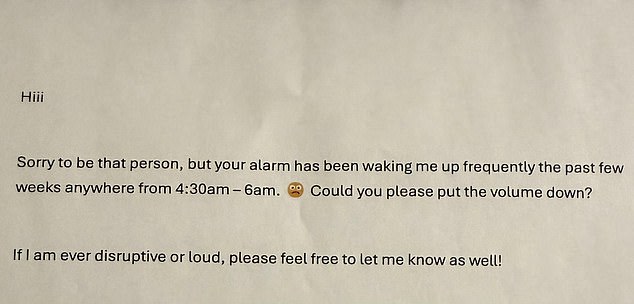

A tenant has been left on the verge of tears after discovering a polite but pointed note from a neighbour.
Posting to Reddit, the woman admitted she feared she had ‘become the hated neighbour’ after repeatedly blasting early-morning alarms loud enough to wake those around her.
‘I received this note on my door today and I feel like a b****,’ she wrote candidly.
‘I do have to say my alarms are very noisy and they are very early.’
The note itself was slipped under her door and read: ‘Sorry to be that person, but your alarm has been waking me up frequently the past few weeks anywhere from 4:30am – 6am. Could you please put the volume down?’
While the exchange was polite, the backstory revealed a far more complicated reality.
The tenant explained she had recently slept through her alarms entirely and once woke up three hours late for work – a mistake that nearly cost her her job.
In a bid to avoid it happening again, she had turned up the volume on her multiple alarms.

Posting to Reddit, the woman admitted she feared she had ‘become the hated neighbour’ after repeatedly blasting early-morning alarms loud enough to wake those around her
‘I made my alarms more frequent and to the loudest setting possible, which has helped me,’ she said, adding that she relies on an Amazon Echo placed against a shared wall.
Complicating matters further, the woman revealed she is a ‘pretty deep sleeper’ and has sleep apnoea, using a CPAP (Continuous Positive Airway Pressure) machine at night, which is something she believes makes it even harder to hear alarms.
‘I really don’t want to disturb other people as I understand sleep is very important, but at the same time I really cannot afford to miss work again in fear of termination,’ she wrote.
‘I genuinely want to cry, I feel like such an awful person.’
Her dilemma struck a nerve, with hundreds of commenters sharing both empathy and practical advice, with much of it focused on ditching sound altogether.
‘Maybe look into alarm systems for deaf people, physical sensation instead of noise,’ one user suggested, pointing to a category of devices designed to wake people through vibration rather than sound.
Wearable tech quickly emerged as a crowd favourite too.
‘Instead, we bought a couple FitBits [and] the vibrating alarm works great,’ another wrote, explaining that silent wrist vibrations can be surprisingly effective for heavy sleepers.

The tenant explained she had recently slept through her alarms entirely and once woke up three hours late for work – a mistake that nearly cost her her job multiple times after discovering she suffers from sleep apnoea
They added that some devices can even wake you during lighter sleep phases.
‘If it senses you flop around any time after 5:30 then it will start vibrating to wake you up… I feel so much better if I’m not woken up during a deep sleep.’
Others echoed the sentiment, with one commenter writing: ‘My Apple watch is great for this, I can easily sleep through sound-only alarms but the vibration on my wrist never fails.’
For those without wearables, bed-based solutions were also widely recommended.
‘For people who are blind and/ or deaf, they have pads that you put on your bed that will vibrate and shake,’ one person shared, while another suggested a vibrating alarm clock that can be placed under a pillow.
Light-based alarms also featured heavily, tapping into the body’s natural circadian rhythm.
One user revealed they set LED strip lights to full brightness before their alarm goes off, so that if their first alarm doesn’t jolt them, they immediately wake to ‘the most assaulting light.’
Some suggestions were more extreme, including wearable devices that deliver a mild electric shock, though these were mentioned more cautiously.
Beyond gadgets, several commenters pointed out that consistently sleeping through alarms, especially multiple, loud ones, can sometimes signal an underlying sleep issue.
Join the discussion
How should neighbors handle noise conflicts when someone’s job or health is on the line?
‘I used to be a chronic oversleeper… You need to go to the doctor about this,’ one user advised, while another shared their own diagnosis.
‘Turns out, I have a subtype of narcolepsy. It’s unbelievable the difference that managing it with medication has made.’
Sleep experts generally agree that factors like sleep apnoea, poor sleep quality, irregular sleep schedules and even genetics can influence how easily someone wakes.
Deep sleepers may spend longer in slow-wave sleep, a stage where external stimuli – including alarms – are less likely to register.
Conditions such as sleep apnoea can also fragment rest overnight, leaving people more fatigued by morning despite technically spending enough time in bed.
Circadian rhythm differences, often referred to as being a ‘night owl’ or ‘early bird’, can also play a role.
Those naturally wired to sleep and wake later may find early alarms particularly jarring, and easier to sleep through.
For the tenant at the centre of the viral post, the situation highlights a common modern tension of balancing personal routines with shared living spaces.