
When my eldest child, Isaac – now 19 – was a toddler, I was determined he would have a childhood full of imaginative play and outdoor adventures, with as little screen time as possible.
There were nature trails, farm visits and endless, endless playdates, for which I would buy expensive wooden aeroplanes and racing cars for him and his little friends to paint and assemble.
Once he started school, his numerous extracurriculars ranged from cricket to musical theatre.
If he was glued to the telly, I felt I was failing as a parent.
Yet, four more children later, it’s a very different story.
My youngest child, six-year-old Benjamin, has only ever joined one club.
Instead, he’s spent hours playing computer games such as Roblox and had more dinners in front of the telly than the older four combined.
As a toddler, rather than being dragged on walks through the woods, he was given an iPad for entertainment if we went to the pub for supper – something that would have been unthinkable for my firstborn.
So when research came out recently which confirmed that younger children are treated more leniently than their older brothers and sisters, particularly when it comes to digital media, I was not remotely surprised.
The researchers from Monash University in Australia, who monitored around 5,000 children, discovered children born later spend less time doing enrichment activities and more time on social media.

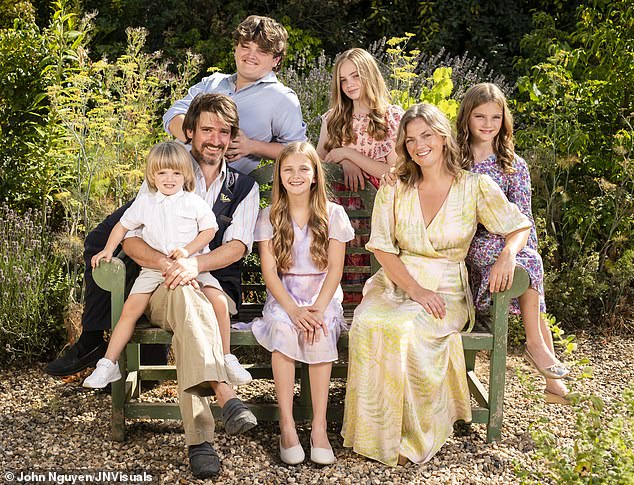
Sybilla Hart with her husband Charlie and their children Isaac, Beatrice, Florence, Celestia and Benjamin back in 2022
They observed parents were less likely to have rules around TV watching and video games for the younger ones – who were also less likely to perceive that their parents expect them to follow rules.
Check, check and check.
It’s a bone of contention with my older children, who say Benjamin gets away with a lot more than they did.
But, frankly, it was inevitable.
Any mother can tell you that the responsibility to give your firstborn the best start in life is overwhelming – not to mention very stressful.
I tried to keep up my efforts with my three daughters, Beatrice, 16; Florence, 14; and Celestia, 11.
As little girls, I was their playtime assistant and would be summoned to help care for their numerous baby dolls or act out scenes from Beauty And The Beast. Later, I ferried them everywhere from cookery lessons and ballet classes to gymnastics and riding sessions.
I did anything to ensure they, too, were exposed to positive influences, rather than moronic computer games or endless TV cartoons.
But it was exhausting – and I drove myself crazy in the process.
By the time Benjamin came along, I’d run out of steam. So I gave up trying to be the mythical ‘perfect parent’ endlessly swerving screen time, and instead accepted that his life would be determined by his choices as much as mine.

Sybilla and Charlie with their five children. Their older children say Benjamin, the youngest (pictured at the front when he was three), gets away with a lot more than they did
But there’s also another, perhaps more surprising, reason why I’m now taking a backseat approach to parenting: I’ve decided to prioritise my 21-year marriage over motherhood.
This doesn’t mean I care less about my children. Rather, I firmly believe that if you have a happy relationship they reap the benefits, too.
If that means the kids have to keep themselves entertained (especially now that the older ones are able to babysit) while my husband Charlie and I go out for the evening to see friends, or even just enjoy a quiet glass of wine together, then so be it.
That may sound awful to the couples who are still resolutely child-centric, but I’ve realised that if you ignore your relationship for the sake of your children, it comes back to bite you.
Marriages are the backbone of a solid family life, so if you aren’t getting on then chances are no one else in the family is content, either.
Children who live in homes where their parents are happy together obviously feel more secure. They need to learn that parents need downtime, too.
Back when I was trying to prove I was a super-mother by never letting my children experience a day that wasn’t taken up with something ‘enriching’, I’d end each weekend as exhausted as if I’d gone two rounds with Mike Tyson.
Charlie and I were like ships passing in the night, too. As a result, we’d find ourselves bickering over small things and becoming more distant and intolerant of each other.
The turning point came during a week when I had driven around the counties of Essex and Suffolk (we live in North Essex) in circles and realised that Charlie and I had spoken to each other for less than half an hour the entire week. All those conversations had been about the children, too.
This man was the love of my life. But I was spending less time with him than the parents in the playground.
I wanted that to change. And I was more than prepared to cut back on my children’s activities to make it happen.
You are not short-changing your offspring by choosing to make some time for yourselves instead of signing them up to every club under the sun. You might be doing them a favour.
Children need to learn how to be bored – and if that means lying on a sofa watching TV for swathes of the afternoon, so be it.
Taking a marriage-over-motherhood approach doesn’t mean you have to be constantly going out on expensive date nights. Just spending some quiet time alone at home with a cup of tea, and having a chat and a debrief, is often enough. Charlie and I tend to go for school-run-friendly date lunches when we can.
So, if you take one piece of advice from my 19 years at the coalface of motherhood, it’s this: don’t ever feel guilty for letting your children do less.
It might just be the best thing you’ve done for everyone – and it’s definitely a good thing for your marriage.