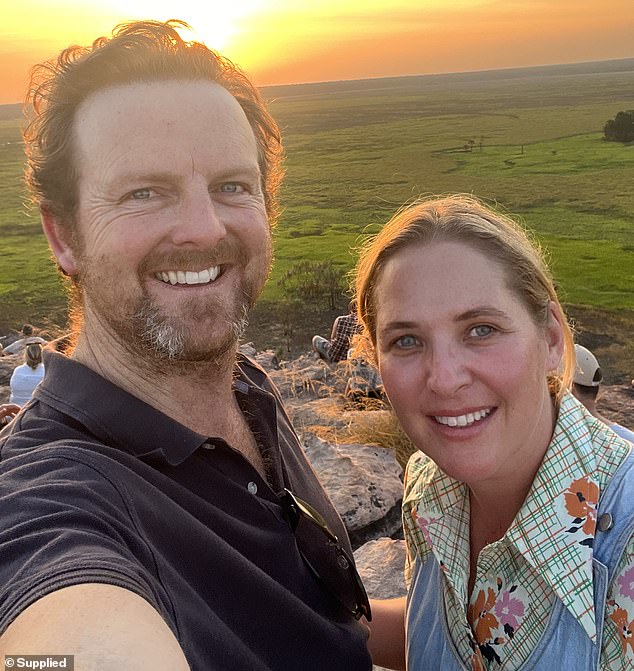

When Tim Weale and his family packed up their caravan and left Sydney to spend four months travelling around Australia in mid-2023, it was everything they had dreamed of.
The then-44-year-old business adviser, his wife Bridget, and their two young children spent months exploring some of the country’s most remote landscapes, winding their way through the Flinders Ranges, across the Mitchell Plateau, along the Gibb River Road and down the spectacular West Australian coastline.
It was the family adventure they had always wanted to give their children – an opportunity to swap city life for campfires, red dirt, and the vast Australian outback.
Looking back now, however, Tim realises that while his family was making lifelong memories, his body was quietly giving him the first signs that something was terribly wrong.
The first symptom of Tim’s stage four prostate cancer appeared while they were camping near Kalumburu, one of the most isolated parts of Western Australia, where the roads were too rough to tow their caravan and the family had resorted to sleeping in swags beneath the stars.
‘I woke up one morning with this really painful ache in my hip,’ Tim, now 47, told the Daily Mail.
‘It was quite sore, but I honestly thought I’d just slept on a rock or a pebble. We were sleeping on the ground every night, so it made perfect sense.’
The pain lingered for several days but, in the middle of the Kimberley, stopping simply wasn’t an option.

When Tim Weale and his family packed up their caravan and left Sydney to spend four months travelling around Australia in mid-2023, it was everything they had dreamed of

The then-44-year-old business adviser, his wife Bridget, and their two young children spent months exploring some of the country’s most remote landscapes
‘When you’re that far from anywhere, there’s no one who’s going to pack up your campsite or drive you hundreds of kilometres over corrugated roads for you,’ he said.
‘You just keep going, and that’s exactly what we did.’
Several weeks later, another unexplained pain emerged while the family was travelling near Exmouth.
Tim had reached onto the roof of the caravan to grab some gear when he felt a sharp pain shoot through his shoulder.
‘I thought I’d strained a muscle,’ he said.
‘That night I asked Bridget to have a look because I thought maybe there was a knot in my back that she could massage out, but there was nothing there.’
The discomfort lingered long enough for Tim to visit a physiotherapist while the family stopped in Carnarvon, yet even after a thorough examination there was no obvious explanation.
‘She couldn’t really tell me what it was, and after a few days it disappeared, so we just kept travelling.’

Looking back now, however, Tim realises that while his family was making lifelong memories, his body was quietly giving him the first signs that something was terribly wrong
By the time the family returned to Sydney later that year, those strange episodes had largely faded into the background.
Life resumed its normal rhythm, and Tim returned to work convinced the aches had simply been part of an active life spent hiking, camping, and driving thousands of kilometres across Australia.
Not long afterwards, another pain developed, this time deep through his pelvis and sitting bones.
Again, he found what seemed like a perfectly reasonable explanation.
‘I’d just gone back to working in an office and sitting in a chair for six or eight hours a day,’ he said.
‘I’d been in the Army when I was younger and probably still had that mentality that I was bulletproof.’
Fit, active, and with no family history of prostate cancer – or cancer of any kind – the disease simply never entered his mind.
‘I honestly didn’t know much about prostate cancer. I didn’t even know it was Australia’s most commonly diagnosed cancer,’ he said.

‘I’d been in the Army when I was younger and probably still had that mentality that I was bulletproof,’ Tim said
Everything changed after being intimate with his wife one evening. Tim noticed blood in his semen.
‘I remember thinking straight away, “Whoa, that’s definitely not normal”,’ he said.
Unlike the earlier aches, this symptom prompted him to make an appointment with his GP the very next day.
The consultation began with questions neither of them expected.
‘My doctor asked whether things had been a bit rough the night before with my wife,’ Tim recalled.
‘I said, “No, nothing out of the ordinary. It was completely normal”.’
Initially, the most likely explanation appeared to be an infection.
An ultrasound showed his prostate was slightly enlarged, so he completed a two-week course of antibiotics before undergoing further testing.

By the time the family returned to Sydney later that year, those strange episodes had largely faded into the background
When the swelling failed to improve, his GP ordered a prostate-specific antigen (PSA) blood test.
The result was so unusual that neither of them quite believed it.
‘My PSA came back at 64,’ Tim said.
‘For someone my age, it would normally be somewhere between about 0.5 and 2.
‘My GP told me he’d never seen a result anywhere near that high.’
Convinced the result must have been a laboratory error, they repeated the blood test less than a week later.
Instead of falling, the number climbed even higher.
‘It had gone from 64 to 68 in less than a week, and that’s when my GP became genuinely concerned.’

An urgent referral to a urologist followed, along with an MRI that suggested there was a 99.9 per cent chance the enlarged prostate was cancerous
An urgent referral to a urologist followed, along with an MRI that suggested there was a 99.9 per cent chance the enlarged prostate was cancerous, and a robotic biopsy confirmed the devastating diagnosis.
Every one of the 12 tissue samples taken from his prostate contained cancer.
Further CT and PET scans then revealed the full extent of the disease.
The cancer had already spread beyond his prostate into his pelvis, sitting bones, tailbone, spine, ribs, lungs, shoulder blade, and right hip.
Only then did those mysterious pains from the family holiday begin to make sense.
‘Knowing now that those aches I felt while we were travelling were actually cancer eating into my bones is incredibly confronting,’ Tim said.
‘At the time I genuinely thought it was sleeping rough, doing 16-kilometre hikes, and living an active lifestyle.
‘Never in a million years did I think it was stage four prostate cancer.’

Doctors diagnosed Tim with stage four metastatic prostate cancer with a Gleason score of nine
Before treatment had even begun, another PSA test revealed the cancer’s alarming progression.
‘In just a couple of weeks, my PSA had gone from 68 to 154.’
Doctors diagnosed Tim with stage four metastatic prostate cancer with a Gleason score of nine.
Because the cancer had already spread throughout his skeleton, they explained it could no longer be cured.
‘Up until someone actually looked me in the eye and said, “Tim, you have incurable stage four metastatic prostate cancer”, I honestly believed there had to be another explanation,’ he said.
‘I had no family history, I was fit and healthy, I was living a great life and I just couldn’t understand why this was happening.’
Sitting beside him, Bridget absorbed the diagnosis too.
‘It absolutely changed our lives forever. It was news no family ever expects to hear,’ Tim said.

Because the cancer had already spread throughout his skeleton, doctors explained it could no longer be cured
Treatment began almost immediately, with radiation targeting the extensive cancer in his hip while chemotherapy worked to attack cancer cells throughout his body.
He was also started on lifelong androgen deprivation therapy, a treatment designed to reduce testosterone to almost zero because the hormone effectively acts as fuel for prostate cancer.
Today, Tim takes oral medication every day and receives a hormone injection every three months.
Although the treatment has reduced his PSA to 0.01 – a level doctors describe as undetectable – it has dramatically altered his life.
Without testosterone, maintaining muscle mass has become an ongoing battle, fatigue is constant and his bone density is at greater risk of deteriorating.
To combat those side effects, he spends two hours in the gym at least three times every week completing an intensive strength program.
‘I have to trick my body into thinking it still needs muscle,’ he said.
‘There are plenty of days when I don’t feel like going because the medication leaves me exhausted, but I know every session gives me the best chance of living longer.’

Tim was also started on lifelong androgen deprivation therapy, a treatment designed to reduce testosterone to almost zero because the hormone effectively acts as fuel for prostate cancer
One of the most difficult parts of the diagnosis came not in the hospital, but afterwards, when he had to tell the people he loved.
His children were just six and eight years old when he decided to explain what was happening.
He chose the drive home after swimming lessons, handing them each a bag of hot chips before gently breaking the news.
‘I told them I’d have treatment, that I’d probably lose my hair and that there would be days when I wouldn’t be my normal self,’ he said.
‘My son looked at me and asked, “Dad, are you going to die?”
‘I said, “Not yet. We don’t know that. We’re going to do everything we possibly can to fight this”.’
While that conversation was heartbreaking, Tim admits telling his parents was even harder.
‘They’re stoic country people,’ he said.

One of the most difficult parts of the diagnosis came not in the hospital, but afterwards, when he had to tell the people he loved
‘But telling Mum and Dad that their eldest son had incurable cancer was probably the hardest conversation I’ve ever had.’
Because treatment began almost immediately, he was unable to travel home to see them that Christmas. Instead, they made the journey to Sydney once his radiation had begun.
Sharing the news with friends proved equally emotional.
Within his friendship group, cancer had already claimed the life of one mate’s wife, making Tim’s diagnosis especially confronting for everyone.
‘My mates were devastated,’ he said.
‘But one really positive thing came from it because almost every one of them went to their GP afterwards and asked for a PSA blood test.’
For Tim, that is exactly why he now speaks publicly.
He believes far too many Australian men dismiss symptoms, avoid doctors, and assume serious illnesses happen to someone else.

After stepping away from a career path that once seemed destined for the CEO’s office, he now works part-time while proudly describing himself as the family’s ‘home husband’, allowing Bridget to focus on her career while he spends precious time raising their children
‘We’ve all grown up with this attitude that, “She’ll be right”,’ he said.
‘The reality is that it is all right until it’s not.’
Today, the former executive no longer measures success by job titles or corporate ambition.
After stepping away from a career path that once seemed destined for the CEO’s office, he now works part-time while proudly describing himself as the family’s ‘home husband’, allowing Bridget to focus on her career while he spends precious time raising their children.
‘I’ve never had this amount of time with the kids before,’ he said.
‘That’s become the silver lining of everything that’s happened.
‘I used to think success meant climbing the corporate ladder. Now success is watching my kids grow up, taking the boat out fishing, spending time with my wife, getting to the gym and making memories while I can.’
His message to other men is simple.
‘If something doesn’t feel right, don’t explain it away and don’t wait,’ he said.
‘A PSA test is just a simple blood test. People still think prostate cancer testing is invasive, but it starts with one blood test.
‘Go to your GP, advocate for yourself and ask for it, even if you have to pay for it yourself.
‘And perhaps most importantly, start having these conversations with your mates, because those conversations could end up saving someone’s life.’