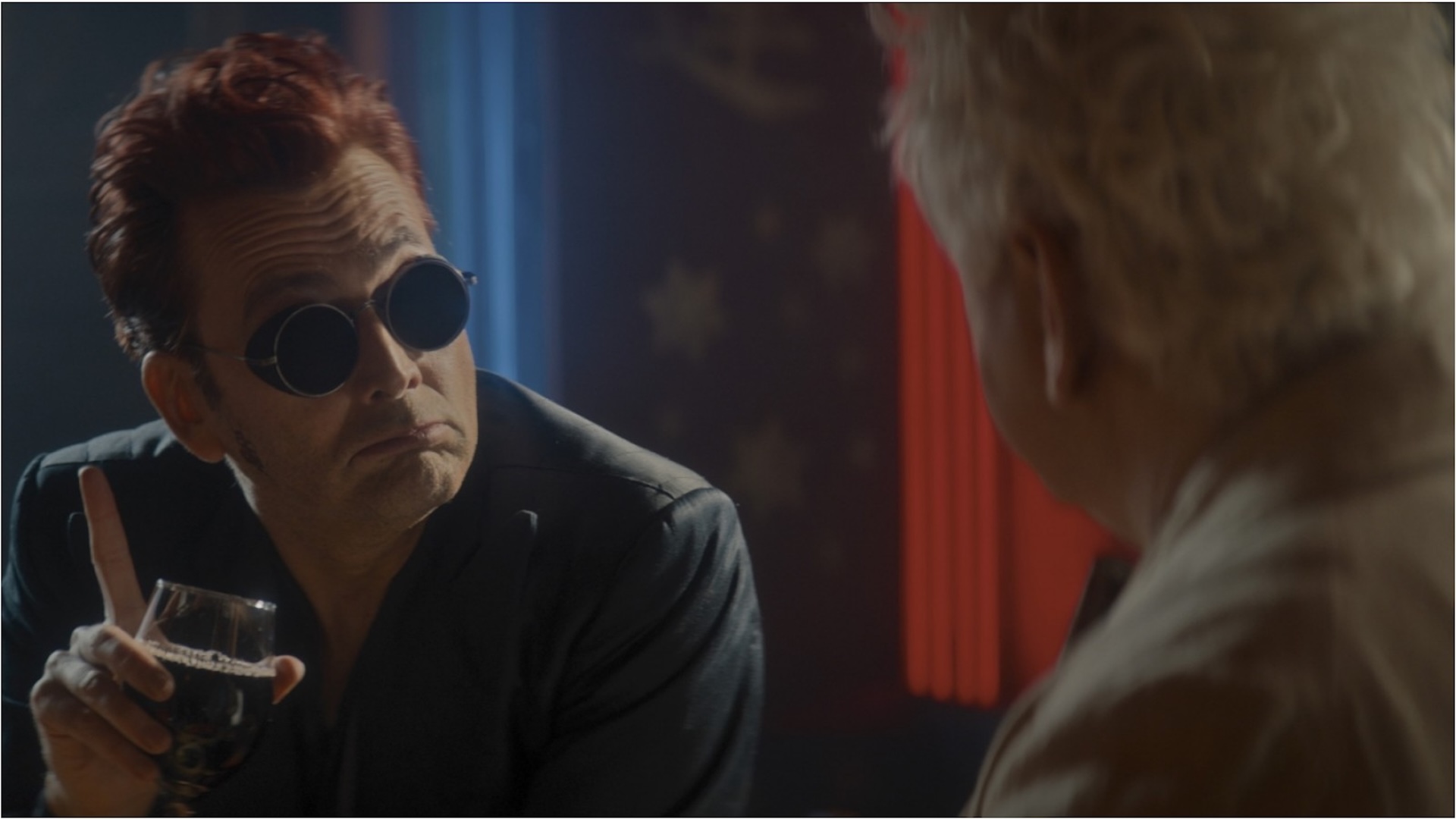

The Second Coming Isn’t the Real Apocalyptic Threat
Though the premise of “The Finale” ostensibly revolves around the Second Coming, and even introduces Extraordinary standout Bilal Hasna as a soft-spoken, endlessly charming Jesus, the potential End Times are less of a threat than you might expect. Part of that is Aziraphale’s doing; in his new role as Supreme Archangel, he’s been promoting a more universal happiness versus a fire-and-brimstone kind of vibe. But the question of the Second Coming almost becomes irrelevant in the face of the disappearance of the Book of Life. A celestial register upon which all of reality is recorded, its also the means by which that same reality can be erased, and the scope of its threat becomes glaringly apparent when the all-powerful Metatron and several archangels vanish from existence.
The finale rushes through much of this plot — understandable as it clocks in at just 96 minutes – but the upshot of it all is that the Archangel Michael, tired of being overlooked in Heaven, stole the book and burns it page by page in the Eternal Flame at the center of the universe. Though Azirphale attempts to talk her off the proverbial ledge, they fail, and the Book of Life is destroyed, save for a single page Crowley manages to rescue, a charred entry for the pair’s beloved Whickber Street bookshop.
The Problem of Free Will
Now essentially the last beings in the universe, Crowley and Aziraphale are confronted by both Satan (Toby Jones) and God (Tanya Moodie), who are summoned into appearing by virtue of being omnipresent through all things. This awkward family reunion essentially turns into a fairly familiar debate about free will and predestination, as Crowley questions why the Almighty would create a universe where humans are punished for simply behaving like humans and, subsequently, essentially being set up to fail. Aziraphale simply wants to know why God decided to give him Crowley and the promise of completeness he represents, only to take it all away.
As Satan points out, these are all questions that will be familiar to any religion or philosophy major: the problem of evil, the question of free will, why an omniscient Creator would allow their creations to suffer needlessly. Good Omens smartly doesn’t attempt to settle thousands of years’ worth of debate on these topics. Instead, it upsets the board entirely. God offers to let Crowley and Aziraphale choose what comes next: Everything can be put back the way it was or something else can be made in its place. But whatever that something else will be, is up to them.
Sequestered in a corner of the shop that transforms into a sort of hybrid Garden of Eden, the pair debate what sort of world they want to make (and live in). For Aziraphale, the answer is easy: He just wants Crowley. But Crowley’s feelings are more complicated: He longs for a universe where free will is real and humanity can truly make their own choices, even if it means creating a world where no angels or demons exist, even if it means the pair of them will never get the chance to be an “us” the way he’s always wanted them to be.
The Good Omens Universe Ends
In the end, a teary Aziraphale agrees, and after a brief and gut-wrenching farewell, the pair disintegrate into nothingness, holding hands and gazing at each other the whole time. The Good Omens universe as we knew it blinks out of existence, before restarting again with a literal Big Bang.