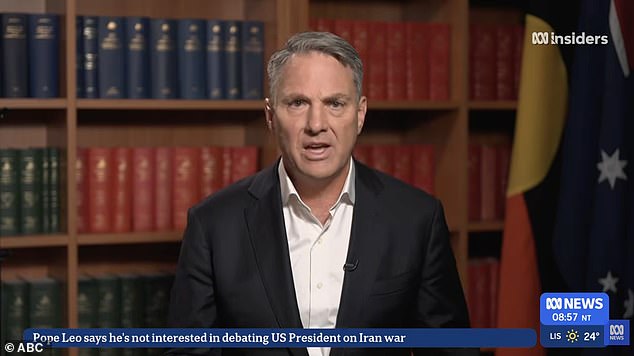
Deputy Prime Minister Richard Marles has labelled the renewed closure of the Strait of Hormuz a ‘disappointing development’, as pressure intensifies on US President Donald Trump to act swiftly to reopen one of the world’s most vital energy chokepoints.
Speaking on ABC’s Insiders on Sunday, Marles warned the ongoing blockage posed a serious threat to global fuel supplies and carried direct implications for Australia as a trade‑dependent nation.
On Friday, President Trump said a naval blockade of Iranian ports would remain in place until a peace deal was reached between Washington and Tehran.
The strait was briefly reopened on Saturday before being closed again on Sunday.
A two‑week ceasefire currently in effect is due to expire on April 22.
‘Obviously, that is a disappointing development,’ Marles said.
‘This remains a fragile ceasefire. What we need to see now is every diplomatic avenue pursued to turn what is temporary into something permanent, to reopen the Strait of Hormuz and return the global fuel supply chain to normality.’
The strait carries around a fifth of the world’s oil shipments, making it strategically and economically vital.

Richard Marles (pictured) said the closure of the Strait of Hormuz was ‘disappointing’
Marles said Australia’s national interests were aligned with international efforts to restore freedom of navigation.
‘It is in Australia’s interest, it is in the world’s interest, that the Strait of Hormuz is open and operating normally,’ he said.
‘Freedom of navigation under the UN Convention on the Law of the Sea is paramount to Australia’s national interests.’
While the government has stopped short of explicitly endorsing the US naval blockade, Marles defended Washington’s response and placed responsibility squarely on Iran.
‘Iran has sought to block the Strait of Hormuz, that is what has happened,’ he said.
‘I can understand the American reaction to that. Ultimately, what we all want, including the United States, is to see the strait open.’
The comments come as President Trump publicly accuses Australia of refusing to assist the United States during the crisis, claims Canberra has flatly rejected.
‘There has been no specific request for any Australian capability,’ Marles said.

Trump (pictured) has previously criticised Australia for not offering help to the US blockade
‘Australia understands how significant the Strait of Hormuz is. Obviously, we will help, but what that looks like depends entirely on circumstances that no one yet knows.’
Australia currently has an E‑7 Wedgetail surveillance aircraft deployed in the Gulf region, a fact that has prompted questions about whether Canberra is assisting US military operations.
Marles said the aircraft’s mission was purely defensive and focused on protecting Gulf states, particularly the United Arab Emirates.
‘The aircraft is there at the request of the UAE to assist with the defence of Gulf states,’ he said.
‘It is optimised to detect airborne threats and coordinate defensive responses. That is different to naval blockade operations.’
He confirmed the aircraft shares information through a multinational air operations centre in Qatar but rejected claims it was supporting the blockade directly.
‘It would not be right to characterise that capability as assisting a naval blockade,’ he said. ‘Its mission, from Australia’s point of view, is defensive.’
Marles also declined to engage directly with Trump’s criticism, insisting the broader US alliance transcended any single administration.

The Strait of Hormuz (pictured) remains closed after opening briefly on Saturday
‘This relationship should not be judged by the comments of any one president or measured over a handful of years,’ he said.
‘It is a long‑term strategic alliance in Australia’s national interest, and it remains fundamental to our security.’
With international talks set to continue in London this week, Marles said Australia would remain engaged but would not speculate on future military contributions.
‘What matters is that the strait reopens,’ he said.
‘That outcome is critical for Australia, for global energy markets and for regional stability.’