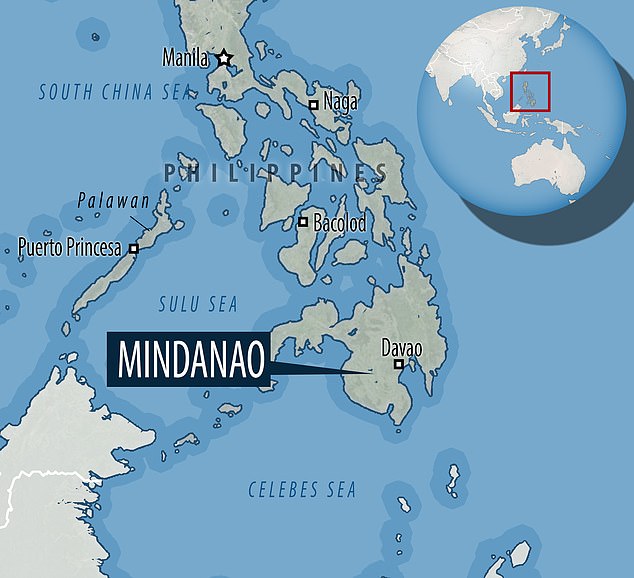
A huge earthquake has struck the Philippines, killing at least three people, injuring five others and triggering tsunami warnings across parts of the Asia-Pacific region.
The quake, which was recorded as a magnitude 7.8, struck at a depth of 10km on Monday morning, according to the German Research Centre for Geosciences (GFZ).
The research centre had earlier pegged the earthquake at 8.2.
The GFZ said the southern Philippine island of Mindanao was struck, with authorities warning residents to seek higher ground after a series of tsunami alerts.
Police have confirmed that at least three people were killed and five others injured in the quake.
Authorities estimate that 37 buildings, mostly commercial properties, were damaged.
Since the initial magnitude-7.8 earthquake struck off the Philippines’ southern coast, 138 aftershocks have been recorded as of 11:00 local time (03:00 GMT), according to the Philippine Institute of Volcanology and Seismology.
The Philippine Institute of Volcanology and Seismology said in a statement: ‘Based on the local tsunami scenario database, it is expected to experience wave heights of more than one metre above the normal tides and may be higher on enclosed bays and straits.
‘It is forecast that the first tsunami waves will arrive between 07:37am to 09:37am (PST). These waves may continue for hours.’
Tsunami warnings were issued in several countries, including the Philippines, Indonesia, Japan and Australia, although some of those warnings have since been lifted.

A huge earthquake has struck the Philippines with the region now facing a tsunami threat

The quake, which was recorded as an 7.8 magnitude, struck at a depth of 10km on Monday morning

A series of earthquakes, or ‘aftershocks’ as authorities described them, continue to impact the region
Tsunami waves ranging from 3cm (0.1ft) to 0.8m (2.7ft) were recorded in Palau, Indonesia and the Philippine region of Davao, according to the US Geological Survey.
People in the coastal areas of Sarangani, Davao Occidental, Tawi-Tawi, Sulu, Basilan, Zamboanga del Sur, Zamboanga Sibugay, Sultan Kudarat and South Cotabato were strongly advised to immediately evacuate to higher ground or move inland.
Authorities urged residents not to delay evacuating, with Philippine President Ferdinand Marcos Jr issuing a stark warning.
He said: ‘Do not wait. Your life is more important than anything left behind.’
The police chief of Alabel town in Sarangani, Philippines, said the police building had some cracks immediately after the quake, which occurred during their flag-raising ceremony, while a Jollibee building collapsed.
‘This is the strongest earthquake we’ve experienced,’ chief Benjie Ancheta told Reuters via phone.
Ancheta said there were no immediate reports of casualties, though some people fainted following the strong tremor.
A series of earthquakes, or ‘aftershocks’ as authorities described them, continue to impact the region, with magnitudes ranging from 3.7 to 1.3 recorded.
The Pacific Tsunami Warning Center previously issued an alert for possible hazardous tsunami waves along the coasts of Indonesia, the Philippines, Palau, Taiwan and Papua New Guinea.
New Zealand’s National Emergency Management Agency has ruled out any chance the earthquake could generate a tsunami affecting New Zealand.
‘NEMA has assessed the information with the assistance of science advisers,’ the agency said in a statement.
‘Based on current information, the initial assessment is that the earthquake is unlikely to have caused a tsunami that will affect New Zealand.’
The Philippines and Indonesia are tectonically complex regions of the ‘Pacific Ring of Fire’, a seismically active belt stretching from South America to the Russian Far East, Reuters reports.