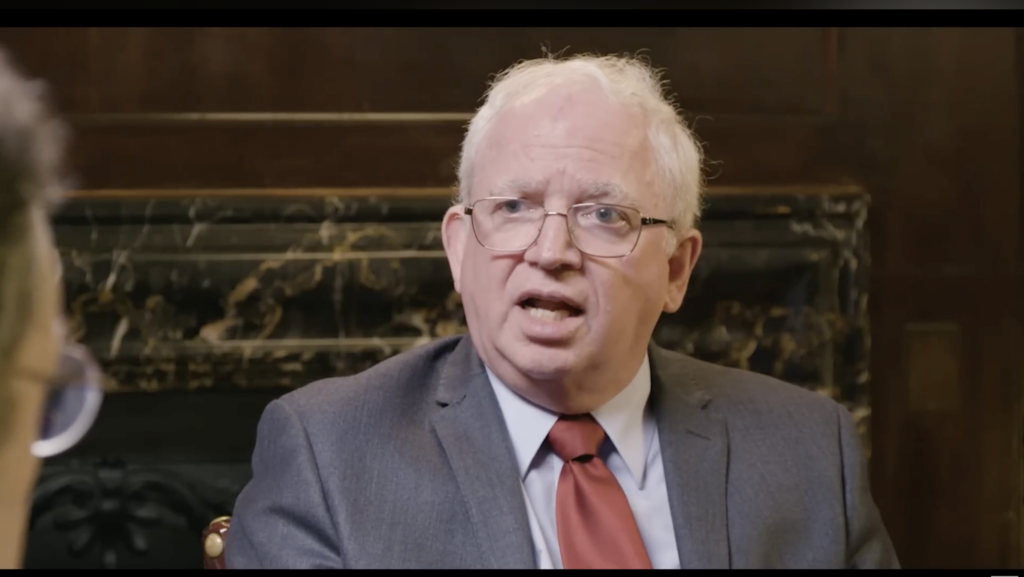
The California Supreme Court upheld the disbarment of constitutional scholar and attorney John Eastman on Wednesday for representing President Donald Trump when he questioned the outcome of the 2020 election.
The California State Bar’s Office of Chief Trial Counsel investigated Eastman for advising Trump following the 2020 election. The bar association argued Eastman violated “ethical obligations” by representing Trump in the questioning of the 2020 election. As States United wrote, the bar alleged Eastman tried to “plan, promote, and assist then-President Trump in executing a strategy, unsupported by facts or law, to overturn the legitimate results of the 2020 presidential election by obstructing the count of electoral votes of certain states.”
But this had nothing to do with “ethics” or even “crime,” and a review of the 11 charges the bar filed against Eastman shows they boil down to one thing: punishing Eastman for representing Trump and raising legitimate questions about the 2020 election results.
For example, one charge alleges Eastman acted with “moral turpitude, dishonesty, and corruption” when he went on Steve Bannon’s War Room to talk about absentee ballot fraud, according to States United. Ballot fraud did — and does — occur. In one example, Zul Mirza Mohamed was sentenced to four years in jail for forging mail-in ballot applications using residents’ names during a 2020 race in which he was a candidate. Ahead of the 2020 election, the Cybersecurity and Infrastructure Security Agency (CISA) admitted there are a host of issues associated with mass mail-in voting, including difficulty in the “process of mailing and returning ballots,” “high number of improperly completed ballots,” and the “shortage of personnel to process ballots in a prompt manner.”
Another charge targets Eastman’s filing on behalf of his client (Trump) in Texas v. Pennsylvania before the Supreme Court. Texas challenged electoral votes from Pennsylvania, Wisconsin, Georgia, and Michigan, arguing that changes to voting rules made by officials rather than the legislature were unconstitutional and therefore undermined the integrity of the results. The Supreme Court ultimately did not hear the case on standing but never ruled on the underlying claims.
Notably, then-Pennsylvania Secretary of the Commonwealth Kathy Boockvar circumvented the state legislature when she unilaterally waived the signature verification process for mail-in ballots. Nonetheless, the bar used that case to suggest Eastman sought to “mislead” the high court.
A separate charge alleges Eastman knew he was filing documents with “false and misleading” statements in Trump v. Kemp, which sought to decertify Georgia’s results over allegations of improprieties in places like Fulton County. Notably, Fulton County Superior Court refused to appoint a judge to oversee Trump’s lawsuit in violation of state law, as Easement pointed out in a previous response to investigators.
In each instance that the California bar alleged “moral turpitude” or “ethical” violation, Eastman was simply doing what lawyers are supposed to do, that is, advocate for their clients to the best of their ability. Just because challenges were sidelined on technicalities does not mean that Eastman provided knowingly “false” information or misled the court.
Despite the obvious lawfare, California Bar Chief Trial Counsel George Cardona celebrated the disbarment, saying that Eastman “advanced false claims about the 2020 presidential election to mislead courts, public officials, and the American public.”
Unfortunately, Eastman isn’t the only victim of Democrat-led lawfare. As The Federalist’s Shawn Fleetwood reported, the 65 Project was founded to deter “right-wing legal talent from signing on to any future GOP efforts to overturn elections.”
David Brock, an adviser to the group, told Axios that 65 Project aimed to “shame” Republicans who signed onto the 2020 election challenges “and make them toxic in their communities and in their firms.” As Fleetwood wrote, “In other words, the group specifically targets lawyers, such as Eastman, who lawfully challenge controversial elections resulting in Democrat victories.”
Similarly, stripping Eastman of his livelihood sends a chilling message that representing a client with the “wrong” views is career suicide in Democrat-led states.
Brianna Lyman is an elections correspondent at The Federalist. Brianna graduated from Fordham University with a degree in International Political Economy. Her work has been featured on Newsmax, Fox News, Fox Business and RealClearPolitics. Follow Brianna on X: @briannalyman2