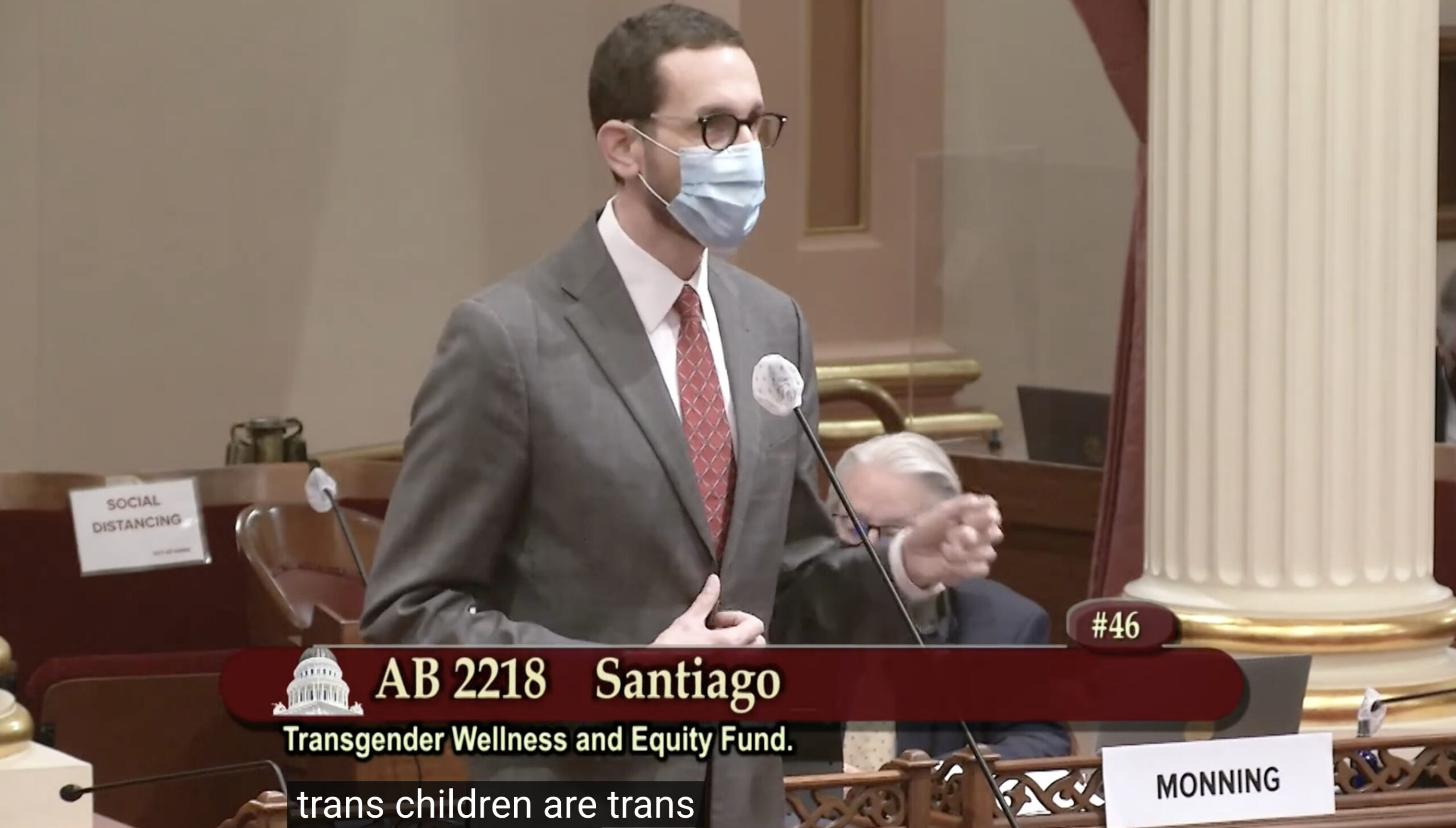
California is about to harm people again, and the dangerous moral narcissist and sexualizer of childhood Scott Wiener is as always leading the way. The state legislature is about to make it more dangerous to tell a self-identified trans kid that he or she wasn’t born in the wrong body.
To understand what’s at stake, start with Jamie Reed. A former medical caseworker and a self-identified “queer woman” with a trans-identifying spouse, Reed believes that transgender identity is real, defensible, and worthy of protection. But she quit her job at a pediatric transgender clinic because the things she saw there were clearly indefensible, even for an advocate of trans identity.
In a much-discussed essay at the Free Press, Reed wrote that her clinic began to see clear signs of social contagion: “Sometimes clusters of girls arrived from the same high school.”
Reed wrote, at length, about the degree to which minors who identified as transgender showed up with mental health problems that ran underneath their declarations about sexual identity: “The girls who came to us had many comorbidities: depression, anxiety, ADHD, eating disorders, obesity. Many were diagnosed with autism, or had autism-like symptoms.”
Despite all those reasons to tread carefully, Reed wrote, the clinic rushed every child declaring a transgender identity straight into the medical pipeline, no questions asked. “To begin transitioning, the girls needed a letter of support from a therapist — usually one we recommended — who they had to see only once or twice for the green light,” she wrote. “The next stop was a single visit to the endocrinologist for a testosterone prescription.”
Even as an advocate of transgender identity, Reed advocated for caution, believing that some young people have real gender dysphoria but many don’t. Social fashion plus depression and anxiety could lead teenagers to a false choice, and careful discussion was required to guide them through their decision: Are you sure about this?
California intends to punish that question, and to punish it harshly. Under the terms of a bill that’s racing through the state legislature, slowing down to talk about a child’s declaration of transgender identity would be categorized as “conversion therapy” and punished for denying a child’s true identity. When a child says I’m trans, the only answer California will accept is here is your prescription for puberty blockers, and let’s get you scheduled for surgery. They’re not just taking away the red light – they also mean to outlaw the yellow light.
Declaring that it’s “psychological torture” to tell a child that he or she may not have been born in the wrong body, Wiener has introduced SB 934, which “allows survivors of conversion therapy to seek civil remedies and justice through malpractice lawsuits for the harm that was done to them, even years after the fake therapy occurred,” substantially expanding the legal deadlines for bringing lawsuits against practitioners.
The bill is strapped to a rocket sled: It moved quickly through Senate committees, passed on the Senate floor, and is now moving quickly through committee hearings in the Assembly.
As it advances, the bill is becoming muddled by its encounter with reality. You can read a series of analyses from legislative staff for yourself, and they identify a legal problem: California is one of many states that already banned “conversion therapy” a long time ago, but the recent Supreme Court decision in Chiles v. Salazar puts that ban at risk. In an 8-1 decision with only an idiot dissenting, the court concluded that Colorado’s ban on conversion therapy “regulates speech based on viewpoint, and the lower courts erred by failing to apply sufficiently rigorous First Amendment scrutiny.” You can’t tell a therapist that they aren’t allowed to say a child wasn’t born in the wrong body, because they have a right to say what they think.
Amending the bill to anticipate legal challenges, the California legislature now proposes to ban “any practices of a licensed mental health provider that seek to direct a patient toward a predetermined sexual orientation or gender identity.” Adopting a supposedly content-neutral posture, the bill in its current form appears to propose that therapists can also be sued for trying to talk children into becoming transgender or gay.
It’s not clear what the bill will look like in its final form, and activists are calling for answers before the legislature wraps up its work and sends it to the governor for a signature. Erin Friday, who leads the parents’ group Our Duty, told The Federalist that Wiener “must clarify whether mental providers who steer a patient toward a transgender identity face the same malpractice liability as those who just affirm a transgender identity.” Friday discussed the bill in detail in a long thread on X:
Many other features of the bill demand a close look from therapists and medical practitioners, including the standard of evidence Wiener proposes to establish in “conversion therapy” lawsuits.
As the most recent legislative analysis says, “the bill specifies that a plaintiff may establish general causation by using expert testimony, scientific literature, or other evidence demonstrating that sexual orientation or gender identity change efforts are capable of causing the type of psychological injury or illness suffered by a plaintiff. Once that general causation is established, the jury may infer specific causation from evidence that the plaintiff was subject to these efforts.”
In other words, a plaintiff doesn’t have to prove specifically that he or she was harmed, but can sue for harm on the general proposition of having received a type of harmful therapy.
Looking beyond therapy, the most recent legislative analysis also notes that the California Baptist Capitol Ministry opposes the bill on the basis of its concerns that pastors may face lawsuits if they “offer counsel consistent with a biblical understanding of human sexuality.”
The unknown effects of this legislation probably outweigh the known effects, but the state legislature appears to be ready to pass the bill so we can find out what’s in it.