
A man who had been onboard the luxury cruise ship stricken by a deadly hantavirus outbreak is being treated in Zurich after developing symptoms following his return to Switzerland.
The outbreak of the rare, rat-borne illness that has a 40 per cent mortality rate has left three people dead and several others seriously ill. The ship remains anchored in the Atlantic off Cape Verde but will eventually dock in the Canary Islands.
The Swiss government said in a statement on Wednesday that the man and his wife had returned to Switzerland at the end of April following a trip to South America.
They had been passengers on board the cruise, but the man only began experiencing symptoms after he returned home.
The Federal Office of Public Health said: ‘After experiencing symptoms of the illness, the patient went to the University Hospital of Zurich. He had previously consulted his family doctor by telephone. He was immediately placed in isolation.’
His wife is currently not experiencing any symptoms, but has been placed in isolation ‘for safety reasons,’ local media has reported.
Authorities are also investigating whether the man has had any recent contact with other people, but have assured that the risk to the general public is low.
The infection of a man in Switzerland comes as the leader of Spain’s Canary Islands expressed his opposition to allowing the cruise to dock on the archipelago, fearing a possible outbreak in the community.
A flight scheduled to evacuate the ship’s sick British doctor to the Canary Islands was cancelled, a source close to the regional presidency told AFP, adding that officials lack sufficient information about the potential risks tied to the ship’s planned arrival in the islands from Cape Verde.
On Wednesday, the president of the Canaries, Fernando Clavijo, told COPE radio station that he had requested an ‘urgent meeting’ with the Prime Minister of Spain, Pedro Sanchez, saying that the decision to allow the cruise ship to dock on Canarian territory was not based on ‘any technical criteria.’

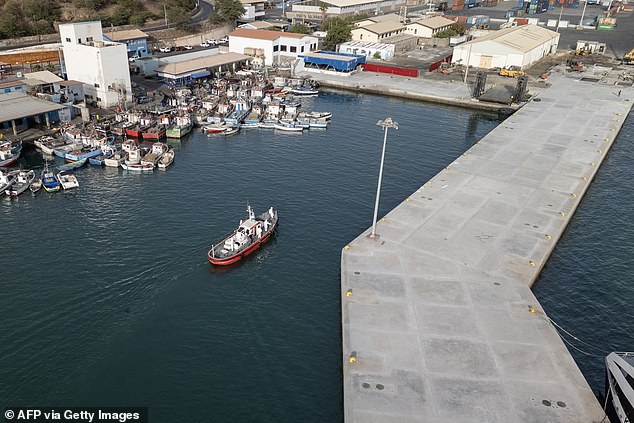
An aerial view of an ambulance boat carrying crew members wearing hazmat suits as they arrive at the port after approaching the pilot door on the starboard side of the cruise ship MV Hondius, while stationary off the port of Praia, the capital of Cape Verde, on May 5, 2026

An aerial view of an ambulance boat carrying crew members wearing hazmat suits as they return to port after approaching the pilot door on the starboard side of the cruise ship MV Hondius, while stationary off the port of Praia, the capital of Cape Verde, on May 5, 2026

Pictured: President of Canary Islands, Fernando Clavijo
He added that there is ‘insufficient information to maintain a message of calm and guarantee the safety of the Canary Island population.’
Clavijo also criticised the Spanish government for its ‘institutional disloyalty’ and lack of professionalism for failing to keep him informed.
He also reproached the Minister of Health, Mónica García, for not providing him with explanations about the criteria followed by the World Health Organisation.
‘I cannot allow it to enter the Canary Islands,’ he insisted.
Earlier on Wednesday, Spanish state broadcaster TVE reported the cruise ship was set to dock at the Canary Island of Tenerife, citing sources from the country’s health ministry.
Following the Canary Islands’ refusal, it was confirmed today that two seriously ill crew members – including the British doctor – were evacuated from the ship, with the WHO chief confirming that ‘the overall public health risk remains low.’
‘Three suspected hantavirus case patients have just been evacuated from the ship and are on their way to receive medical care in the Netherlands,’ Tedros Adhanom Ghebreyesus said on X.
The patients are a 56-year-old Briton, a 41-year-old Dutchman and a 65-year-old German.
The German national will be brought to a hospital in the German city of Duesseldorf for testing, Bild reported on Wednesday, adding that the woman presented no symptoms.
Spain’s health ministry has previously said the ship was due to arrive at the Islands in ‘three to four days’, adding that upon arrival, ‘crew and passengers will be duly examined, cared for, and transferred to their respective countries.’ It is unclear which port the ship will dock at.
The health ministry said the WHO had explained that the Canary Islands were ‘the closest place with the necessary capabilities’ medically.
Cruise operator Oceanwide Expeditions said its plan was for the ship to sail north ‘to the Canary Islands, either Gran Canaria or Tenerife, which will take three days of sailing’.
The MV Hondius has been at the centre of an international health scare since Saturday, when the WHO was informed that the rare disease – usually spread from infected rodents, typically through urine, droppings and saliva – was suspected of being behind the deaths of three of its passengers.

An ambulance boat carrying crew members wearing hazmat suits, returns to the port of Praia, the capital of Cape Verde, on May 5, 2026 after a visit to the cruise ship MV Hondius
As others fell ill, passengers and crew have been in isolation after Cape Verde authorities barred the ship from docking. The ship is anchored just off the island nation’s capital, Praia.
Two specialist doctors in infectious diseases are heading from the Netherlands to the MV Hondius ship, its operator said on Wednesday.
‘Two infectious disease physicians, currently en route from the Netherlands, will embark m/v Hondius and remain with the vessel after its anticipated departure from Cape Verde,’ said Oceanwide Expeditions in a statement.
These doctors would only board the ship following the successful transfer of three people, two of whom are suffering from ‘acute symptoms’, the operator added.
The third person is a close contact of a passenger who died onboard on May 2.
New footage from inside the vessel showed the ship’s decks mostly deserted, with only a few people wearing medical masks moving about.
Common spaces were empty as passengers were isolated in their cabins. At least five people with full protective gear, white overalls, boots and face masks, were seen disembarking from the ship into a small vessel.
Another video shared on social media by Turkish influencer Ruhi Çenet shows the moment the vessel’s crew told passengers someone had died.
Footage shows a crew member saying: ‘One of our passengers sadly passed away last night.’
‘I’m told by the doctor we’re not infectious. The ship is safe when it comes to that.’
But the video then cuts to Çenet telling the camera that ‘the situation was much worse than we were told,’ as he explains that a day after he left the ship, the wife of the person who had died also passed away.
‘After a third person died, it became clear that there was hantavirus on board.’
The Dutch operator Oceanwide Expeditions indicated Tuesday that a solution was in sight, with plans to evacuate two sick crew members to the Netherlands for ‘urgent medical care’, along with a third person who had been in close contact with a German passenger who died on Saturday.
Once the evacuation has taken place, MV Hondius ‘can continue its route’, Ann Lindstrand, the WHO’s representative in Cape Verde, said.
The cruise, which set sail from Ushuaia in Argentina on April 1 destined for Cape Verde and counted 88 passengers and 59 crew members, with 23 nationalities onboard, the WHO said.
One of the dead, a Dutch woman, had left the ship at the Atlantic island of Saint Helena and had flown to Johannesburg, where she died on April 26.
Two hantavirus cases have been confirmed – including in one of the fatalities and a British passenger currently in intensive care in Johannesburg – with five further suspected cases, the WHO said.

Vide grab shows the moment a crew member tells passengers someone died onboard the cruise
What are hantaviruses?

Hantaviruses are typically spread by rodents (file image)
Hantaviruses are a family of viruses which can cause serious illnesses and death.
They are typically spread by rodents and are not normally spread person-to-person.
The viruses can cause two syndromes – hantavirus pulmonary syndrome (HPS) and haemorrhagic fever with renal syndrome (HFRS).
Early symptoms of HPS include fatigue, fever and muscle aches.
Intensive headaches, back pain, nausea and blurred vision are symptoms of HFRS.
Minimising contact with rodents at home, in the workplace, or in a campsite can help reduce the risk of exposure to hantaviruses.
Three of those seven have died; the one in Johannesburg was critically ill, and three still on board had reported symptoms, including one who is now asymptomatic, it said.
The WHO was trying to deduce how hantavirus had appeared on the ship, with the first person who died having developed symptoms on April 6.
Dozens of people are now being traced after they boarded a flight with one of the cruise ship passengers who later died of a rat–borne virus.
A Dutch passenger had left the ship in Saint Helena with ‘gastrointestinal symptoms’ on April 24 and was pronounced dead upon arrival at the emergency department of a Johannesburg hospital.
The WHO said: ‘Contact tracing for passengers has been initiated.’
Airlink operates one flight a week from the island, which takes around four hours.
The South African authorities had asked the airline to notify the passengers that they must contact the health department, a representative said.
According to the UK Government’s hantavirus advice, symptoms typically appear between two and four weeks after exposure, but can range from two days to eight weeks, meaning illness may develop in other passengers in the coming days or weeks.
Around 40 per cent of cases result in death, according to the US Centres for Disease Control.
Early symptoms can include fatigue, fever, muscle aches and intense headaches.
They are not usually spread person-to-person and are typically only transferred via bodily fluids and close contact.
The risk of contracting the illness can be reduced through minimising contact with rodents.
Meanwhile, the UK Government is putting ‘plans in place’ for the onward travel of Britons stuck aboard the cruise ship, the Prime Minister said.
In a post on X, Sir Keir Starmer said: ‘My thoughts are with those affected by the hantavirus outbreak onboard the MV Hondius.
‘We are working closely with international partners to support British nationals on board, and we’re putting plans in place for their safe onward travel.
‘The risk to the wider public remains very low – protecting the British people is our number one priority.’