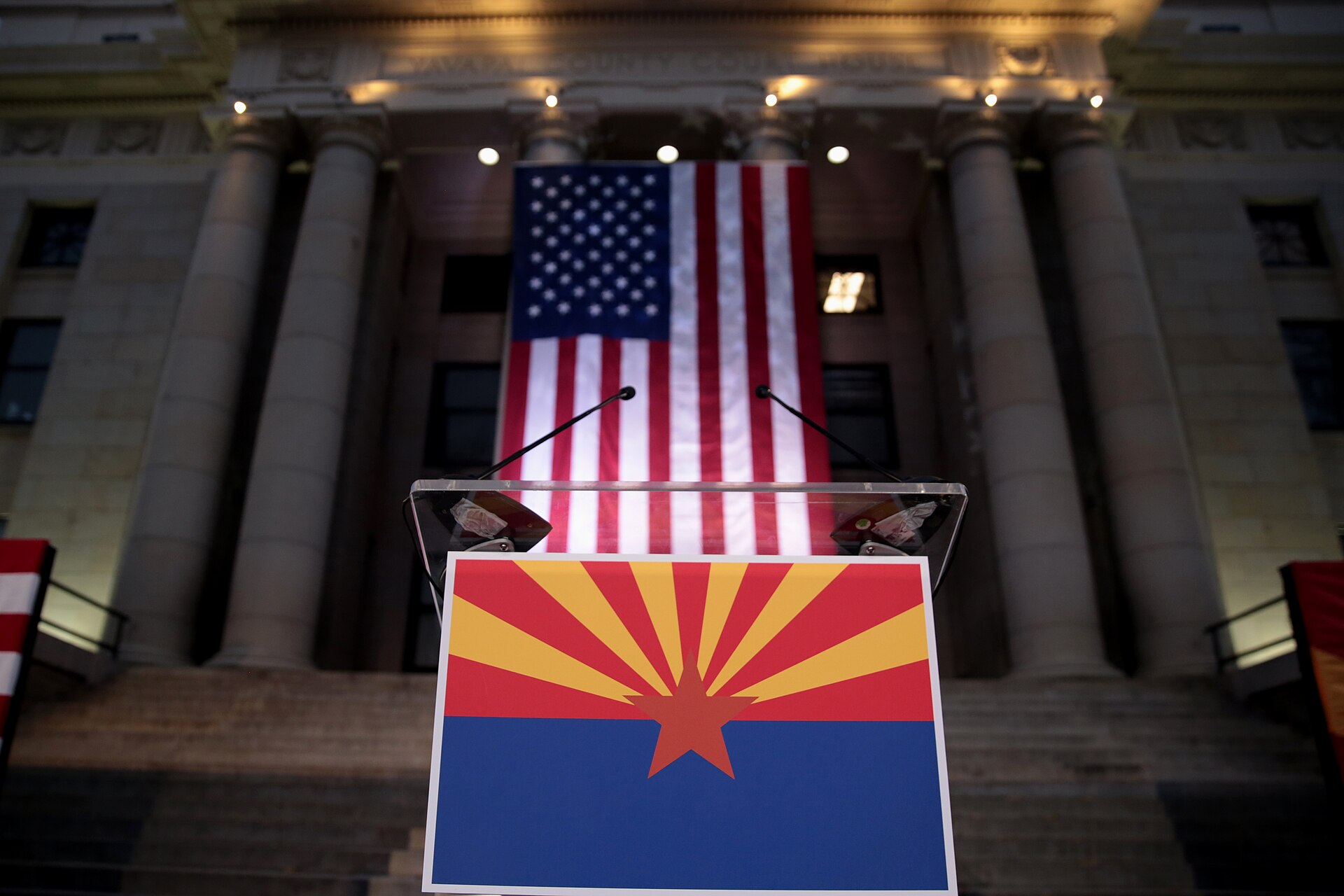

The Trump Department of Justice (DOJ) formally requested on Tuesday that the U.S. Supreme Court resolve a challenge to provisions of Arizona law requiring residents to prove they’re American citizens when registering to vote.
The agency’s request came in the form of a petition for certiorari that asked the high court to take up and hear arguments in a legal dispute over Arizona statutes governing voter registration.
As The Federalist previously reported, the contested provisions mandate residents to show documentary proof of citizenship (DPOC) when registering via state voter registration forms. They also required such proof for individuals submitting mail-in ballots and voting in presidential contests. (In Arizona, individuals who do not provide DPOC when registering to vote are permitted to do so as “federal-only voters” and only cast ballots in federal elections).
The DOJ petition takes aim at a February 2025 ruling by the 9th Circuit Court of Appeals that blocked portions of the laws from taking effect. More specifically, the appellate court panel agreed (2-1) with the district court that the challenged sections violated provisions of the 1964 Civil Rights Act and 1993 National Voter Registration Act (NVRA), which requires state officials to make “a reasonable effort to remove the names of ineligible voters from the official lists of eligible voters.”
The Justice Department asked SCOTUS to address numerous questions pertaining to the NVRA and whether it preempts states like Arizona from “implementing a program to remove noncitizens from its voter rolls within 90 days of a federal election.” The agency further requested that the high court provide definitive answers on whether the NVRA bars states from mandating residents show DPOC when “registering to vote in federal elections using the state registration form” or “from denying individuals who used the federal registration form, which does not require documentary proof of citizenship, the ability to vote by mail.”
The DOJ pointed to the Supreme Court’s partial emergency stay (“pause”) of a lower court block against Arizona’s “commonsense election-integrity measures” ahead of the 2024 election to substantiate its argument that “these policies are not preempted” by the NVRA and that “further review is warranted.” The agency also provided arguments as to why the court should side with it on the questions presented.
“As to the voter-roll question, the NVRA’s restrictions on removing individuals from the list of eligible voters do not apply to noncitizens who were never eligible to register in the first place,” the petition reads. “As to the registration-form question, while the current federal form requires only that applicants attest to their citizenship, the NVRA grants States the flexibility to require on their own forms that applicants supply documentary proof of citizenship.”
The DOJ said that the petition filed by the Republican National Committee (RNC) in the dispute is a better vehicle to address the contested issues than those filed by a group of Arizona legislators and the state. The administration argued that the latter’s’ petitions “raise additional questions that do not warrant this Court’s review at this time,” such as the legislators’ challenge to the 9th Circuit’s holding that the NVRA bars Arizona from mandating voters “who registered using the federal form — and thus without documentary proof of citizenship — to vote in person rather than by mail.”
“But this Court previously denied a stay on this question … and it should not grant certiorari now. The NVRA requires States to ‘accept and use’ the federal registration form … and it is far from clear whether and how States may nevertheless subject federal-form registrants to special voting restrictions,” the petition reads. “Further percolation would be beneficial, as this is a novel question that, to our knowledge, no other courts have addressed because no other States have enacted such laws.”
At least four justices must agree to hear a case before it can be considered by the full Supreme Court.
Shawn Fleetwood is a staff writer for The Federalist and a graduate of the University of Mary Washington. He is a co-recipient of the 2025 Dao Prize for Excellence in Investigative Journalism. His work has been featured in numerous outlets, including RealClearPolitics and RealClearHealth. Follow him on Twitter @ShawnFleetwood