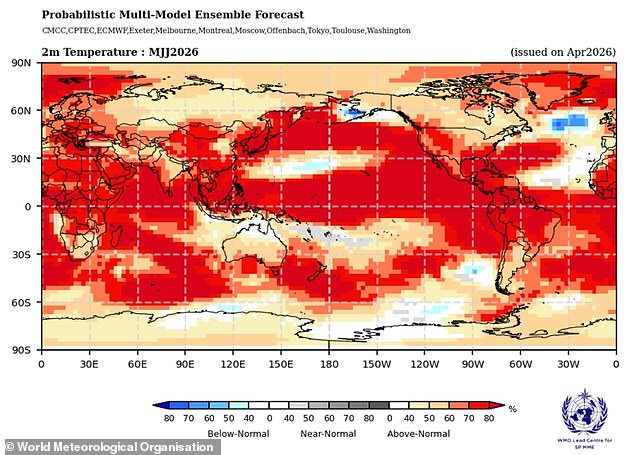

El Niño has arrived and weather experts fear the global climate phenomenon may be primed to match a deadly event that led to the deaths of more than 50 million people.
The National Oceanic and Atmospheric Administration officially declared on Thursday that ocean conditions have warmed to the point where an El Niño event is active and will likely continue well into 2027.
El Niño is a natural climate pattern where warmer-than-usual water in the Pacific changes weather patterns around the world for several months at minimum.
In their official advisory, NOAA stated: ‘El Niño conditions are present and expected to strengthen into the Northern Hemisphere winter 2026-27.’
The declaration means NOAA’s Climate Prediction Center has found that sea surface temperatures are at least +0.9°F above average and are expected to stay that way for the foreseeable future.
Climate scientists fear this frequent weather event will become a ‘Godzilla’ or ‘Super El Niño’ by the end of the year, meaning sea surface temperatures rise to 3.6°F above normal or even higher – which NOAA classifies as ‘strong.’
On Thursday, NOAA confirmed those fears, stating that there is a 63 percent chance of El Niño becoming ‘very strong’ between November 2026 and January 2027.
Climate officials added that this El Niño will likely be one of the strongest since 1950, and there is a fear it could match an El Niño event from 1877, which triggered severe droughts and crop failures around the world, contributing to more than 50 million deaths globally.
This is a breaking story. More details to follow.

Scientists warn that a so–called ‘super El Niño’ could push global temperatures (pictured) to record–breaking highs
Many climate historians think the 1877 event reshaped world history and some consider it one of the first ‘truly global climate disasters.’
Just a 4.86°F increase in sea surface temperatures in the Pacific Ocean wreaked havoc across several continents.
Parts of Africa, Southeast Asia and Australia experienced severe drought and forest fires. India saw its normal monsoon rains disappear, while Northern China suffered devastating dry spells that led to harvest failures. In Brazil, rivers dried up and agriculture collapsed.
There were also outbreaks of malaria, plague, dysentery, smallpox and cholera across already weakened populations.
Researchers have estimated that the resulting scarcity of food and disease outbreaks killed up to four percent of the Earth’s population at the time. That would be the equivalent of at least 250 million people dying if El Niño caused that to happen today.
Thursday’s announcement revealed that the area of the central Pacific where scientists actively monitor sea surface temperatures for El Niño was 1.3°F above normal – breaking the El Niño threshold of 0.9°F.
However, NOAA also revealed that ocean waters in eastern Pacific have already risen to 3.8°F above average.
This pattern, where warmer water is detected in the east, is typical when a strong El Niño is developing.

Pictured: Drought-stressed wheat plants near parched ground in a field in Kansas. Scientists fear El Niño will lead to more droughts, especially in the northern US

El Niño often disrupts global rain patterns, making the climate wetter in the southern US and drier in the north (Stock Image)
In the US, El Niño has a major impact on the natural jet stream which flows from west to east over the middle of the country.
As El Niño heats up the Pacific, this pushes that jet stream farther south, so it flows over the southern and Gulf states.
This brings wetter weather to the South, drier weather to the Midwest and warmer weather to the Pacific Northwest and Northern Plains.
Deepti Singh, associate professor at Washington State University, told the Washington Post: ‘Simultaneous multiyear droughts similar to those in the 1870s could happen again.’
‘What is different now is that our atmosphere and oceans are substantially warmer than they were in the 1870s, which means the associated extremes could be more extreme.’