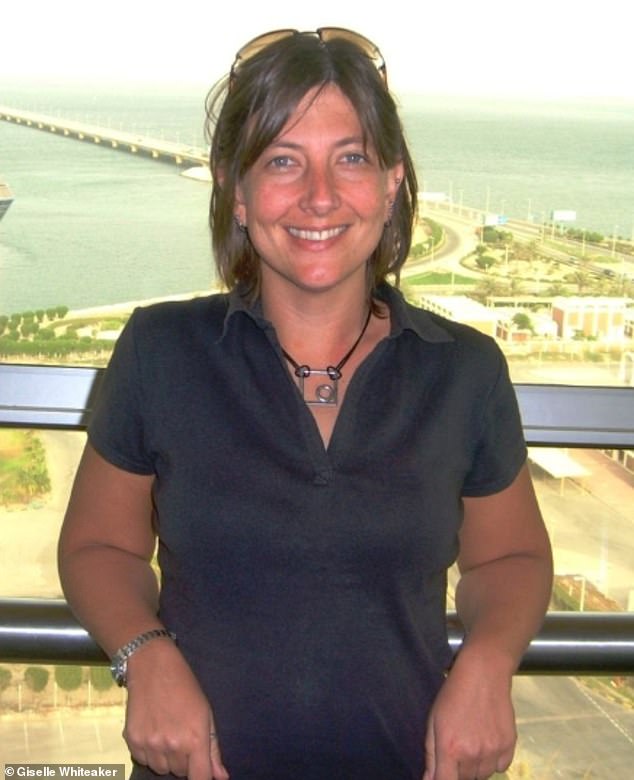

A woman has revealed how she managed to pay off her first home by the age of 37 using a little-known mortgage plan.
Giselle Whiteaker, 54, purchased her first property in Australia in the late 90s when she was just 25, and paid it off 12 years later using an offset mortgage.
An offset mortgage essentially links your savings account, or in some cases your current account, to your mortgage with the same bank.
When you make a payment on your mortgage, the amount is ‘offset’ by the balance of your savings account, and the interest is calculated on the difference between the two.
For example, if you had £200,000 and £20,000 in your linked savings account. you will only pay interest on £180,000 of the mortgage.
‘I bought my first property at the tender age of 25 without a lot of foresight,’ Giselle told the Daily Mail.
‘We’re told that buying a property is a big investment that should be thoroughly researched and planned. When I bought my first home, I completely disregarded that advice.
‘At 54 now, I’m a little more fiscally cautious, but I managed to pay that first mortgage off early without compromising too much on my lifestyle, so perhaps it wasn’t a bad thing.
‘Despite being Australian, my property journey started in Japan, in the late 90s, straight after graduating from university.

Giselle Whiteaker (pictured), 54, from Australia, managed to pay off her first home by the age of 37 with an offset mortgage

Giselle purchased her first home (pictured) in Australia when she was 25 – after receiving a ‘little pot of money’ from her Japanese pension scheme
‘I was accepted into the Japan Exchange and Teaching Programme (JET), an initiative run by the Japanese government that sees graduates of any discipline placed in roles across Japan to foster international exchange.
‘I spent three character-forming years as an assistant English teacher and a local curiosity in Hokkaido, scoffing ramen, learning to speak passable Japanese and earning around £20k per year, which felt like a fortune.
‘When I left Japan to move to Korea, the stars aligned to hand me a little pot of money, equivalent to about two months of my salary.
‘There was a legal and bureaucratic shift around pensions, with the Japanese government formally allowing foreign residents to reclaim pension contributions after leaving the country.
‘So there I was, 25 years old, handed an unexpected bank balance. I’d like to say I thought long and hard about what to do with it, but that wouldn’t be entirely true.’
Before starting her next adventure, Giselle moved back home to Australia for two weeks, where her mother advised her to spend her newfound savings on a property.
She explained: ‘Between moving from Japan to Korea, where I was going to earn significantly less, but it was cheaper to live, I spent two weeks at home, and my mother pointed to the property ladder.
‘Ever obedient, I started looking to climb it. I perused printed property listings – this was well before the rise of Zoopla and Rightmove, or in fact, the internet – and found a one-bedroom, two-storey terraced cottage where the owner was in a property chain and needed a quick sale.

When Giselle moved to Korea, she gave her mother Power of Attorney so she could finalise the paperwork and secure a tenant for the property

Giselle purchased the one-bedroom, two-storey terraced cottage where the owner was in a chain and needed a quick sale – and paid the mortgage of 12 years later

Whiteaker has since purchased her next property (pictured), also in Australia, which came with a £340,000 price tag
‘They snapped up my middle-of-the-range offer of £35,000, and I scraped together just enough with the pension refund and my savings to cover the 10 per cent deposit and associated fees.
‘It was so tight that I refused to pay the £10 banker’s draft fee, withdrawing the funds in cash and running them across the road in person to the real estate agent.
‘Before I knew it, I owned my first home. Now I just had to pay for it.
‘When I told my bank I was hoping to pay the mortgage off before the end of the term, they recommended an offset mortgage. These weren’t common, but the way they explained it made sense.’
‘Off I went to Korea, giving my mother Power of Attorney so she could finalise the paperwork and quickly secure a tenant before the property started costing me too much.’
Giselle then slowly started building up the amount in her savings account, as the greater the balance, the greater the benefit of an offset mortgage. Unexpected windfalls and extra cash left over at the end of the month went straight into her linked account.
‘I set the repayments at the minimum level, around £225 per month, but over the next two years, whenever I accumulated savings of £200 or more, I transferred the funds into the offset account. The rental income that was above the mortgage repayment amount (less than £100 per month) also went into offset.
‘I didn’t make any big purchases after this. The house was it. It helped that the cost of living was quite low in Korea.
‘I had a second-hand scooter instead of a car, which was cheaper to run. I cooked at home most of the time, prepared my lunches to take to work, and ate cheap street food when I was out. I found ways to travel cheaply, and I had a whole new low-cost country to explore.
‘After Korea, my partner and I moved into the property for a few years. He had his own home and mortgage in Glasgow, so before we cohabited, we sat down over a glass of wine and negotiated how we were going to make this work in an equitable way.
‘We agreed to keep our finances separate and as long as we were residing in it, treat my property as a rental, splitting household bills and payment of an agreed slightly-below-market-value “rent”.
‘This was a win-win: cheaper than us paying rent elsewhere, cheaper for me than paying rent alone, and all the while, my mortgage was steadily decreasing.
‘We planned to work overseas again at some point, so I bought the furniture with the idea that it could stay in the property when we left, giving me the potential for a higher rental yield with a furnished property.
‘That’s not quite the way it turned out – a few years later, we cordially went our separate ways. There were no arguments over who owned what, which was a win in itself. I went back to Japan, then on to Dubai, my income increasing exponentially, meaning more money going into offset.
‘Within 12 years, nine of which I spent overseas, the offset covered the mortgage balance, with less than £150 left owing.
‘I was paying a minuscule amount of interest, with the monthly repayments coming from the offset savings.
‘The mortgage was practically paid off, in that I could have closed the mortgage and taken full ownership at age 37.
‘I chose not to. Instead, knowing I could draw the decade or so of savings out of the offset if kept the account open, I retained it as my single person’s financial back-up plan. This gave me freedom.
‘It was there in 2009, when I was made redundant in Dubai during the Global Financial Crisis. It was there when I worked part-time and travelled for five months between visas. It was there when I went back to study and had a limited income.
‘In the end, I didn’t ever need to dip into it. But I liked knowing I could.
‘Around five years ago, the time finally came. I closed the loan account and became a mortgage-free homeowner.’
But not for long, and almost 30 years after her first investment, Giselle purchased her next property for £340,000.
She said: ‘There are probably smarter ways for the financially savvy to buy and finance property, but I’m not one of them.
‘I’m just good at living within my means and saving when I can. So once again, I have an offset mortgage. I’m sure I’ll pay it off early.
‘When my friends ask – and sometimes when they don’t – I recommend they look into an offset mortgage.
‘It may not be the most common way to finance a property, but for anyone like me who doesn’t have a finance brain, but wants to be debt-free sooner, it’s worth considering.’