Late one Friday afternoon in March last year, the curtain in the ‘witness room’ of South Carolina’s state execution chamber opened to reveal convicted murderer Brad Sigmon strapped to a chair.
A large metal basin had been fitted underneath it to collect his blood and he was dressed all in black to hide the bloodstains that would soon soak through his clothes.
With straps around his ankles, lap, waist and even his chin, he could barely move an inch. A black-and-white target had been Velcroed to his clothes over his heart.
A black hood was then placed over his head, before another curtain was pulled back to reveal three square gun ports cut into a wall 15ft away from him. Standing behind each was a volunteer prison guard holding a loaded rifle.
Without any countdown, they suddenly fired together, the three special bullets -designed to fragment as much as possible on impact – opening up a fist-sized hole where his heart once was. Sigmon, 67, was pronounced dead three minutes later.
He had been sentenced to death for murdering his ex-girlfriend’s parents, David and Gladys Larke, with a baseball bat in 2001.
He’d had the dubious privilege of becoming the first US death row inmate in 15 years to be executed by firing squad, choosing it over lethal injection and the electric chair. Sigmon didn’t pick the chair because it would ‘burn and cook him alive’, said his attorney Gerald King, adding that lethal injection was ‘just as monstrous’.
Convicted Alabama murderer Kenneth Eugene Smith, on the other hand, became the first American prisoner ever to be executed by nitrogen asphyxiation in 2024. Two years earlier, three executioners had spent 90 awful minutes trying to kill him by lethal injection but had given up after they couldn’t find the two veins they needed.

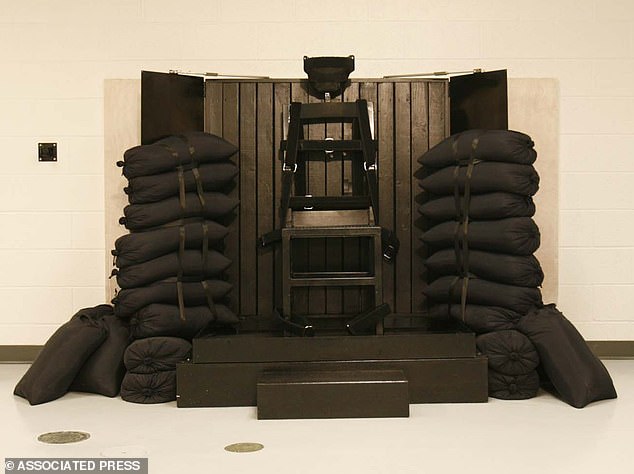
Pictured: The execution chamber at Utah State Prison where prisoners are executed by firing squad

Pictured: The gas chamber at San Quentin State Prison in California
When I interviewed him a few months before he died, Smith, who had languished on death row for three decades, said he was ‘terrified’ at the prospect of being executed a second time and felt he’d been punished enough.
His protests were in vain. He was strapped to a bed wearing a full-face mask that forced pure nitrogen into his lungs. Witnesses said he thrashed violently in panic and terror before losing consciousness, suffocating some five minutes after the deadly gas began to fill his airways.
An autopsy later revealed that his lungs had been flooded with ‘dark maroon blood’ – a sign of a so-called ‘negative-pressure pulmonary edema’. Experts believe that, because he hadn’t been sedated, he automatically panicked when he couldn’t breathe.
The authorities had given both Smith and Sigmon the grim choice of how they would die and both rejected lethal injection – for decades America’s de facto execution ‘protocol’.
Now many more death row residents face the same grisly decision. Donald Trump’s administration has just revealed plans to add firing squads, nitrogen gas and electrocution as permissible ways of executing people convicted of the most serious federal crimes.
Some US states already have these alternative execution methods on their books to punish state crimes but rarely use them.
The President, who has reportedly even mused about broadcasting executions live, is keen to expand not only the methods available but also the number of criminals meeting their end in these ways.
To some, this will signal a chilling return to a more barbaric age. To others, it is merely fitting retribution for the worst of the worst criminals.
Trump has long been an enthusiast for the ultimate sanction. In the final six months of his first term, he hastily signed the death warrants of 13 federal inmates by lethal injection – more than had been executed by the previous ten presidents combined.
His successor, Joe Biden, then placed a moratorium on federal executions, commuting (or reducing to life imprisonment) the death sentences of all but three of the 40 people on death row. (The remaining trio were 2013 Boston Marathon bomber Dzhokhar Tsarnaev; Dylann Roof, convicted in 2016 of killing nine black worshippers at a South Carolina church; and Robert Bowers, who killed 11 people at a synagogue in Pennsylvania in 2018.)

Pictured: Members of the press during a tour of the Lethal Injection Facility at California’s San Quentin State Prison

Former Death row inmate Brad Sigmon (pictured) who was executed by firing squad in March last year
Trump is not quite so merciful, and a new report from the Department of Justice (DoJ), which ultimately reports to him, not only says that it is clearing the way for firing squads, electrocutions and lethal gas for federal crimes but, with many death row cases taking decades to complete every permissible appeal, it is intent on ‘streamlining internal processes’ to ‘expedite’ the killings.
Trump has reportedly even considered trying to introduce the guillotine (which has never been used in the US), hold ‘group executions’ and ‘mused about televising footage of executions, including showing condemned prisoners in the final moments of their lives’, according to Rolling Stone magazine.
A White House official said: ‘He [Trump] had a particular affinity for the firing squad, because it seemed more dramatic, rather than… putting a syringe in people and putting them to sleep’, adding that the ‘eye-for-an-eye’ President enjoyed fantasising publicly about ‘lining up criminals and drug dealers before a firing squad’.
At a campaign rally in 2022, Trump won roars of approval when he suggested copying hardline leaders in China, Iran – and, it might be added, Nazi Germany – in sending the executioner’s bullet to the condemned’s family along with a bill for it.
Trump also considered a ‘flashy, government-backed video ad campaign that would accompany a federal revival of these execution methods’, including ‘footage from these new executions’, said Rolling Stone.
An administration official said: ‘The President believes this would help put the fear of God into violent criminals.’ A Trump spokesman denied the claim. The law as it stands is messy, patchy and inconsistently applied.
It’s further complicated by the fact that some capital crimes are federal offences, over which Trump and the DoJ have jurisdiction, and others are state offences.
Some 27 states theoretically carry out capital punishment, although six of them have passed moratoriums on the practice. Nine US states authorise the electric chair, nine permit death by gassing, five allow inmates to be executed by firing squad, while three states allow hanging – a method that went out of fashion in America in the 19th century.
The 48-page DoJ report stresses that the move to expand execution methods for federal crimes has been driven by difficulties obtaining the drugs needed for lethal injections – which remain by far the most common execution method in the US, authorised in all death penalty states.

Death row inmates from left to right: Robert Bowers, the gunman who massacred 11 worshippers at a Pittsburgh synagogue in 2018, Dylann Roof who commited racist slayings of nine members of a Black South Carolina congregation and Dzhokhar Tsarnaev, convicted for carrying out the April 15, 2013, Boston Marathon bombing attack

An artist’s impression of the execution of Louis XVI by guillotine on January 21 1793 during the French Revolution. President Trump has reportedly considered trying to introduce the guillotine (which has never been used in the US), to hold ‘group executions’
Officials have been struggling to get hold of the drugs because activists have been putting pressure on manufacturers, including in Europe, who often didn’t know their products were being used in this way. The suppliers include a small London firm, Dream Pharma, which supplied drugs to the Arizona Department of Corrections.
Certainly, when people hear about how lethal injection actually works, many might prefer to perish another way.
Opponents say it has the highest rate of ‘failed’ executions – 7.2 per cent compared with 5.4 per cent for gas, 1.9 per cent for electrocution and 0 per cent for firing squads.
The procedure typically involves the inmate being strapped to a bed and two large needles (one a back-up) puncturing their arm.
The needles are connected to long tubes running through a hole in a cement-block wall to several intravenous drips filled with the drugs in an adjacent room.
At the warden’s signal, a curtain is raised so witnesses can watch the execution unfold.
Commonly, a cocktail of three drugs is used: first to render the inmate unconscious, then to stop them breathing and finally to stop their heart. It sounds like a peaceful way to go – but campaigners have flagged numerous examples of horribly botched procedures during which the condemned have been left writhing around in ‘excruciating pain’ for hours.

Kenneth Eugene Smith (pictured) became the first American prisoner ever to be executed by nitrogen asphyxiation in 2024

Pictured: The gallows at a Vienna Regional Court in 1964. Although three US states allow hanging it is a method that went out of fashion in America in the 19th century
Many of these episodes are the result of using under-trained prison staff to inject the drugs because doctors typically refuse to do so on ethical grounds. If the executioner injects the drugs into a muscle instead of a vein, or if the needle becomes clogged, the agony can be prolonged before death finally comes. Many prisoners have damaged veins from previous intravenous drug use, often making the search for a vein slow and difficult.
The first Trump administration tried to get around the drug shortages by injecting inmates with an overdose of pentobarbital, a sedative often used to euthanise pets, although lawyers claimed inmates could suffer a painful breathing condition where fluid floods the lungs.
Critics insist that Trump’s desire to accelerate executions and introduce new ways of carrying them out reflects an administration driven by ‘bloodlust’.
Support for capital punishment has been declining in the US, although 52 per cent of Americans still back it, according to the Death Penalty Information Centre. A string of overturned convictions and botched executions have prompted accusations that Trump is using inmates’ lives as a political football, and statistics suggest that, since 1973, some 2.2 per cent of people sentenced to death have later been exonerated.
Matt Wells, deputy director of anti-death-penalty group Reprieve US, said the DoJ report highlights the administration’s ‘determination to execute at all costs. They don’t care how they do it. This report opens the door to a whole range of appalling methods’.
Experts have argued that Trump’s ‘favourite’ method – firing squad – may, somewhat ironically, be by far the most humane. Doctors say that almost everyone shot in the heart loses consciousness in seconds.
In 2010, Deborah Denno, a law professor at New York’s Fordham University who had studied various execution methods, called the firing squad a ‘dignified execution’ despite ‘its brutal image and roots’.
Four years later, Court of Appeals judge Alex Kozinski echoed that view, adding that while the guillotine was ‘probably best’ [that is, most reliable], it was ‘inconsistent with our national ethos’.
‘The firing squad strikes me as the most promising,’ he said. ‘Eight or ten large-calibre rifle bullets fired at close range can inflict massive damage, causing instant death every time. There are plenty of people employed by the state who can pull the trigger and have the training to aim true.’

America’s last recorded botched execution by firing squad dates all the way back to 1879, when Utah riflemen missed murderer Wallace Wilkerson’s (pictured) heart entirely

Pictured: The nitrogen mask execution chamber at Louisiana’s State Penitentiary
Indeed, America’s last recorded botched execution by firing squad dates all the way back to 1879, when Utah riflemen missed murderer Wallace Wilkerson’s heart entirely. He hadn’t been tied down and stiffened at the last moment, dislodging the target pinned to his chest.
Wilkerson reportedly leapt up, screaming: ‘Oh my God! They’ve missed it!’ and then took 27 minutes to die. Anti-death-penalty campaigners claimed that sadistic shooters missed his heart on purpose to prolong his agony.
Utah has since attempted to prevent similar mishaps by ensuring the inmate’s head is immobilised by a strap and the chest, shins and arms similarly held in place. Sandbags are stacked around the chair and wooden boards erected behind it to prevent the bullets from ricocheting around the room. Ceiling lights glare down on the prisoner to further guide the riflemen’s aim while a small square of white cloth, bearing a black target, is placed over the heart.
In Utah, one of the Winchester rifles used by the firing squad is usually loaded with a wax round so nobody knows if they fired a fatal shot. (Experienced shooters insist they can tell the difference as a dummy round produces less recoil.)
Until Brad Sigmon was shot dead last year in South Carolina, the firing squad had been used only three times since 1976 and always in Utah. Many dismissed it as barbaric and even a former Utah governor, Gary Herbert, conceded it was ‘a little bit gruesome’.
Killer Gary Gilmore, the first person to be executed after the reinstatement of the death penalty in 1976, famously growled ‘Let’s do it’ before he was shot by a firing squad in 1977. His words are said to have inspired the creator of the Nike slogan ‘Just do it’.
The US remains the only country in the world to retain the use of the electric chair, or ‘Old Sparky’, but South Carolina is the only state that still prefers it as the default execution method.
The inmate is usually shaved and strapped to a wooden chair. A metal electrode in the shape of a skullcap is attached to the scalp, another to an ankle. The inmate receives a blast of up to 2,000 volts for 30 seconds and, if their heart is still beating, another one.
Although death should be almost instantaneous, it is a notoriously grisly spectacle – sometimes with flames leaping from the condemned’s mask-covered head as their overheating body swells and turns scarlet. Experts say it isn’t painless, either, because the current sends the muscles into uncontrollable and agonising spasms.

The execution room at the Oregon State Penitentiary. The west coast state has not carried out an execution since 1997
Nine states permit inmates to be gassed. Before the introduction of nitrogen, the condemned were usually dispatched by having a pail of sulphuric acid placed under the execution chair, with crystals of sodium cyanide then released into the pail. The prisoner slowly loses consciousness as they breathe in the gas and eventually die from hypoxia, the cutting off of oxygen to the brain.
Experts say it is unquestionably painful and nerve-racking, comparing it to the experience of having a heart attack. A former prison warden recalled: ‘At first there is evidence of extreme horror, pain and strangling. The eyes pop, the skin turns purple and the victim begins to drool.’
And as for the time-honoured tradition of permitting inmates to choose their last meal, this hasn’t survived the attention of money-conscious officials. In Oklahoma, the cost is now limited to $25 (£19), compared with $40 (£30) in Florida.
In 2011, Texas – by far the biggest executioner of any state – stopped the practice after racist killer Lawrence Russell Brewer requested a vast feast including two chicken fried steaks, a triple-meat bacon cheeseburger, three fajitas, a ‘meat lover’s’ pizza, a pint of ice cream and peanut butter fudge. He didn’t eat any of it.
Then again, who would have much of an appetite nowadays when facing the daunting execution alternatives on offer in Trump’s America?