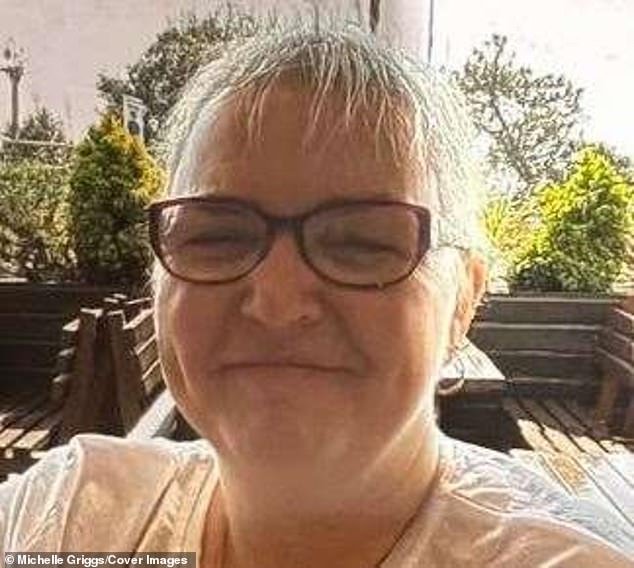

A single mother diagnosed with cervical cancer has urged women not to ignore unusual symptoms after initially dismissing her own as the menopause.
Michelle Griggs, 50, began experiencing unusual bleeding, aching joints and night sweats in June 2024, with symptoms worsening over the following two months.
After searching online, the social club manager from Folkestone, Kent, became convinced the changes were linked to menopause – particularly as she had attended regular smear tests and had been given the all-clear just months earlier.
But after visiting her GP as a precaution and undergoing several scans, Ms Griggs was told she had stage one cervical cancer at Kent and Canterbury Hospital.
She said: ‘I, like everyone else, figured maybe it was menopause because I was about that age. I really thought it was the menopause, because everything matched what I had read online.
‘I had a scan, and when I called the next day to see if the results were back they asked me to pop in, so immediately I knew it wasn’t going to be good news.
‘I remember leaving that appointment feeling really dazed, it didn’t really sink in.
‘It was a total shock because I had been having my smears regularly and I just didn’t think of that. I left in disbelief.’

Michelle Griggs, 50, began experiencing unusual bleeding, aching joints and night sweats in June 2024, with symptoms worsening over the following two months
Cervical cancer affects the cervix – the opening to the womb – and is almost always caused by long-lasting infection with certain types of human papillomavirus (HPV), a very common virus spread through sexual contact.
Worldwide, it is the fourth most common cancer in women, with around 660,000 cases and 350,000 deaths each year.
In the UK, about 3,000 women are diagnosed annually and around 850 die, while in the US there are roughly 14,000 new cases and 4,000 deaths each year.
Warning signs can include unusual vaginal bleeding, pain during sex, pelvic pain or unusual discharge, although early stages often cause no symptoms at all.
Treatment depends on how advanced the cancer is and can include surgery, radiotherapy and chemotherapy.
In the UK, women aged 25 to 64 are invited for cervical screening every five years, which now checks for high-risk HPV, while in the US screening usually begins at 21 using smear tests, HPV tests or both.
Crucially, the HPV vaccine has already led to huge drops in infections and early cell changes, with studies showing cervical cancer rates falling by up to 90 per cent in vaccinated women – making it one of the most preventable cancers if screening and vaccination are taken up.
Ms Griggs underwent an intensive course of chemotherapy, radiotherapy and brachytherapy – a form of internal radiotherapy where small rods containing radiation are placed near the cervix.

Cervical cancer is almost always caused by long-lasting infection with certain types of human papillomavirus (HPV), a very common virus spread through sexual contact

Cervical cancer symptoms to look out for include unusual vaginal bleeding, pain during sex and lower back or pelvic pain.
Her treatment included two months of radiotherapy, five days a week, which caused her to lose her eyebrows, eyelashes and most of her hair.
Ms Griggs said continuing to work where possible and relying on close friends helped her through the toughest months.
She said: ‘I was able to still go in to work and do the admin bits which kept me going. You need something. I think if I just sat indoors all the time it would have just eaten away at me.
‘It helped me to have a positive attitude and mindset, and I was so lucky to have a really supportive network around me.
‘I have got some really good friends who stayed with me. You do really find out who your friends are when you’re going through something like that.’
Ms Griggs was given the all-clear in September 2025, marking the milestone with lunch and cocktails. She will now have regular check-ups to ensure the cancer does not return.
She said: ‘I still get a bit tired sometimes depending on what I am doing. I can’t walk as fast as I used to. But apart from that I haven’t really had any long-term side effects at the moment.
‘My eyelashes and my eyebrows grew back, and I had my first haircut in December.’

In the UK, women aged 25 to 64 are invited for cervical screening every five years, which now checks for high-risk HPV, while in the US screening usually begins at 21 using smear tests, HPV tests or both
Now backing Cervical Cancer Awareness Month, Ms Griggs is urging women to attend smear tests and seek medical advice if anything feels unusual.
She also praised Macmillan for the support she received throughout her treatment, including help with travel costs and finances.
She said: ‘Obviously when people go to have smears it is not a very nice experience, but it is definitely worth going and putting yourself through those 15 minutes of not very niceness.
‘If you feel any change or see any change go straight to the doctors to get it checked out, even if it is something silly, it is still worth it.
‘Macmillan are really good. Being a single parent who can’t work anymore I needed help with finances, and they let me know what help I could get. Don’t be ashamed to ask for help.’