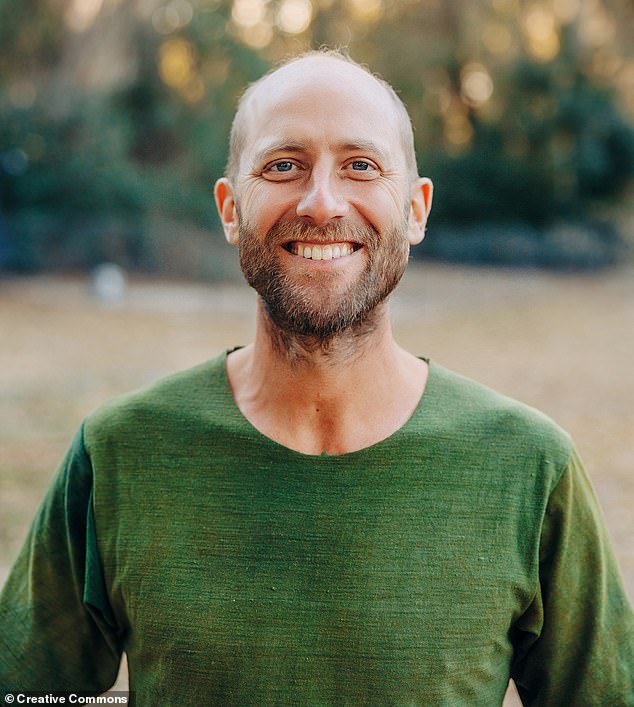
When Robin Greenfield was 25 years old, he set a goal for himself to become a millionaire by the time he was 30.
He was earning a high salary while running a marketing company and was ‘quite on track’ to achieve that.
His life consisted of expensive dinners out as well as endless parties and lavish purchases. But flash forward to now, over a decade on, and his life looks very different.
Greenfield, 39, from Ashland, Wisconsin, ultimately left it all behind, quitting his job and moving into an old sauna with no electricity or running water.
In 2011, after realizing how much ‘destruction’ he was causing to the earth, he decided to leave the ‘typical American lifestyle’ behind and set out on a journey to live more ‘simply and sustainably.’
He made a lifetime commitment to earn less than the federal poverty threshold, which is $15,960 annually, and left his high–paying corporate position.
He now forages all of his own food, eating various fruits, vegetables, grains, mushrooms and fish; he has no car or phone, relies on a well to get water, bathes in lakes or rivers – he once went 1,000 days without showering – and uses leaves as toilet paper.
Greenfield has lifted a lid on his unusual lifestyle exclusively with the Daily Mail, revealing both the highs and lows of living ‘simply and sustainably,’ as well as the drastic measures he has to take to complete daily tasks like getting clean and using the bathroom.

Robin Greenfield, 39, from Ashland, Wisconsin, has no job and lives in an old sauna with no electricity or running water

The sauna is insulated, which helps keep it warm, but getting through the cold Wisconsin winters isn’t easy with no heat or electricity
‘In 2011, I was living a fairly typical American lifestyle. I was very focused on material possessions and financial wealth,’ he explained.
‘I was happy and healthy, I had meaning, purpose, romance, friendship – I [thought I] was living the exact life I wanted to be living in many ways.
‘But then I realized I wanted to radically transform my life. I learned the way that I was living was causing incredible destruction to the earth.
‘I was living a life full of exploitation, oppression and destruction. I started to watch documentaries and read books … I realized I was wrapped up in this deep web of consumerism.
‘I decided that I was going to one step at a time transform my life and try to live in more harmony with earth, with my fellow humanity and with the plants and animals, and really take responsibility for my own actions to become the change I want to see in the world.’
Greenfield started by setting a goal of 100 changes that he wanted to make in two years, which included things like eating more locally produced and minimally processed foods, ditching all single–use plastic and paper bags, carrying a reusable to–go container when eating out and taking any uneaten food home with him and harvesting rainwater, amongst other things.
He also began dumpster diving and ‘eating food that was being wasted,’ making his own personal care items such as toothpaste and body moisturizer, and using herbal remedies instead of pharmaceuticals.
‘I took my life back one step at a time. It’s been a journey of 15 years now and there’s still changes I’m making today,’ he reflected.

When Greenfield was 25 years old, he set a goal for himself to become a millionaire by the time he was 30. He was earning a high salary while running a marketing company and was ‘quite on track’ to achieve that. He’s seen during college

In 2011, after realizing how much ‘destruction’ he was causing to the earth, he decided to leave the ‘typical American lifestyle’ behind and set out on a journey to live more ‘simply and sustainably’ (pictured recently)
In 2016, he bought his first ‘tiny home,’ a 50–square–foot structure in San Diego, California, and in the summer of 2025, he moved into a friend’s sauna, where he lives now.
The sauna is insulated, which helps keep it warm, but getting through the cold Wisconsin winters isn’t easy with no heat or electricity.
He uses heated stones to warm his bed. He cooks over a wood stove and has an outdoor ‘compost toilet’ – a waterless toilet that uses aerobic decomposition to break down human waste into fertilizer or safe compost.
‘I committed to a year of not using a flush toilet and I’m six months in. I carry a bucket with me when I’m traveling and bring my poop with me to a compost toilet or bury it in the woods in a totally hygienic way,’ he shared.
‘I rarely ever shower, I once went [1,000 days] without showering. Instead, I bathe in the natural waters – in lakes and rivers.
‘There’s no running water [in the sauna] but there is a well that has running water on the property that I use.
‘There’s electricity on the property, but none in my actual home. In my ideal world, I would have no electricity at all but I am accessible to electricity [on the property].
‘I do not have a phone, I got rid of it in 2015, I just have a computer. I charge that with the electricity on the property. At night I use a small solar lamp and candlelight.’

He cooks over a wood stove and has an outdoor ‘compost toilet’ – a waterless toilet that uses aerobic decomposition to break down human waste into fertilizer or safe compost

He uses leaves as toilet paper, seen here


He eats fruits like ‘apples and blackberries and blueberries’ as well as ‘unusual plants like cattail pollen and puffball mushrooms and wild rice’
Last year, he set a goal of foraging 100 percent of his food and medicine for a year, which he is now six months into.
‘Everything I need, I am harvesting from the land. I do this through a lot of knowledge and skills. I have a lot of relationships with the plants and animals that allows me to meet my basic needs while being harmonious to the earth,’ Greenfield said.
He eats fruits like ‘apples and blackberries and blueberries’ as well as ‘unusual plants like cattail pollen and puffball mushrooms and wild rice.’
He has no car – instead, he uses a bicycle to get around – and barely has any money.
‘My life isn’t based around the monetary system. The food I eat, the car I drive, the home I live in, the services that I use, the items I buy – the idea is that every one of these needs can be met in a way without money,’ he explained.
‘My food – I harvest it. Water comes from a well or springs. Transportation – I ride a bicycle and use my physical energy rather than fossil fuels. I make a lot of my own items – when things break, I fix them.’
He said the most challenging part of his journey has been ‘overcoming the societal norms and stigmas.’
‘That was very challenging for me at first – the concern of what people would think,’ he admitted.
‘But now, when deciding what actions I’m going to take instead of thinking about what others might think, I ask, “Is this beneficial to the earth, the community and myself?” That has allowed me so much freedom.’

He shared: ‘Everything I need, I am harvesting from the land. I do this through a lot of knowledge and skills’

Greenfield vowed that while some of his transformation has been difficult, he feels like his life has grown in so many ways since making the changes
Greenfield vowed that while some of his transformation has been difficult, he feels like his life has grown in so many ways since making the changes.
‘[My life] is very peaceful in so many ways and it’s very connective,’ he gushed. ‘I have a deep relationship with water, I have a deep relationship with the earth.
‘I spend so much more time breathing fresh air and being with the plants and animals. It’s a deep sense of peace, comfort, connection, meaning, purpose, love, belonging.
‘People look at my life and they think I have given up a lot. Yes in some ways I’ve given up things but I haven’t given up the desire to live a deeply meaningful, purposeful, connective, successful life.’
Greenfield has been documenting his endeavors on social media, as well as on his website, and he hopes it will inspire others to also take on the ‘alternative way of living’ like him.
‘I want to help others get out of these broken systems of exploitation and oppression and to be able to take responsibility of their lives to live in a more harmonious way,’ he shared.
‘I’m not saying there’s a good way or a bad way or a right way or wrong way, but I’m trying to show that there is another way that a lot of people don’t know about.
‘For those who see this and realize this is what they want, I’m here to be of service to help them along this path. My website is a deep resource for those looking to live more sustainably and simply outside of the monetary system in a much more community and connected way.’