
They include a US Spitfire pilot, shot down over enemy territory on D-Day while under British command, and a brave Belgian serving with the 23rd Hussars when his tank was blown to bits. The majority, however, were Brits, men like Glasgow-born Charles Coyle who was sunk three times – but didn’t come back from the third.
What they all have in common, all 98 of them, is that they died in the most pivotal battle in modern history – the Battle of Normandy – but were subsequently somehow overlooked.
Not anymore, however. For this morning, as we mark the 82nd anniversary of D-Day and the Allied landings on the beaches of Northern France, there will be an especially poignant moment at the annual service of commemoration held at the British Normandy Memorial.
There, alongside the names of the 22,442 men and women already on this unfailingly moving monument – erected with the help of the Daily Mail’s famously generous readers – will be an entire new wall of heroes. They are those who were omitted in 2021 when this memorial was completed, largely due to clerical errors 80 years ago. It is chiefly thanks to the diligent research of the memorial’s expert researchers that these omissions have been unearthed and rectified.
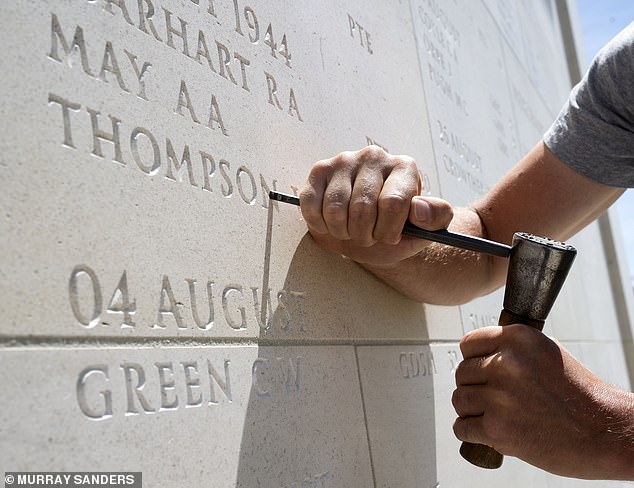
In recent weeks, a trio of British engravers have been carefully hammering away at the stonework on the west wall of the central court in a new section entitled ‘Addenda’ – meaning additions to the original. The time and effort required to get all this right has been extensive. But if you want to know how much it means to the families involved, then just ask Clive Thompson.
‘This has just brought my grandad back to life. It’s tremendous what they have done,’ says Mr Thompson, 74, from Carlisle and himself a former reservist. The family had never known a great deal about William Thompson’s death, beyond the fact that he had been in the Territorial Army when war broke out, was killed at sea in 1944 and buried in Dover. ‘My father used to say “Dad died during the war” and that was that,’ says Clive.
In fact, Gunner Thompson of the Royal Artillery had been serving as a gunner in an armed British cargo ship heading back from Normandy on July 30, 1944. Just off Beachy Head, it was twice hit from a swarm of high-speed German torpedo boats.
Though the SS Ocean Courier managed to limp home, five men were killed, including Mr Thompson. He was buried in a marked grave in Dover but was never classified as a Normandy veteran. As a Royal Artillery Gunner in a merchant vessel before being buried in Kent, he had slipped through the bureaucratic cracks.

A trio of British engravers have been carefully hammering away at the stonework in a new section of the Normandy Memorial entitled ‘Addenda’

The monument – erected with the help of the Daily Mail’s famously generous readers – will be an entire new wall of heroes

One family member called the memorial ‘tremendous’, adding that it brought his grandfather – William Thompson, a gunner killed at sea in 1944 – ‘back to life’
Now, the father of three will join the ranks of all the others – more than 22,500 of them – who died in what history calls Operation Overlord. His name came to light after the Normandy Memorial’s lead researcher, Jane Furlong, was checking another casualty. ‘It just means so much to us all,’ says Clive Thompson. Though his father (William’s eldest) is no longer alive, the two younger children are delighted with Dad’s posthumous recognition, especially Aunt Joan who had never even met her father when he was killed.
Another not-forgotten hero is Charles Coyle, from Maryhill, Glasgow. He, too, signed up for the Royal Artillery but, thanks to a heart murmur, was deemed unfit for frontline duties. Instead, he was posted to an anti-aircraft gun on a cargo ship with one of the ghastliest missions of the Second World War – the Arctic Convoys. In March 1942, his ship was sunk in Murmansk, yet he survived. So much for ‘light’ duties. A year later, Gunner Coyle was torpedoed and sunk again off North Africa. Once again, he clung to the wreckage. In August 1944, aged just 25, he was on board the SS Empire Rosebery helping to resupply the troops in France when the ship hit a mine in the Channel. He was never seen again.
He left behind a widowed mother and younger sister, Margaret, who would raise her own children and grandchildren on the story of gallant Uncle Charles. The only trace of him was a name on the Naval Memorial in Portsmouth. Margaret’s daughter, Angela Wallace had always presumed that was that. ‘I had no idea he was a Normandy veteran until we got a call,’ she tells me. ‘Mum always talked about him and I’m immensely proud of him. You can’t imagine all the things he went through at that age. I’m just so happy he is getting this recognition all these years later.’
Some of those now being added to the memorial were not British nationals but, none the less, turned out to be under British command – like that US Spitfire pilot. Lieutenant Richard Barclay as shot down on this very day in 1944. He had already flown two D-Day missions, spotting enemy gun positions, but volunteered for a third after a subordinate refused to fly.
This week I watched Edinburgh master engraver, Gus Fisher, 36, make the final touches to all the new names, ranks and dates. Whereas the original engraving was done by automated machinery, these have all been etched by hand.
The setting, above Gold Beach, is as magnificent as ever, watched over by the founding trustee without whom this would not be here. Back in 2014, while covering the 70th anniversary of D-Day, BBC royal correspondent Nicholas Witchell was approached by a band of elderly Normandy veterans. Might he help right a great wrong? Every Allied nation had a national memorial in Normandy except the UK. Mr Witchell threw his energies and nearly all of his spare time into getting the thing to the drawing board, then raising the funds – aided by the Daily Mail – and finally seeing it evolve into the glorious landmark we see today. Since retiring from the BBC, he has refused all invitations to pen his memoirs and, instead, devotes his time to keeping this place going (his temporary home, right now, is actually on site in a Portakabin).

Another not-forgotten hero is Charles Coyle, from Glasgow, who was on board the SS Empire Rosebery helping to resupply the troops in France when the ship hit a mine in the Channel

Nicholas Witchell says the centre ‘badly need the donations’ to get their planned statue of Winston Churchill ‘cast and up on a plinth’
He is on a video call when I drop in. ‘We’re just sorting out the seating plan for Saturday,’ he laughs. At one point, he was actually helping out in the kitchen of the café in the memorial’s new Winston Churchill Centre. ‘I’ve now been promoted to shelf-stacker in the shop,’ he says proudly.
The 52-acre site is immaculate, the trees and plants now bedded in under the care of two full-time gardeners from the Commonwealth War Graves Commission. However, there is still one final task. There is an empty space at the Eastern end of the memorial that is waiting for the one and a half times life-size statue of Winston Churchill – dressed exactly as he was when he landed in Normandy.
‘The model’s finished but we badly need the donations to get the statue cast and up on a plinth,’ says Mr Witchell. ‘It’s the last piece of unfinished business for the veterans.’
Tomorrow, Mr Witchell and the team will welcome ministers, diplomats, members of the Churchill family, and the grandson of the British commander, General Bernard Montgomery. Pride of place, however, will go to four of the very last surviving Normandy veterans – plus the families of those dead men who had never received the credit they deserved – until now.
‘Lest we forget’ goes the old saying. There is no chance of that here in Normandy.