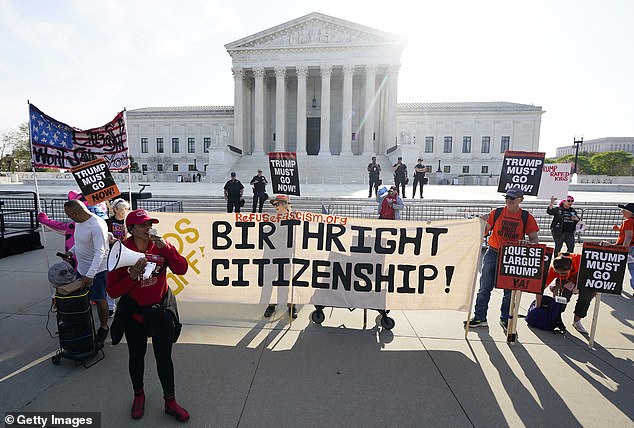

The Supreme Court slapped down Donald Trump’s attempt to end birthright citizenship in a major blow to the administration’s radical vision for the composition of the country.
In a landmark 6-3 decision in which three conservatives – John Roberts, Amy Coney Barrett, and Brett Kavanaugh sided against Trump – the Justices halted the President’s attempt to end birthright citizenship, calling it blatantly unconstitutional.
The ruling is a major defeat for Trump, and comes as the high court has ruled against him in a handful of major cases – including invalidating his sweeping tariff regime, and blocking his effort to fire Lisa Cook from the Fed’s board of governors.
Trump had an uncharacteristically subdued response when confronted by a reporter about the sweeping blow, despite calling out ‘traitor’ Justices who sided against him in the past.
‘I guess I have to accept it. It is the Supreme Court. I think it is very bad for our nation, we are the only nation that does it,’ he said in the Oval Office.
He called on Congress in a Truth Social post to ‘make up’ the loss through legislation.
‘Congress should start TODAY to work on ending expensive and unfair to our Country, Birthright Citizenship. They will have my Complete and Total Support!’
The constitutional guarantee was enshrined by the 14th Amendment, and ratified in 1868 to guarantee citizenship to freed slaves and impacts an estimated 150,000 children born in the US annually to noncitizens.
Trump first tried to end birthright citizenship by executive order on Inauguration Day 2025 – a move subsequently struck down by lower courts as unconstitutional.

Birthright citizenship was enshrined by the 14th Amendment, and ratified in 1868 to guarantee citizenship to freed slaves, but has since applied to every person born on US soil or its territories
‘Citizenship, then and now,’ conservative Chief Justice John Roberts said, writing for the majority, ‘was the right to have rights… to freely participate in our political community.’
‘The Framers of the Fourteenth Amendment extended that promise to “every free-born person in this land,”‘ Roberts added. ‘We keep that promise today.’
Roberts was joined by Trump-appointed Amy Coney Barrett and liberal Justices Sonia Sotomayor, Elena Kagan and Ketanji Brown Jackson in the majority.
Conservative Justice Brett Kavanaugh joined the majority in part but dissented in part. He did not agree that Trump’s order was unlawful, but rather that he couldn’t take unilateral action without congressional approval.
The stakes in the case were momentous, and put Supreme Court precedent on a collision course with the expansion of executive power.
Trump made history in April by becoming the first sitting president to attend Supreme Court oral arguments in person – a sign of how important the case was to him.

From left, Supreme Court Chief Justice John Roberts, Justice Elena Kagan, Justice Brett Kavanaugh and Justice Amy Coney Barrett at the State of the Union in February

President Donald Trump speaks to reporters at the White House

Protesters demonstrating against Trump’s immigration policies in Washington, DC, in 2017
But as he stared down the Justices in the face, including those he appointed himself, they expressed skepticism.
The Supreme Court’s longest-serving conservative, Clarence Thomas, did not hold his fire in a 92-page fiery dissent, which was joined by Trump-appointed Justice Neil Gorsuch. ‘I am not sure that today’s opinion will stand the test of time,’ he said.
Thomas argued that the majority had ‘repurposed the Fourteenth Amendment to protect its own set of preferred rights,’ which he said did not align with the text of the 14th Amendment’s Citizenship Clause.
The Citizenship Clause ‘added greatly to the dignity and glory of American citizenship,’ Thomas continued, adding that the majority opinion, in his view, ‘devalues that citizenship.’
Conservative Justice Samuel Alito penned another blistering dissent, arguing that the majority, in his view, made a ‘serious mistake,’ and said the ruling ‘preserves a powerful incentive to enter or remain in this country illegally.’
Trump has not shied away from criticizing the Supreme Court for blocking his key policy priorities in his second White House term, and has accused his own conservative nominees on the court of being ‘disloyal.’

President Donald Trump in the Situation Room of the White House

Supreme Court Justices Amy Coney Barrett and Ketanji Brown Jackson at the US Capitol

President Donald Trump speaks to members of the media on the tarmac in Paris. Trump has publicly criticized Supreme Court justices for blocking some of his most sweeping executive orders and actions to date
‘They were appointed by me, and yet have hurt our Country so badly!’ Trump declared on Truth Social in the wake of the tariff ruling, adding later that ‘certain ‘Republican’ Justices have just gone weak, stupid, and bad.’
The case hinged on narrowly interpreting the 14th Amendment’s Citizenship clause: ‘All persons born or naturalized in the United States, and subject to the jurisdiction thereof, are citizens.’
The President’s legal team argued that the children were not ‘subject to the jurisdiction’ of the US when they were born.
They claimed that ‘subject to the jurisdiction’ means full allegiance to the US, and parents unlawfully in the US do not qualify, and neither should their children.
Senior Trump administration officials viewed the executive order as a key component of Trump’s hard-line immigration agenda – an issue that has become a defining feature of his second White House term.
Opponents had argued that a ruling in Trump’s favor would have upended long-held notions of citizenship and would yield immediate, operational consequences for infants born in the US.
Critics suggested it could put the impetus on Congress and the administration to immediately clarify the status of the newborns.
After Trump signed the citizenship executive action in February last year, the directive was immediately challenged by states and civil rights groups, including the ACLU. The order has never taken full effect.
The case, Trump v Barbara, pitted Trump’s order against a group of affected families nationwide, backed by the ACLU and other groups. These groups contended that the 14th Amendment guarantees citizenship to anyone born on US soil, and has been read that way for more than a century – and upheld in laws passed by Congress in the decades since.
Many of the Justices seemed skeptical of the Trump administration’s arguments during the April 1 oral arguments. The 6-3 majority was a slimmer outcome than many court-watchers had expected, but was hailed by immigration advocates and lawyers for plaintiffs nonetheless.

Supreme Court justices pose for their group portrait in 2022
In what proved to be a telling exchange, Chief Justice John Roberts told US Solicitor General John Sauer at the outset of oral arguments that he viewed a key argument from the Trump administration as ‘quirky.’
Roberts noted he was having a hard time making sense of the Trump administration’s legal position on the 14th Amendment’s exceptions to birthright citizenship, citing exceptions the administration listed, including children of ambassadors, children born on warships, and other very limited groups.
‘I’m not quite sure how you can get to that big group from such tiny and sort of idiosyncratic examples,’ Roberts noted.
‘We’re in a new world now,’ Sauer told Roberts.
‘It’s a new world,’ Roberts said in response, ‘but it’s the same Constitution.’
Trump’s own nominees, Justices Coney Barrett, Kavanaugh, and Gorsuch, also appeared skeptical of the administration’s arguments in April.
Kavanaugh cited the passage of the 1952 Immigration and Nationality Act (INA), noting that it essentially mirrors the text of the 14th Amendment and the text of the 1898 case.

The President made history in April by becoming the first sitting president to attend Supreme Court oral arguments in person

Trump speaks during an event in the Oval Office of the White House on June 22
‘One might have expected Congress to use a different phrase if it wanted to try to disagree with [precedent set in] on what the scope of birthright citizenship, or the scope of citizenship, should be,’ Kavanaugh said.
‘I am not seeing the relevance as a legal constitutional interpretative matter,’ he finally told Sauer, after a brief back-and-forth.