
Rachel Reeves was handed a crumb of comfort today with the economy performing better than expected in February – before it was hammered by the Middle East crisis.
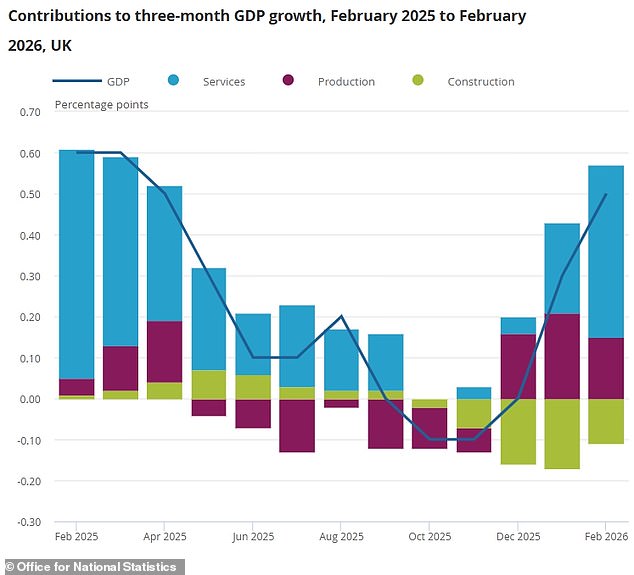
GDP was up 0.5 per cent over the month, the fastest expansion in more than two years and significantly higher than analysts had pencilled in.
The dismal flatlining previous detected in January was also revised up, albeit only to 0.1 per cent. A recovery in construction was the main driver of the improvement.
However, economists warned that the figures were now largely of historic interest, as the fallout from Donald Trump’s war on Iran is set to stoke inflation and crush activity. The first strikes were launched on February 28, meaning they are not covered by the official statistics yet.
The IMF warned this week that disruption to oil, gas and other crucial products from the Middle East might tip the world into recession.
The international body said Britain is likely to be the worst-hit major country, with energy costs and inflation already higher here.

The ONS said real GDP grew by 0.5 per cent in the three months to February, following a growth of 0.3 per cent in the three months to January and no growth in the three months to December

Real GDP is estimated to have grown by 0.8 per cent in the three months to February 2026 compared with the same three months a year ago

Chancellor Rachel Reeves, at a reception for End Child Poverty at 11 Downing Street on Monday
A figure of 0.8 per cent has been forecast for the UK in 2026, down sharply from the 1.3 per cent predicted in January.
ONS Chief Economist Grant Fitzner said today: ‘Growth increased further in the three months to February led by broad-based increases across services.
‘Within services, growth was driven by wholesaling, market research, hospitality, and publishing, which all performed well in the three months to February. Meanwhile car production recovered from the effects of the autumn cyber incident.
‘Growth in services and production was partially offset by another fall in construction, albeit at a slower rate than previously, with leasing and intellectual property licencing also continuing to contract.’
Chief Secretary to the Treasury James Murray said: ‘Growth only happens when the economy is on solid ground. That’s why in a changing world our plan to restore stability, boost investment and deliver reform is the right one to build a more stronger more resilient Britain.
‘At the IMF meetings in Washington the Chancellor has set out how we will go further and faster to boost Britain’s competitiveness and build a stronger, more resilient economy, keeping costs down for families and businesses and taking back control of our energy costs as today we cut bills by up to 25 per cent for 10,000 British businesses.’
Susannah Streeter of the Wealth Club said there were ‘heartening’ signs that the economy might be more resilient than thought.
‘Unfortunately, it’s likely to be a brief respite given the toxic economic shock being unleashed by the Middle East conflict, with sharply higher energy costs set to weigh down companies and consumers,’ she said.
‘There will be fears that the economy will have taken one step forward only to take two steps back once the full effects filter through.’
Suren Thiru, chief economist at ICAEW, said: ‘These figures are unlikely to ease stagflation fears given that February’s surprisingly strong growth has been pushed firmly into the rear-view mirror by the renewed energy and supply chain shocks caused by the Middle East conflict.
‘February’s growth will have been followed by a more miserable March with skyrocketing fuel prices and supply chain chaos sparked by the Iran war likely to have stalled economic activity, despite an early Easter boost to sectors like retail.
‘Even if a peace deal is reached soon, a severe spell of stagflation looks locked in with surging energy costs expected to trigger sizable falls in investment and consumer spending, likely leaving growth weaker than many – including the IMF –expect.
‘Though the Iran war has shifted policymakers’ focus more towards interest rate rises than reductions, a prolonged policy pause remains most likely, particularly as the likely squeeze on growth from the conflict should help dampen inflation over time.’