Up next

William Connor II Net Worth
As the UK continues to be roasted by Europe’s blistering ‘heat dome’, many will be hoping that temperatures will soon start to cool.
But an imminent ‘Super El Niño’ could send the mercury even higher later this year, experts have warned.
NASA satellites recently confirmed that the weather phenomenon – characterised by warmer water in the equatorial Pacific – is ‘underway’.
The space agency predicts this El Niño event will have ‘widespread effects’, including bringing wetter conditions to the American Southwest and drought to countries in the western Pacific.
But experts say we can also expect extreme heat ‘almost everywhere’ – including the UK.
While its influence on British weather is indirect, a particularly strong El Niño event could raise global temperatures and supercharge the heating effects of climate change.
Simon Culling, a prominent data collector and investigator for the UK’s Tornado & Storm Research Organisation (TORRO), wrote on X: ‘If the current predictions for the forthcoming El Niño phase are realised, what does this mean for the UK?
‘It may mean hotter summers for both 2026 and 2027 and increases the risk of a significant cold spell in winter 2026/27. Let’s see what plays out.’

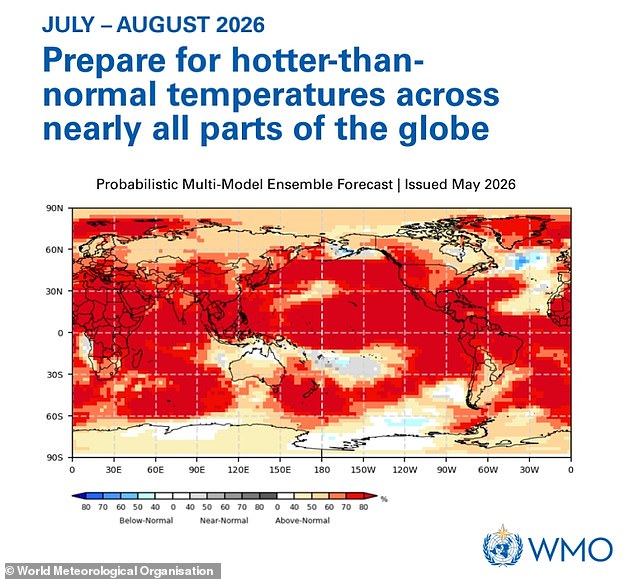
The WMO has warned that people should prepare for hotter-than-normal temperatures ‘across nearly all parts of the globe’

There are several heat and thunderstorm warnings still in place today, following a record-breaking day yesterday
Yesterday, the record for the hottest June day was broken as a temperature of 36.1°C was recorded in Gosport, Hampshire.
It broke the previous top temperature of 35.6°C in 1976 and 1957, the Met Office said.
Over the weekend the weather is expected to transition into more changeable, fresher summer conditions.
However, forecasts indicate that July will see drier-than-average conditions with above-normal temperatures.
While its effects on the UK are yet to be determined, meteorologists say El Niño’s intensity will likely be comparable to the 1997/98 event which saw global temperatures reach their highest on record.
During its development, the UK experienced an exceptionally hot, sunny and humid August characterised by heatwaves.
Speaking on the possible development of El Niño Grahame Madge, a climate science communicator at the Met Office, previously said: ‘This is likely to be a significant event.
‘It’s likely to be the strongest El Niño event so far this century. And we’re probably comparing it to the 1998 one. This was a significant year for global temperature and at the time, it was the warmest year on record.’
Mr Madge said that while the influence of El Niño is a significant driver in global weather, it’s not the only one.
‘It’s possible we could see some impacts from El Niño, but equally possible that we could see other drivers being more dominant,’ he explained.
The El Niño–Southern Oscillation is a natural climate pattern which cycles between a hot El Niño and a cool La Niña phase every two to seven years.
During the El Niño part of the cycle, warm waters that build up in the Pacific spread out and raise the Earth’s average surface temperature.
This heat ends up escaping into the atmosphere, raising the planet’s temperature for months.
Although this cycle has been going on for hundreds of thousands of years, current signs in the Pacific point to this year being one of the strongest El Niño patterns ever recorded.
Current measurements show that sea surface temperatures in the tropical Pacific are rising faster than at any other time this century – and could reach 1.5–2°C (2.7– 3.6°F) above normal.
While it is not yet certain, this is a very strong sign that a powerful El Niño weather pattern is brewing.
According to the World Meteorological Organisation, we can expect above-normal temperatures in ‘nearly all parts of the globe’.
The strongest heat signals are forecast across southern and western North America, Central America, the Caribbean, Europe, North Africa, and much of Asia.
Northern parts of Asia may also be warmer than usual, although the forecast there is less certain.
In the Southern Hemisphere, warmer-than-normal conditions are also expected across many areas.
Northern South America is likely to see the strongest warming, while Southern Africa is forecast to experience widespread above-normal temperatures.
In Australia, warmer conditions are mainly expected along the western, southern, and eastern coasts, with no clear trend in the north.
Tropical regions around the world are also forecast to be hotter than normal, especially Equatorial Africa and parts of Southeast Asia and the Maritime Continent.
WMO Secretary–General Celeste Saulo said: ‘We need to prepare for a potentially strong El Niño event – which will exacerbate drought and heavy rainfall and increase the risk of heatwaves both on land and in the ocean.’