
Justices Clarence Thomas and Samuel Alito blasted their Supreme Court colleagues on Tuesday for ducking a pivotal interstate dispute over issuing commercial driver’s licenses (CDLs) to illegal aliens who can’t read or speak English.
The verbal smackdown came about in the high court’s most recent order list, in which the justices disclosed which cases they will not be taking up and hearing arguments in during its upcoming 2026 term. Among the rejected cases was Florida v. California and Washington, in which Florida sought to file a lawsuit against California and Washington “for defying federal law by providing commercial driver’s licenses to illegal aliens who cannot read English,” as summarized by Thomas.
In its October 2025 filing, Florida Attorney General James Uthmeier asked the high court to greenlight and consider his state’s legal complaint against the aforementioned Democrat-run states over the contested policy. He noted that Florida’s “serious and dignified” claims “arise under the United States Constitution,” and that “there is no alternative forum to provide adequate relief.”
Article III of the U.S. Constitution notably grants the Supreme Court “original Jurisdiction” “In all Cases … in which a State shall be Party.” And yet, seven of the current court’s justices declined to take up and address the matter.
Writing in dissent on behalf of himself and Alito, Thomas blasted the high court for shirking its constitutional responsibility to handle disputes between the states. He additionally highlighted the “disturbing phenomenon” alleged by Florida: that the practice of states issuing CDLs to illegals who aren’t proficient in English is “causing fatal accidents on the road.”
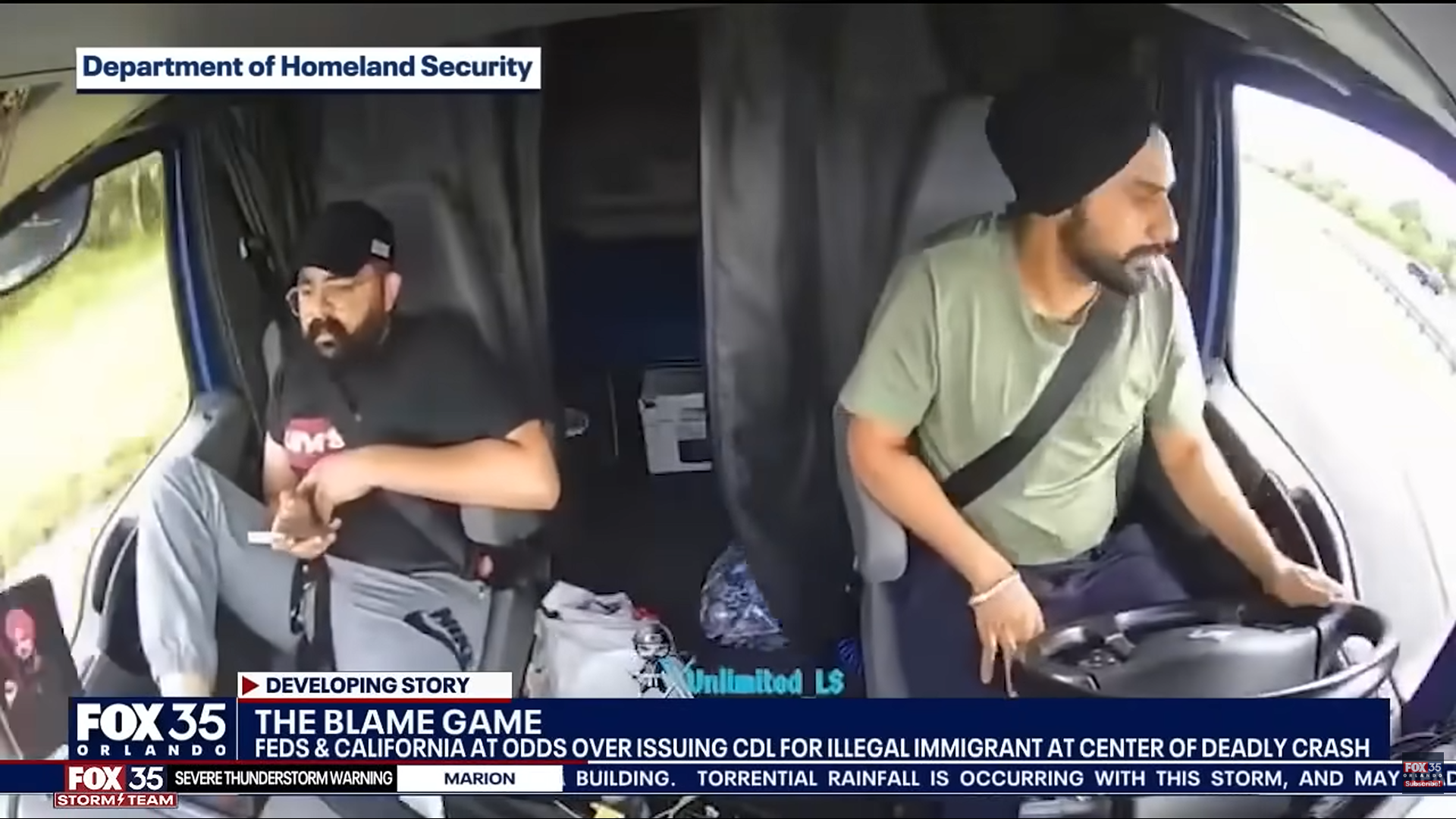
The deadly consequences stemming from states issuing CDLs to non-English speaking or reading illegal aliens have garnered nationwide attention in recent months. As The Federalist previously reported, the Department of Transportation said that “[t]hirty people died in 17 semi-truck crashes caused by noncitizen commercial truck drivers in 2025” alone, with those figures likely being “an undercount.”
In his dissent, Thomas highlighted one of these tragedies stemming from the Sunshine State, in which a CDL-licensed Indian national “crashed a tractor-trailer into a minivan on the Florida Turnpike,” leaving three dead. As noted by the justice, law enforcement later discovered that the illegal alien “likely could not read the road signs” due to his inability to comprehend basic English — circumstances in which federal law bars states from issuing CDLs.
Turning to the jurisdictional issue, Thomas cited the Constitution, which gives the Supreme Court “exclusive original jurisdiction over Florida’s suit because it involves one State suing other States.” He further noted how Congress has made the court’s “original jurisdiction ‘exclusive’ in ‘all controversies between two or more States’” and expressed “doubt [that] this Court has discretion to refuse to hear cases within its exclusive original jurisdiction.”
“The only statute addressing this Court’s jurisdiction over these kinds of cases nowhere contemplates a process of discretionary review,” Thomas wrote. “Nonetheless, this Court has adopted a discretionary approach to its exclusive original jurisdiction based on ‘policy judgments that are in conflict with the policy choices that Congress made in the statutory text specifying the Court’s original jurisdiction.’ … Thus, both JUSTICE ALITO and I have repeatedly called for revisiting the Court’s precedents in this area.”
Thomas concluded his assessment that the Supreme Court “likely should have granted” Florida’s request to file its legal motion even under this “discretionary approach.” Addressing the factors SCOTUS uses when weighing such matters, the Bush 41 appointee underscored that the court’s existing standards and the jurisdictional issue favor the Sunshine State.
“This Court declines to even hear Florida’s claims, even though it has nowhere else to bring them. Because I would allow Florida to file its complaint, I respectfully dissent,” Thomas wrote.
Shawn Fleetwood is a staff writer for The Federalist and a graduate of the University of Mary Washington. He is a co-recipient of the 2025 Dao Prize for Excellence in Investigative Journalism. His work has been featured in numerous outlets, including RealClearPolitics and RealClearHealth. Follow him on Twitter @ShawnFleetwood