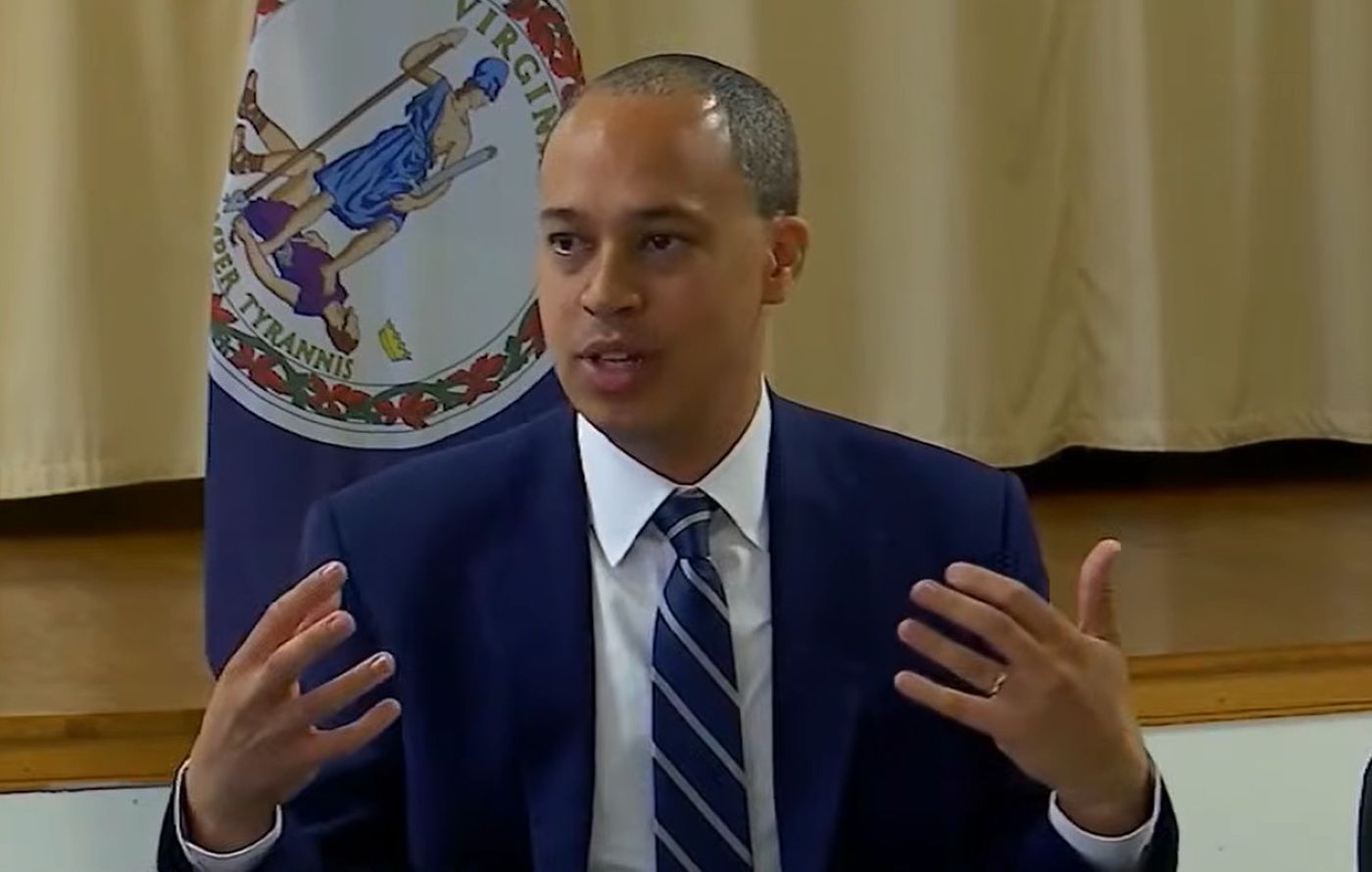

Virginia Democrats suffered a major loss Friday after the commonwealth’s Supreme Court overturned its attempt at an extreme partisan gerrymander. But the case itself saw Democrats conveniently argue that the “election” is a single day for purposes of gerrymandering, but in all other cases, it is 45 days long.
In 2020, Democrats forced through changes to the way Virginia conducts elections, turning the normal “Election Day” into a 45-day voting extravaganza. Because they instituted that 45-day voting period and then tried to sneak the referendum onto the ballot after more than a million Virginians had already cast ballots 42 days into the 2025 election, Democrats were forced to defend the referendum by claiming that the “election” is only one day.
“Before evaluating the exegesis of the term ‘election’ by legal scholars and courts, it is worth observing that the Commonwealth’s view would be unrecognizable to the average citizen,” the Supreme Court’s majority opinion said.
“Imagine one of the over one million Virginians who had voted in person before Election Day in 2025 walking into a polling place,” it continued, pointing out the absurdity in the Democrats’ position. “The voter says to the officer of election, ‘I am here to vote in the election.’ The officer of election responds, ‘we are not conducting an election here.’ ‘But that’s why I am here,’ the voter replies. ‘Maybe so, but let me explain,’ the officer of election insists, ‘you can vote in the election, but we are not conducting an election today. Elections are only conducted on Election Day.’”
“Legal scholars and courts would have the same bewildered reaction as the hypothetical average citizen,” the court said. “The definition of ‘election’ has always broadly denoted the ‘act of choosing.’”
In 2025, Democrats waited until the 42nd day of early voting to ram through the proposed referendum, which would have disenfranchised nearly half of Virginia’s voters. In Virginia, the constitutional process for a referendum requires that two separate legislative sessions pass the referendum, with an intervening election allowing voters to have an “indirect” say in the referendum. If the subsequent legislative session passes it, then it goes to a “direct” vote.
By the time Democrats got around to offering the referendum for first passage, 1.3 million voters had already cast ballots. In the Democrat framework, they had set up a scenario where “early Virginia voters unknowingly forfeited their constitutionally protected opportunity to vote for or against delegates who favor or disfavor amending the Constitution by not anticipating a legislative vote on a constitutional amendment four days before the last day of voting,” the high court said.
In rejecting that argument — that the election is “Election Day” this time, but in all other instances it is the 45-day course of voting — the Supreme Court was forced to explain to Democrats what an “election” actually is.
Early voting disenfranchises many voters who have voted without the full breadth of knowledge about what they are voting for. That was the case with this very referendum, and it may have played out poorly for the election prospects of now-Gov. Abigail Spanberger, D-Va., had Democrats not waited until 1.3 million votes were cast before shoving the referendum through. In what is perhaps a starker example of how early voting distorts election results, more than 360,000 Virginians cast ballots before news broke about now-Attorney General Jay Jones, D-Va., fantasizing about murdering Republican colleagues and their children.
The court did not make any judgments as to whether a 45-day election or a single-day election is preferable, but rather noted that if an election is going to span 45 days, all days are included in the election, and “Election Day” is therefore the endpoint of the election.
“The near universal definition of ‘election day’ is a ‘single day established by law for voters to cast ballots by presenting themselves in person at a voting precinct,’” the opinion stated, differentiating it from an “election” generally. “The semantic differences between these terms have a rich provenance. Beginning in colonial days, it was common in Virginia and other colonies for elections to last for days as election officials (usually sheriffs) canvassed the countryside to collect votes during elections.”
“When the law speaks of an ‘election,’ it ‘plainly refer[s] to the combined actions of voters and officials meant to make a final selection of an officeholder,’” the majority continued. “The definition is short and clear: ‘History confirms that “election” includes both ballot casting and ballot receipt.’”
Therefore, if voting is going to last days, “The metes and bounds of an election begin with the point of casting votes and end with the point of receiving votes and closing the polls on the last day of the election. Election Day is the boundary marker for the last act constituting an election.”
Breccan F. Thies is the White House correspondent for The Federalist. He is a co-recipient of the 2025 Dao Prize for Excellence in Investigative Journalism. As an investigative journalist, he previously covered education and culture issues for the Washington Examiner and Breitbart News. He holds a degree from the University of Virginia and is a 2022 Claremont Institute Publius Fellow. You can follow him on X: @BreccanFThies.