
When my phone rang, I looked at the screen and saw my husband’s name. I felt a familiar knot of anxiety and silently hoped this time we might have a calm, ordinary conversation.
Kipp and I had been struggling for months — perhaps even years.
He often criticised me and could erupt in anger, but I had given him one final opportunity to change. I wanted to believe our ten-year marriage could still be saved. Instead, what he told me next destroyed everything I thought I knew. His voice sounded tense and unfamiliar. “The police have just interviewed me,” he said. “But it’s all a misunderstanding. They’ve made it sound much worse than it is.”
“What are you talking about?” I asked, my voice shaking. He told me the police had questioned him about a 13-year-old girl from the community group where he volunteered. Kipp, then 45, had allegedly sent her “inappropriate messages”. He was calling me from the police station.
“I haven’t done anything wrong,” he insisted. “I’m completely innocent, I promise.”
I believed him because I could not imagine any alternative. How could my husband, the father of our two young children, have done something so terrible? Surely there had been some kind of mistake.
Three days later, that belief was destroyed.
I read a nine-page transcript of the disgusting messages he had sent to the girl, who he had first contacted when she was just 11. Over the following weeks, six more young victims came forward, describing inappropriate messages and sexual abuse. My husband was not simply a liar. He was a predatory paedophile who had concealed his true nature in plain sight — using me and our children, then aged six and three, to appear respectable.

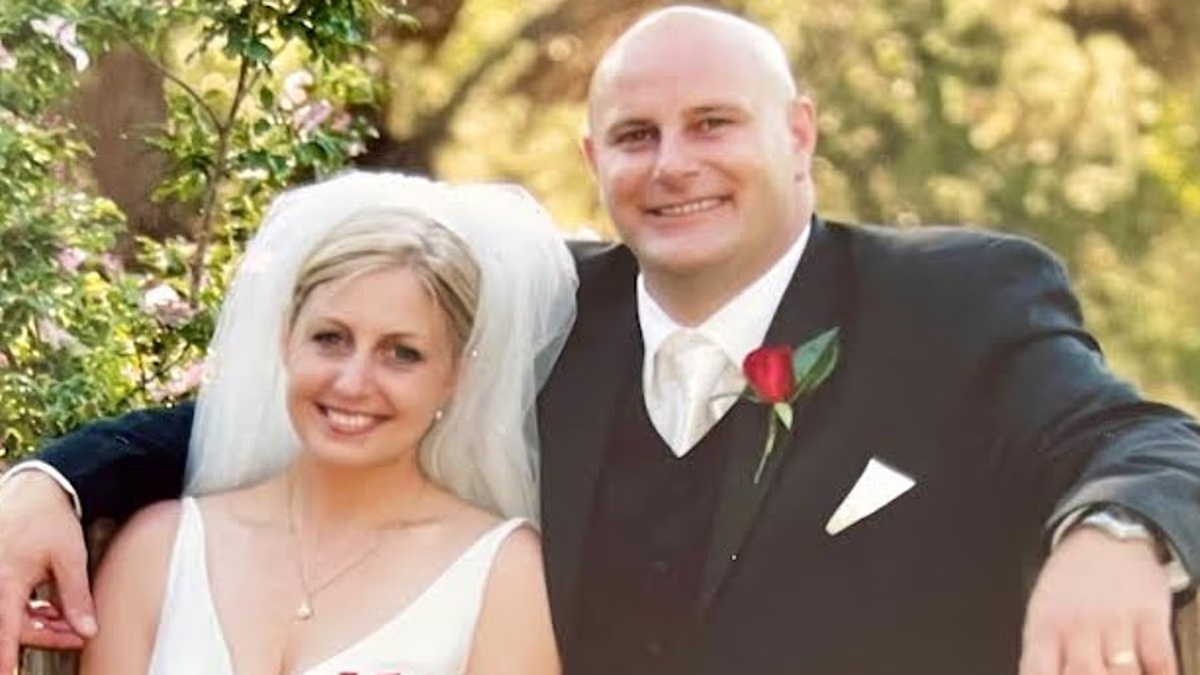
Lauren and Kipp pictured on their wedding day in November 2005. They welcomed a daughter three years later and a son in 2012
I felt physically ill because of what he had done, but I was also overwhelmed by guilt. How had I lived with this man for 16 years without knowing? Did that make me responsible in some way? Should I have noticed something or intervened? Had our entire relationship been a lie?
When I met Kipp in March 1999, he was the most charismatic and exciting man I had ever encountered.
I was 19 and training as a student nurse. Kipp was 28, had his own home and worked in banking. One evening, while I was at the community group where he volunteered — the same organisation he remained involved with until his crimes were exposed years later — he approached me and asked me out.
Kipp had a presence that drew people in. Everyone listened when he spoke, trusted him and felt valued in his company. I thought I was incredibly lucky.
He was warm, affectionate and attentive. He surprised me with holidays, gifts and constant compliments. My friends and family adored him, and so did I.
After 18 months together, we moved in. In the beginning, our life seemed wonderful. Kipp was loving, thoughtful and devoted.
But after about a year, his behaviour began to shift. His temper became unpredictable, and the charming man I knew developed an increasingly jealous side.
One evening, he became furious after finding a friendly message from an old friend on my phone. He accused me of being unfaithful.

Lauren was 19 and studying nursing when she met Kipp, then 28, who owned a home and worked in banking. The pair are pictured on holiday

Their relationship changed forever when Kipp was exposed for sending sexual messages to a 13-year-old girl
I was shocked that he could question my loyalty over something so harmless, yet somehow I ended up feeling guilty for making him suspicious.
I dismissed it as a misunderstanding. But not long afterwards, he returned home drunk at 4am after a night out, switched on the bedroom lights and demanded to know who I had invited over. His evidence was that the toilet roll was facing a different way.
Under any other circumstances, it would have sounded absurd. Yet I spent the early hours trying to prove I had done nothing wrong, reassuring him that I loved him and would never cheat.
As the years passed, his jealousy and insecurity developed into controlling behaviour.
He criticised me for folding his socks incorrectly or buying a different brand of margarine.
According to Kipp, I did everything badly — from replacing the toothpaste lid to having sex that was not frequent or satisfying enough, despite us sleeping together several times a week. Slowly, my confidence disappeared.
Only later did I recognise the pattern as coercive control: behaviour designed to undermine a partner until they feel weakened and dependent.
Between these incidents, Kipp would become affectionate again. Those good periods kept me attached and made me question whether the bad moments had really been as serious as they seemed. So when he proposed on my 25th birthday, I accepted, convincing myself that the happy times outweighed the painful ones. I also believed marriage might make him change.
We married in November 2005. Three years later, our daughter was born, followed by our son in 2012.
But Kipp grew increasingly remote and controlling, choosing to spend more time with friends or at the community group.
He was caring towards the children, but he regularly made me feel inadequate. In front of friends, he sometimes made supposedly humorous comments that marrying me and having children had ruined his life.
Nobody laughed. In fact, some friends urged me to leave him. In May 2015, I finally told Kipp that we should separate.
His response left me stunned. He broke down in tears, threatened to take his own life and promised that he would change.
I made the mistake of giving him another chance. Two months later, he called me from the police station.
Kipp was released while the investigation continued. Three days later, we were summoned to a meeting at the community group, where he was expected to step down from his committee role because of the girl’s complaint.

“I blamed myself, even though I was certain there had been no warning signs,” Lauren says

Lauren is now studying Criminology and Criminal Justice and has written a fictionalised book about her experience to warn other women
I arrived expecting the meeting to clear up the confusion and prove Kipp’s innocence. He had admitted sending the messages, but told me they were jokes or had been taken out of context. I accepted his explanation.
Instead, the committee presented the evidence: nine pages of messages between my husband and the 13-year-old, discovered by her parents on her phone. The transcript showed that Kipp had initiated contact when she was 11 and that the conversation had gradually become sexual. Her parents had taken the messages to the police and then provided them to the organisation.
There was no possible misunderstanding. The evidence forced me to see Kipp as he truly was. I felt sick with horror. He had sent messages late at night, including one saying, “I’d love to be off work today with a little hottie like you,” and he had asked whether he could massage her.
MORE STORY: Urgent Outlook Security Warning: Flaw Could Let Hackers Hijack Email
Her replies revealed how uncomfortable she was. She appeared to be trying to end the conversation and persuade him to leave her alone.
“I have to go to school now,” she wrote in one message. Those words made her age painfully clear. I jumped up and ran outside, with Kipp following me. As I got into the car, shock and disgust gave way to anger.
“You sound like a paedophile,” I shouted. “Do not come home.”
Kipp had nowhere else to go and stayed with his mother.
I returned to the house and sat in silence, trying to understand what I had just read.
Kipp sent me lengthy messages insisting he was innocent and pleading with me to listen. Eventually, I could not take any more and blocked his number.
Then came the painful task of explaining his absence to our children. “Daddy has done something bad,” I told them gently. “He cannot live here anymore.” They were distressed and confused. I could barely understand the situation myself, so I had no idea how to explain it to them.
I was too ashamed to tell anyone what had happened, although the news soon spread.
A week later, an anonymous caller threatened Kipp. “I know what he’s done,” the man said. “I’m going to kill him.” Fearing that our family might be in danger, I took the children to my parents’ home.
My parents gave us enormous support, but the worst was still ahead.
Over the next few weeks, members of the group told me that six additional victims had come forward. Their allegations involved inappropriate communications and, in some cases, sexual abuse.
Several months later, Kipp Walford was charged with more than 20 offences, including three counts of rape, indecent acts with a child under 16 and sexual penetration of a child under 16.
The seven girls were aged between 11 and 17, and the allegations covered a seven-year period. One claim stated that Kipp had raped a 16-year-old in our home while I was away. It was almost impossible to accept that such an offence could have taken place in the house where I had raised my children and believed we were living a normal family life.
I could not avoid the most terrifying question: had he also targeted our own children?
My daughter was younger than all of the other alleged victims, but I worried about her and her friends in case Kipp received a lenient sentence.
My heart broke for the girls who had reported him. They must have felt frightened and isolated, yet they had found the courage to speak out. I never doubted them. I searched my memories repeatedly, looking for any warning sign I might have overlooked.
Had I been so devoted to the man I thought I loved that I failed to see what was happening? I blamed myself, even though I genuinely believed there had been no obvious indication of his crimes.
The idea of having shared a bed with Kipp made me feel physically sick. I began questioning whether he had married me simply to create the image of a respectable husband and father.
It was disturbing to realise that our relationship had begun through the same community setting where he later approached vulnerable young girls.
At the time, I had not considered the age difference unusual. I was 19 — still a teenager — while Kipp was close to 30. Now I wondered whether he had groomed me as well. I felt embarrassed and foolish for not seeing that the charm I had found so irresistible might have been an act. It took years to understand that, like his victims, I was not to blame.
Despite facing serious sexual abuse charges, Kipp applied for unsupervised contact with our children. I fought the request with everything I had. After three years of exhausting court proceedings, I was finally granted sole custody.
Kipp’s trial began in November 2017. He was 48 and had pleaded not guilty to every charge, meaning the victims were required to give evidence and revisit their trauma. Most testified by video link from the prosecutor’s office, while one chose to appear in court.
I attended the closing arguments, verdict and sentencing. My thoughts were with the young girls and everything they had endured. How could they have been expected to stand up to Kipp, who was 6ft 3in and powerfully built?
As I watched the man I had once loved, I looked for any sign of remorse. Instead, he appeared angry rather than sorry and refused to meet my gaze.
In March 2018, Kipp was found guilty of 21 offences, including indecent acts with a child under 16 and the rape charges. He received a 14-year sentence, with a non-parole period of 11 years.
Several victims read statements about the impact of his crimes at the pre-sentencing hearing, which Kipp’s family attended after supporting him throughout the trial. I found it intimidating to enter the courtroom and see them there, so I can only imagine how difficult it was for the girls. Their courage was extraordinary.
In June 2019, the children and I moved to another town to begin again. But leaving did not immediately ease the guilt I carried. I needed extensive counselling before I stopped holding myself responsible.
My therapist repeatedly reminded me that I had also been victimised. At first, I struggled with that idea because I felt my experience could never compare with what the girls had suffered. Gradually, however, I understood that Kipp had deceived and controlled me for years. The marriage and family life I believed I had were built on a falsehood.
Four years after moving, I began volunteering for a domestic abuse charity and supporting other victims. I also wrote a fictionalised book based on my experience, an intensely cathartic process. Titled Now I See You, it is intended to warn other women about the signs of coercive control and the dangers of falling into a similar trap.
I am studying for a degree in Criminology and Criminal Justice because I want to understand coercive control more deeply. I hope to work in policy and help improve support and outcomes for victims. In my spare time, I campaign against domestic abuse and speak publicly about coercive control.
I think about the girls Kipp abused every day and hope they have been able to find peace.
My children are now 17 and 14, and both are doing well. They know their father committed something terrible and is in prison, but they have chosen not to hear the full details.
The court prohibited Kipp from contacting them until they reached adulthood. Once they are adults, the decision about whether to see him will be theirs.
Now 47, I am in a loving relationship with a new partner. He has shown me what a healthy relationship should feel like and helped me gradually learn to trust again.
Some people may ask how I could spend so many years with Kipp without recognising what he was capable of.
But people like him do not reveal their true selves to everyone. Until it was too late, nobody knew what he had been hiding.
Now the truth is known. I can only hope Kipp is never given the chance to harm anyone else — and that by telling my story, I can help other women in similar situations find the strength to leave.
Some details have been changed to protect the victims’ identities. Lauren’s book is available at laurentrevan.com
As told to DONNA SMILEY