
Donald Trump appeared to cast doubt on the Federal Bureau of Investigation’s conclusion that North Korea was responsible for what the agency described as the largest hack in history.
On Saturday evening, the FBI said its investigation had determined that TraderTraitor, a North Korean cyber group, carried out an unprecedented attack on Binance, the world’s largest cryptocurrency exchange.
Binance said on Thursday that the estimated damage was “around $6.3 billion,” making the breach one of the most serious cryptocurrency security incidents ever recorded.
TraderTraitor is believed to be linked to the Lazarus Group, which attracted global attention in 2014 after being accused of hacking Sony Pictures in retaliation for The Interview, a film that mocked North Korean leader Kim Jong Un. Trump has often referred to Kim as “Little Rocket Man,” a jibe aimed at North Korea’s nuclear weapons program.
Hours after the FBI’s Cyber Branch announced its findings, Trump offered an uncertain response, saying he did not know whether North Korea was behind the attack.
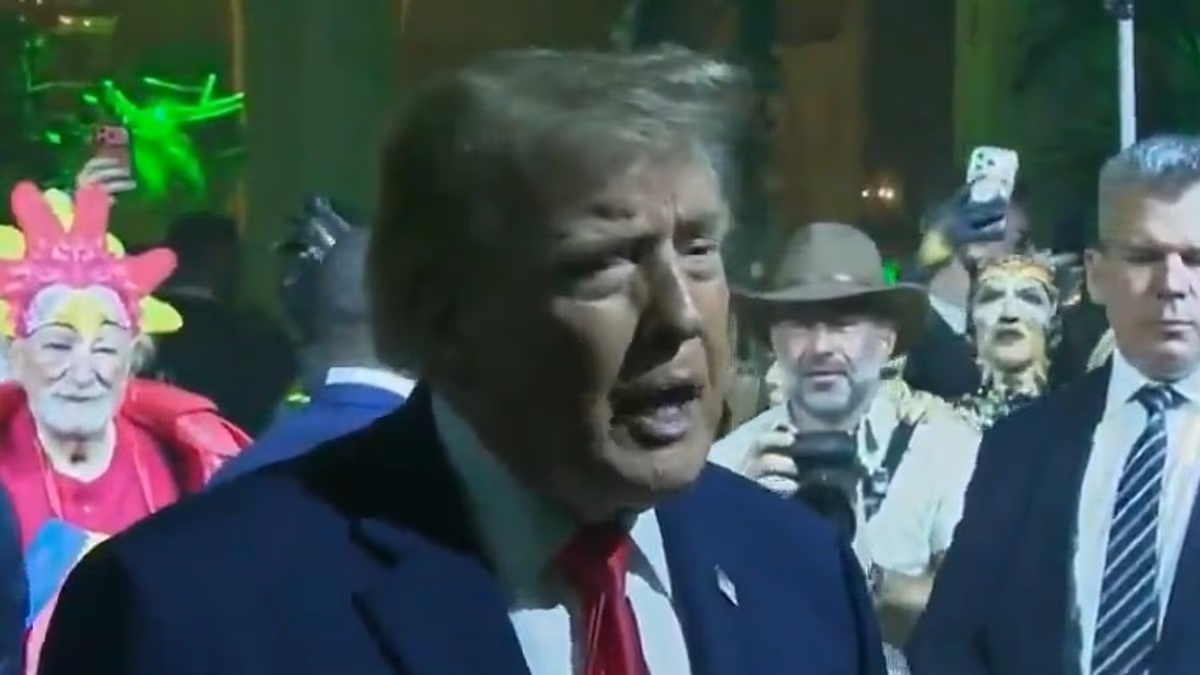
Asked about the investigation by a reporter at Mar-a-Lago on Saturday night, Trump said his administration was still “learning about” what had happened.
“We don’t know if it’s North Korea,” he said.
“But if it is, we’ll talk to North Korea about it.”
Trump added: “I’ve always felt it was a little bit dangerous. But they say they have it pretty much under control. We’ll see.”

Donald Trump questioned the FBI’s assessment of a North Korean cyberattack on Saturday. He and Kim Jong Un have had a complicated relationship and are pictured together in 2018

North Korean hacking group TraderTraitor has been accused of targeting Binance. Kim Jong Un has not publicly denounced other investigations involving the group

The FBI, led by Director Kash Patel, said Saturday that its investigation had uncovered an unprecedented attack targeting Binance
Binance co-CEO Richard Teng said in a video message on Friday that the company was “working nonstop” and committed to covering all losses from the hack. He also sought to reassure customers that their “assets were safe.”
“This was a complex attack,” Teng said, explaining that the hackers had used a self-destruct mechanism that made the incident difficult to trace.
Binance said on Saturday that it had replaced 90 percent of the stolen cryptocurrency. The remaining 10 percent would take longer to acquire because the tokens were “less liquid,” the company said.
TraderTraitor has previously been linked to sophisticated, multibillion-dollar cyberattacks. The group has featured in several elaborate fraud operations, dating back to 2014, when hackers infamously targeted Sony Pictures following the release of The Interview, a fictional comedy about the assassination of North Korea’s leader.
North Korea never accepted responsibility for that attack. Its extensive hacking operation has since become an important part of the country’s overseas activities. A United Nations panel found in 2024 that cyberattacks generated roughly half of North Korea’s foreign-currency income.
Security officials have previously warned that the proceeds from cyberattacks help fund North Korea’s military and nuclear weapons programs.
The Daily Mail has contacted the White House and the FBI for comment.
The FBI’s findings come against a complicated international backdrop, as relations between Trump and Kim appear increasingly strained.
ALSO READ: Australian Couple Buy Dream Japan Home for $16,000: How You Can Too
Earlier this month, five people familiar with their relationship told Reuters that the prospect of another meeting between the two leaders was diminishing.

At Mar-a-Lago on Saturday, Donald Trump told a reporter, “we don’t know if it’s North Korea,” despite the FBI’s statement attributing the attack to TraderTraitor
The United States reportedly received no response from North Korea about arranging a meeting before a regional summit in China in November.
Asked about the possibility of meeting Kim, Trump told reporters at the White House: “I get along with him very well, and I’m not sure that anybody’s asking for a meeting.”
Kim has continued to meet with other world leaders. He traveled to the Chinese border last weekend for an unexpected meeting with one of Chinese President Xi Jinping’s senior lieutenants.
In September, Kim joined Xi and Russian President Vladimir Putin at a military parade in Beijing. Xi also visited North Korea during the summer, marking his first trip there in seven years.
Trump became the first sitting US president to enter North Korea during his first term, meeting Kim at the Korean Demilitarized Zone.
At the time, he said he had “no problem” visiting the country and was “proud to step over the line.”

Kim Jong Un has not arranged another meeting with Trump, but met with a senior Chinese official earlier this month
Later that year, Trump said Kim had sent him a “beautiful letter.” In 2020, Kim also sent a message wishing the US president a quick recovery after Trump tested positive for Covid-19.
Patricia Kim, a senior fellow at the Brookings Institution, told The Washington Post that the geopolitical environment has changed considerably since the two leaders first met in 2018.
“Back then, Washington was negotiating from a position of considerably greater leverage,” she said.
“Today, Kim is in a much stronger position. He is far less diplomatically isolated, having forged a new security partnership with Moscow and deepened his economic and political ties with Beijing. And he’s done this all while continuing to expand North Korea’s nuclear and missile capabilities.”
Trump has repeatedly pledged to prevent foreign adversaries from expanding their nuclear capabilities.
That foreign policy objective drew the United States into conflict with Iran and led to negotiations with North Korea.

Kim Jong Un has also strengthened ties with Russian President Vladimir Putin. The two leaders are pictured together in Beijing last year
In 2018, Trump and Kim issued a joint statement committing to the denuclearization of North Korea. The White House described the agreement as an “epochal event of great significance in overcoming decades of tensions.”
Since then, however, North Korea has continued to expand its nuclear arsenal, according to data from the Stockholm International Peace Research Institute.
Kim has condemned the US war in Iran while supplying ammunition and troops to Russia for its invasion of Ukraine, further strengthening ties between Pyongyang and Moscow.
As the geopolitical landscape shifts, the United States has fewer tools with which to pressure North Korea over cybercrime.