
Welcome to Polished with Elise Wilson, where Daily Mail’s qualified makeup artist and hair stylist answers your beauty questions, offers expert advice, and tests the latest skincare and makeup trends so you don’t have to.
Anyone who knows me will be familiar with my strong dislike of the word ‘biohacking’.
The term was once associated largely with Silicon Valley billionaires who tracked every minute of their sleep, consumed endless supplements and spent vast sums attempting to turn back their biological clocks. It has since become so ubiquitous that I cannot help but roll my eyes whenever I hear it.
However, the beauty industry has now embraced the trend, and even I have to admit that some of the results are hard to dismiss.
When research indicates that a course of microneedling treatments may boost collagen production by as much as 400 per cent, and seemingly ageless celebrities attribute their glass-like complexions to procedures that activate the skin’s natural repair processes, the subject deserves attention.
As I have written before, the heavily overfilled ‘pillow face’ that defined Hollywood beauty for years has thankfully fallen dramatically out of favour.
Today, the ultimate beauty status symbol is skin that appears so healthy, smooth, firm and radiant—with no obvious evidence of cosmetic work—that people might wonder whether you are Benjamin Button.
Muscle relaxers and dermal fillers remain hugely popular, but interest is increasingly shifting towards treatments designed to improve the skin’s overall quality, rather than simply freezing lines or restoring lost volume.

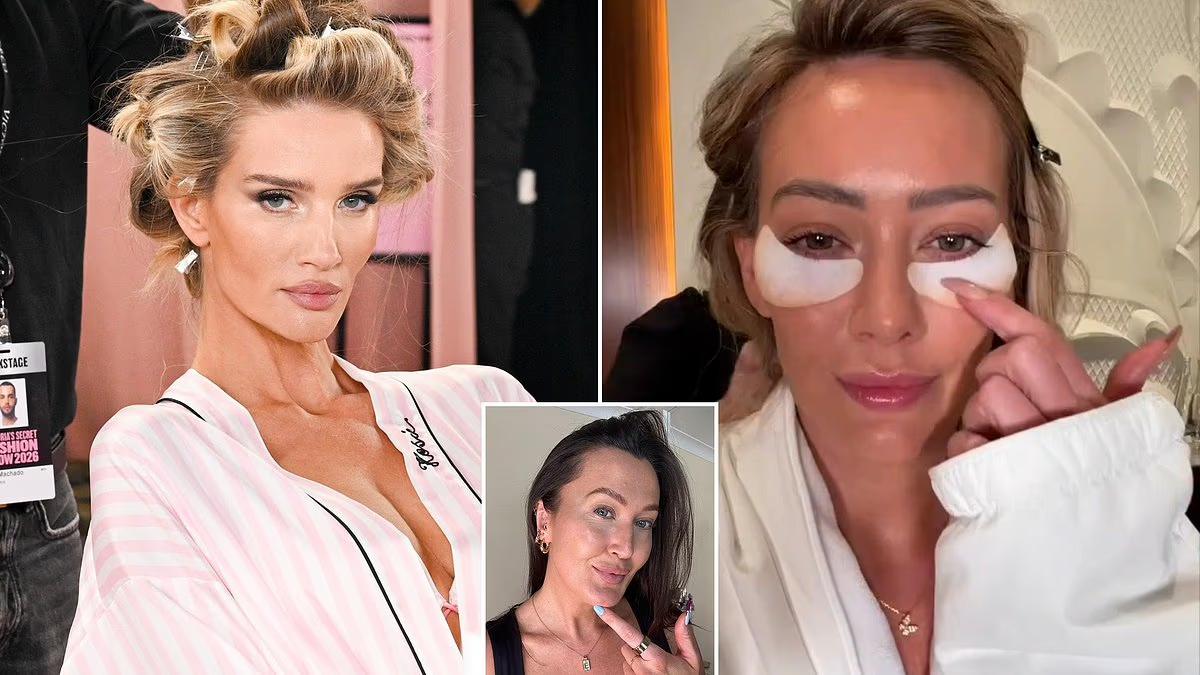
From Hilary Duff’s microneedling obsession to the Victoria’s Secret runway glow, I know the exact bio-hacking treatments promising younger-looking skin. Pictured: Rosie Huntington-Whiteley backstage 2026
Think microneedling, sophisticated light therapies that tackle years of sun damage, Korean skincare innovations involving microscopic ‘cellular messengers’, and facials promising a red-carpet-worthy glow in under an hour.
Having become something of a microneedling and BBL convert myself, I can certainly entertain the hype when the results are so visibly impressive.
The only downside is my already expensive beauty maintenance routine is showing absolutely no signs of getting any cheaper.
So, in the name of research (and a little personal vanity), I’ve investigated four of the most talked-about treatments currently making waves in the beauty world, including the famous faces helping fuel their popularity.
Microneedling: The treatment Hilary Duff is obsessed with
If there’s one treatment I believe deserves a permanent place in the anti-ageing conversation, it’s microneedling.
I’ve been having it done for years, and while it certainly isn’t the most relaxing way to spend an afternoon, the improvements I’ve noticed in my skin’s texture and overall appearance have made me a loyal convert.
And I’m in good company as actress Hilary Duff, 38, recently admitted she’s equally enthusiastic about the procedure, telling People magazine: ‘I do all the things. I love Botox. I’m obsessed with microneedling and salmon sperm [facials].’

Hilary Duff, 38 (pictured), recently admitted she’s very dedicated to her skincare treatments, telling People magazine: ‘I do all the things. I love Botox. I’m obsessed with microneedling and salmon sperm [facials]’
She also told Australian radio host Smallzy that she is very vigilant and undergoes microneedling monthly.
So, what exactly makes this treatment so appealing, you ask? Well, unlike injectables, which temporarily relax facial muscles or restore lost volume, microneedling is designed to encourage the skin to repair and rejuvenate itself.
Using a device fitted with tiny sterile needles, the treatment creates thousands of controlled micro-injuries in the skin, triggering a natural wound-healing response.
Collagen and elastin are the essential structural proteins responsible for keeping our skin firm, supple and resilient, and unfortunately, their production naturally declines as we age.
Skincare expert and founder of Ciel Muse Beauty in Nelson Bay, Summer Smith explains that this is precisely why collagen-stimulating treatments have become such an attractive option for women wanting to improve their complexion without dramatically changing their appearance.
‘Microneedling is one of the most transformative treatments for skin rejuvenation!’ she told me.
According to Summer, the treatment can help soften the appearance of fine lines, improve certain types of scarring and encourage smoother, firmer-looking skin over time.
‘I love recommending microneedling as a non-injectable option for clients wanting to improve their skin quality naturally,’ she explained, adding that it can also complement injectables as part of a broader rejuvenation plan.

New research suggest collagen levels may increase by as much as 400 per cent following a series of four microneedling treatments. Pictured: Hillary Duff
There has even been research suggesting collagen levels may increase by as much as 400 per cent following a series of four treatments, although this figure shouldn’t be interpreted as a guaranteed result for everyone.
Summer is quick to point out that individual skin health, age, genetics and lifestyle all influence the outcome, making a personalised approach essential.
Most treatment plans involve multiple sessions, commonly spaced four to six weeks apart, allowing sufficient time for the skin to recover and remodel.
There’s also a more intensive variation known as radiofrequency microneedling, which combines the traditional needles with controlled heat energy delivered beneath the skin’s surface.
This additional technology aims to improve concerns such as skin laxity, texture and certain scars, although it carries its own risks and isn’t necessarily the best option for everyone.
And while the prospect of thousands of tiny needles entering your face might sound rather barbaric, the process is generally performed with numbing cream to minimise discomfort.
Expect some redness afterwards, but don’t fall into the trap of assuming a bright-red face means you’ve received a better treatment.
‘More redness doesn’t necessarily mean better results – the goal is to stimulate the skin safely and effectively.’
Proper aftercare is equally important, particularly avoiding irritating active ingredients while the skin barrier recovers of the following few days.

Ahead of the 2026 Victoria’s Secret Fashion Show in October, models including Elsa Hosk (right), Joan Smalls, Jasmine Tookes and Amelia Gray Hamlin visited celebrity facialist Keren Bartov (left), whose brief was to sculpt, tighten and create the coveted ‘glass skin’ effect
Pro2Lift Geneo: The futuristic facial behind the Victoria’s Secret glow
If microneedling is about playing the long game, the Pro2Lift Geneo Facial is what I’d turn to when I want my skin to look amazing immediately.
I experienced the treatment earlier this year at Sydney’s Vaia Skin & Wellness, and it’s one of those rare facials where you emerge looking noticeably fresher without spending the following week hiding behind oversized sunglasses.
FIND OUT MORE: White House Launches Trump TV to Sidestep Traditional News Networks
And the Victoria’s Secret angels have discovered its appeal too.
Ahead of the 2026 Victoria’s Secret Fashion Show in October, models including Elsa Hosk, Joan Smalls, Jasmine Tookes and Amelia Gray Hamlin visited celebrity facialist Keren Bartov, whose brief was to sculpt, tighten and create the coveted ‘glass skin’ effect.
According to WWD, Geneo technology formed part of her pre-show toolkit, with its ultrasound function used to enhance the absorption of skincare products.
Importantly, that doesn’t mean each model underwent the full Pro2Lift treatment, but it does offer a glimpse into the technology being used behind the scenes to prepare some of the world’s most photographed faces.

The Pro2Lift Geneo combines five treatment functions designed to exfoliate, oxygenate, firm and refresh the complexion, while providing a rather luxurious facial massage. Kim Kardashian (pictured) is also a big fan
Other celebrities who have been linked to Geneo treatments include Kim Kardashian (of course), Paris Hilton and Gal Gadot.
In simple terms, the Pro2Lift Geneo combines five treatment functions designed to exfoliate, oxygenate, firm and refresh the complexion, while providing a rather luxurious facial massage.
Its OxyGeneo technology exfoliates the skin while encouraging a local oxygenation response, while TriPollar radiofrequency delivers controlled heat to support skin tightening and collagen remodelling.
Electrical Skin Activation and ultrasound are incorporated into the treatment, alongside lymphatic-style massage techniques designed to help reduce the appearance of puffiness.
There are also customisable OxyPods containing ingredients such as vitamin C, red algae and charcoal, allowing therapists to tailor the facial to concerns including dullness, congestion and uneven-looking skin tone.
In my experience, the most impressive part was how immediately healthy and luminous my skin looked afterwards.
There was no uncomfortable recovery period, no dramatic peeling and certainly no need to rearrange my social calendar.
Treatments start from around $260, while Vaia’s customised version costs $340.

Its OxyGeneo technology exfoliates the skin while encouraging a local oxygenation response, while TriPollar radiofrequency delivers controlled heat to support skin tightening.
Exosomes: The Korean skincare innovation everyone is talking about
Originating from the rapidly evolving world of regenerative medicine and now attracting attention in the Korean beauty scene, exosomes are tiny particles that can carry proteins, lipids and genetic material.
Researchers are investigating their potential role in tissue repair, inflammation and skin regeneration, and naturally, the beauty industry has been quick to recognise the possibilities.
Jodie King, dermal clinician and director of Skin Clinic Blyss in Sydney, said the technology represents an exciting shift towards improving overall skin health rather than targeting individual concerns.
‘Their role in skin health is an exciting area of research, particularly their potential to support skin repair, regeneration and recovery,’ she added.
One of the brands making waves locally is South Korean cosmeceutical company Exomide, which has introduced an exosome-based topical booster to Australian and New Zealand clinics.
According to the company, its skin treatment contains five billion exosomes and has been developed to complement professional procedures such as microneedling, radiofrequency needling and certain energy-based treatments.
Jodie incorporates Exomide as a topical finishing treatment at her clinic and says patients have reported improvements in their skin’s appearance and post-treatment comfort with less sensitive in the days that follow.
There’s even a scalp-focused application aimed at improving the appearance of hair density, which, given my ongoing fascination with anything promising fuller hair, has certainly piqued my interest too.

One of the brands making waves locally is South Korean cosmeceutical company Exomide, which has introduced an exosome-based topical booster. It contains five billion exosomes and has been developed to complement professional procedures such as microneedling for enhanced healing results
BBL: The light treatment tackling years of sun damage
Finally, we arrive at one of my personal favourites: BBL.
And before anyone gets the wrong idea, I’m not referring to the Brazilian Butt Lift – this particular BBL stands for BroadBand Light, and in my opinion, it’s a considerably more appealing way to spend your money.
As someone who has spent years testing everything from resurfacing lasers to techy skincare devices, I’ve become particularly fond of treatments that address pigmentation and uneven skin tone.
Because while fine lines inevitably attract plenty of attention, nothing can make a complexion appear tired quite like years of accumulated sun damage.
BBL is often referred to as a laser treatment, although technically it uses intense pulsed light rather than a traditional laser beam.
The technology delivers controlled pulses of broad-spectrum light into the skin, targeting excess pigment and small blood vessels responsible for concerns such as sunspots, freckles and facial redness.
According to Natasha Lee, founder of Sanctuary Skincare Clinic, the light energy heats these targeted areas, allowing the body to gradually clear the treated pigment and vessels over the following days and weeks.
The result can be a noticeably clearer, more even-looking complexion without changing the structure of your face.
During treatment, the sensation is often described as a warm rubber-band snap against the skin, which is gentle, and sessions are relatively quick.
Immediately afterwards, you may notice some slight redness, while pigmented spots can temporarily darken before gradually shedding or fading over the following one to two weeks.
Natasha says a course of around three treatments, usually spaced four to six weeks apart, is commonly recommended, although this depends on your skin concerns.
And while BBL can produce impressive results for suitable candidates, it’s important to remember that not all pigmentation responds in the same way.
Conditions such as melasma can be aggravated by heat or light, while darker skin tones and recently tanned skin may carry a higher risk of unwanted pigmentation changes.
Disclaimer: The information in this article is intended for general educational purposes only and does not constitute medical advice. Cosmetic treatments carry potential risks and side effects, and results will vary depending on individual skin types, concerns and treatment plans. Always consult a qualified medical or skincare professional before undergoing any cosmetic procedure to determine its suitability for you.