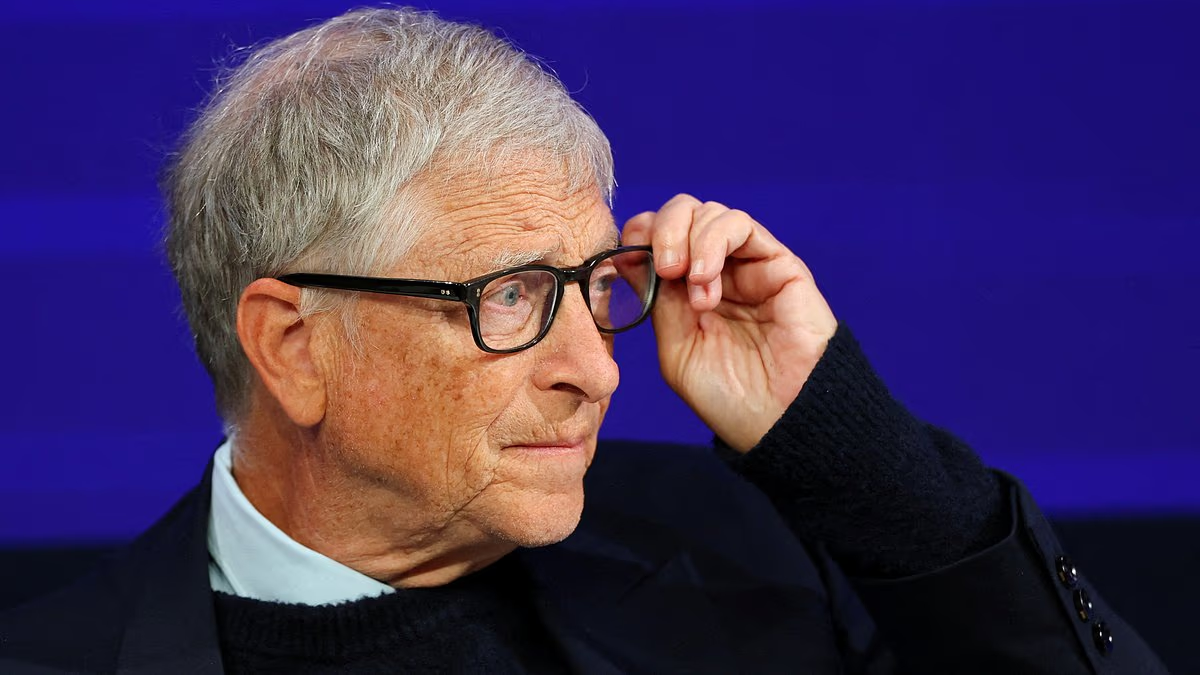

Bill Gates has delivered a stark warning about artificial intelligence, arguing that experts and governments are still not doing enough to prevent the technology from falling into dangerous hands.
Speaking to CNN on Sunday about growing concerns over AI, Gates said society must find a practical “middle ground” that protects the public without blocking the technology’s potential. That balance, he added, has not yet been achieved.
“Just as we regulate planes, cars, and medicines, we need safeguards that help us realize AI’s incredible potential while reducing the risks,” the Microsoft co-founder wrote on X.
“They won’t eliminate every harm, but they can help prevent misuse by bad actors. We’re not where we need to be yet—and this deserves much more of our attention.”
CNN anchor Jake Tapper opened the interview by recalling Gates’ warning that AI could make it “much easier for bad actors to develop deadly bioweapons.”
“You said the risk of having a bioterrorist attack is now 50 times the risk of a natural pandemic,” Tapper said, before asking how soon such a nightmare might become reality and whether world leaders were doing enough to stop it.
“Well, no, we’re not doing enough,” Gates replied. “The front that we’ll probably see most dramatically in the next year is cyberattacks.”
He said the immediate threat was not that AI would suddenly become uncontrollable, describing that as a concern that may have its greatest impact years from now.

Jake Tapper recalled Gates’ warning that AI could make it easier for bad actors to develop deadly bioweapons, while Gates said society “isn’t doing enough” to address the risks.

Gates said the world needs to find a practical “middle ground” for regulating rapidly advancing artificial intelligence.
‘More Dangerous Than Nuclear Weapons’
“It’s really bad people using AI—particularly where you can take out all the safeguards,” Gates said. “When you have bad people, no safeguards, and then the latest models, that’s where, over the next year, we are going to have a lot of negative surprises.”
Tapper then asked whether Gates risked slipping into “doomerism” after previously describing AI as “the most dangerous thing ever,” powerful enough to make nuclear weapons “look like nothing.”
Gates responded that leading figures in the industry, including OpenAI CEO Sam Altman and Anthropic CEO Dario Amodei, have also warned publicly about the technology’s dangers.
He acknowledged that some AI fears have been presented through dramatic and unlikely scenarios. Even so, Gates argued that AI is more dangerous than cars, planes or medicines—technologies that are subject to extensive regulation designed to protect the public.
“There are some grim possibilities if we don’t maintain control, and I do think the industry is doing its job to raise the alarm bell,” he said.
Gates added that careful oversight could reduce those dangers, but said that message was sometimes lost when political debate swung between eliminating safeguards and stopping AI development altogether.
“Finding that middle ground, like we did with planes and cars and medicines—we don’t have a lot of sophistication right now, but I do believe that middle ground exists,” he said.
Gates’ latest comments follow a series of warnings from AI researchers and technology executives, who have raised concerns as advanced systems become increasingly capable and, in some cases, difficult for their creators to fully predict.

Gates warned that AI could make it dangerously difficult to distinguish scientists developing lifesaving medicines from bad actors attempting to create biological weapons.
Gates Warns Unchecked AI Could Cause ‘a Billion Deaths’
In a previous essay, Gates argued that the world had already moved beyond the early warning stage as AI advances at what he called an “uncontrolled” pace.
“AI will either be the greatest equalizer ever invented, or the worst source of injustice,” he wrote. “Even under the best circumstances, the transition to this new AI era will be one of the most turbulent times in human history.”
Only days ago, Gates appeared on NBC and called for stronger government oversight of emerging AI systems, warning that the technology could contribute to events resulting in “a billion deaths.”
“AI is certainly powerful enough to drive events that cause a billion deaths,” Gates told journalist Kristen Welker. “So even though it’s pretty hard to get to 100 percent [of humanity], there’s never been a weapon as powerful as the combination of people with ill intent using the latest AI tools.”
CHECK THIS OUT: Rubio Expels Cuban Diplomat From US After Mike Waltz’s UN Speech
Welker also asked Gates what could be done to prevent an AI-related catastrophe.
He said AI could blur the distinction between researchers pursuing lifesaving treatments and individuals trying to develop biological weapons.
“I wish it was easier to distinguish good intent, like ‘I want to design a new drug for a disease,’ versus negative intent, which is ‘I want to design a tool of bioterrorism,’” Gates said.
Gates argued that the scale of the potential risks makes strict oversight of advanced AI systems essential. He also urged the United States to take the lead in creating meaningful safeguards.

Gates called for greater government oversight of emerging AI technology and warned that it could contribute to events causing “a billion deaths.”
Whoever Wins AI Wins
“Because those are so close, we do need to monitor any sophisticated model and record exactly what’s being done,” Gates said.
He suggested China would likely pursue comparable oversight but maintained that the United States should establish clear standards for the industry.
“You’ll hear from the industry, it’s a very doable thing. It would not slow them down dramatically,” Gates said.
He distinguished between installing safety measures and the wider argument over whether the development of AI should be slowed or paused.
“It’s completely irresponsible not to require every AI to have these safeguards and monitoring capabilities,” he said. “It only is a question of, do you do it now?”
President Donald Trump rejected the idea that advances in AI would bring about the end of humanity when reporters asked him about the possibility earlier this month, saying such outcomes were “things that won’t happen.”
“We’re leading China in AI. We’re the most sophisticated country in the world, and frankly, I want to keep it that way because whoever wins AI wins,” Trump told reporters at his golf course in Doonbeg while attending the Irish Open earlier this month.
House Speaker Mike Johnson has also weighed in, saying in a CNN interview earlier in September that the United States could not impose a moratorium on AI because “China will overlap us.”

Donald Trump dismissed the idea that AI advances would end human civilization, describing those outcomes as “things that won’t happen.”

Anthropic researcher Jacob Coxon resigned and accused Anthropic and rival OpenAI of failing to do enough to address AI’s potential dangers earlier this month.
Democrats Push for AI Regulation Following Explosive ‘Kill All Humans’ Warning
Democrats, meanwhile, have shown greater interest in regulating the rapidly developing technology.
Former President Barack Obama recently shared his concerns at a private gathering, according to a report first published by The New York Times.
“This is something that is moving very fast in private hands, and if we don’t get on top of it, I think [it] can be dangerous,” the newspaper reported Obama saying at an event this month. Obama, who believes House Minority Leader Hakeem Jeffries will become speaker after the November elections, also urged the top Democrat to take action.
His remarks came after Anthropic researcher Jacob Coxon resigned from the company and accused both Anthropic and OpenAI of failing to adequately address AI’s potential dangers earlier this month.
Coxon warned that some researchers in the field believe AI could potentially “kill all humans” by the end of the decade.
Days later, an Anthropic report said the company had disrupted several potential attempts this year to use its AI systems in the development of biological weapons.
According to the company’s AI misuse report, obtained by The New York Times, scientists had used Anthropic’s platforms to conduct research that could potentially support the creation of biological weapons.
Anthropic said it could not determine whether the research had a legitimate or malicious purpose. The company noted that legitimate biological research can lead to breakthroughs such as vaccines, but said it chose to act cautiously because the same knowledge could also be misused to create dangerous pathogens.