


The snap election follows almost two years of student-led protests, triggered by the 2024 collapse of a canopy at Novi Sad railway station that killed 16 people. Many blamed the disaster on corruption.
FIND OUT MORE: JFK Jr. Crash: Navy Diver Reveals Redacted Carolyn Bessette Details
The collapse prompted some of Serbia’s largest demonstrations since the fall of strongman Slobodan Milosevic in 2000. A final pre-election rally in Belgrade on Thursday brought an estimated 150,000 people onto the streets.
The Students’ List, made up of candidates backed by the largely leaderless movement, represents the strongest challenge yet to Vucic’s right-wing populist Serbian Progressive Party, or SNS, which has dominated politics during its time in power.

A protester throws a water bottle outside Rome’s Colosseum

A youth protest organised through social media descends into clashes with police, burning barricades and looting in central Barcelona

Around 100 people, including 27 minors, were arrested after objects were thrown at police, rubbish containers were set alight and shops were damaged around Plaça de Catalunya, La Rambla and Ronda Universitat

Candidates from the Students’ List greet students who marched to Belgrade and join them in a procession ahead of Serbia’s final pre-election rally on October 21

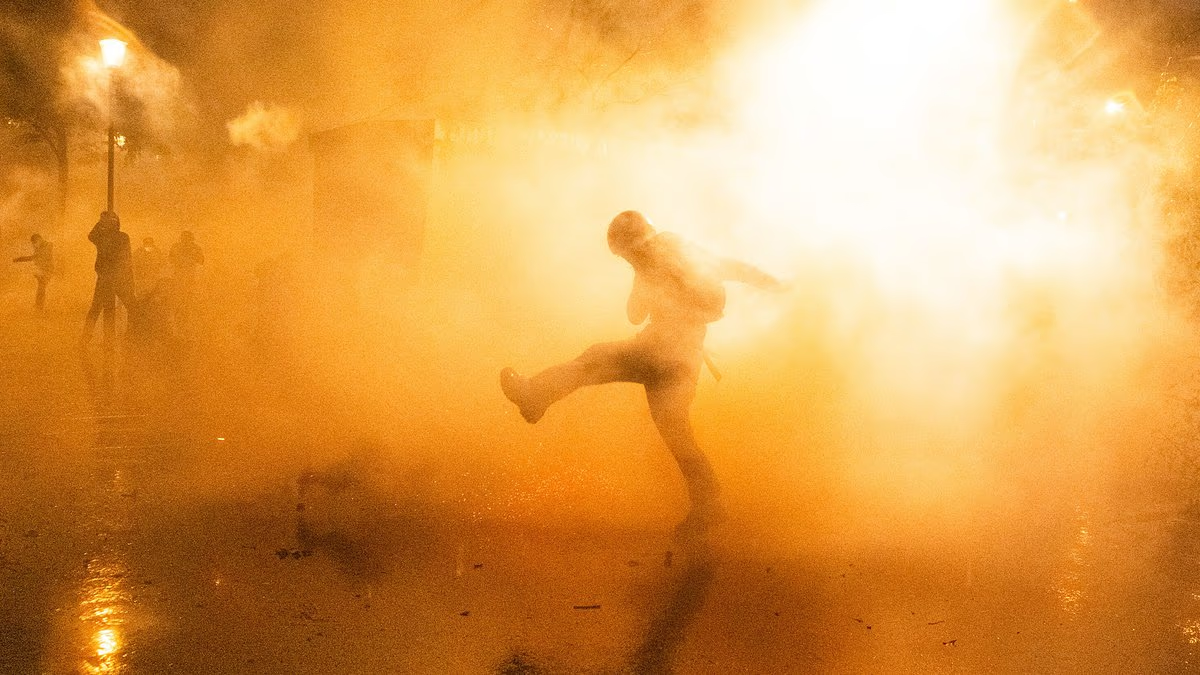
A demonstrator sets off a pyrotechnic device during an anti-government student protest in Tirana, Albania

A demonstrator in a gas mask throws an object during an anti-government student protest in Tirana, Albania

Riot police advance behind shields as flames rise from a street fire in Tirana, Albania

A burning barricade is visible through the shattered glass of a bus shelter during unrest in central Barcelona
Several major opposition parties have chosen not to contest the election, instead urging supporters to vote for the student-backed candidates.
Albania has also experienced sustained protests. Prime Minister Edi Rama said today that his government would take a tougher stance against demonstrators demanding his resignation, including introducing new penalties for violent protests.
Edi Rama said a law due to be published this week would allow fines of more than $550 for anyone who remained in a crowd carrying out acts of violence or looting in a public place, or who concealed their identity.
The Socialist Party leader said in a speech shared on social media that the measures would apply to any gathering ‘when it results in property damage’.
Months of anti-government demonstrations have escalated in recent days into fierce confrontations between protesters and security forces.
Rama said the legislation would also allow police to restrict gatherings in specific circumstances where there was a risk of violence.
‘Anyone demanding my resignation is mistaken if they think it can be forced or imposed in any way, but I do not believe that everything they are saying and demanding is wrong,’ he said.
The law would provide compensation for small businesses affected by protests and permit action against those who encourage, organise or coordinate the participation of minor schoolchildren in rallies.
Teachers have supported high school students who joined the protests this year.
Demonstrators have targeted the education ministry and other government buildings, citing corruption, demanding better conditions for students and calling for Rama to resign.
Police said that following Saturday’s protests, 23 people had been formally arrested, 13 others faced legal proceedings and 30 were wanted.