
When John F Kennedy Jr lost control of his Piper Saratoga II on the night of July 16, 1999, Captain W Russell ‘Russ’ Webster was among the first officials to reach the scene.
The crash occurred seven and a quarter miles off Martha’s Vineyard’s southwestern tip. Kennedy, his wife Carolyn, and her sister Lauren died instantly, while the wreckage came to rest 116 feet below the Atlantic’s surface.
Because the tragedy unfolded within his jurisdiction as Coast Guard Commander of Group Woods Hole, on Cape Cod’s western edge, Webster became Incident Commander for Operations during the exhausting five-day search. It was the largest search-and-rescue mission in US history involving private citizens killed in a small-aircraft crash.
Twenty-seven years later, he has recounted those events in The Last Flight: The Untold Story of the Search for JFK Jr and the Race Against the Atlantic, written with his historian wife, Theresa Mitchell Webster.
In this exclusive excerpt, he explains how the Coast Guard, the National Oceanic and Atmospheric Administration (NOAA), and the Navy located the wreck, recovered the victims in a painstaking operation, and carried out a respectful burial at sea.
Wearing a red-and-white-striped short-sleeved polo shirt and a life jacket, Senator Ted Kennedy watches silently as the divers prepare to descend.
He has insisted that Navy divers recover John, Carolyn, and Lauren together, so his nephew cannot be seen as receiving preferential treatment, even after death.
Once they reach the wreck, the divers have only a limited window to work. Every step across the seabed sends more silt into the water, making visibility even worse. Yet shafts of sunlight passing through the 116 feet of water offer a small amount of illumination during their descent.

JFK Jr and his wife Carolyn died instantly in the crash

The single-engine Saratoga came to rest 116 feet below the ocean’s surface

Ted Kennedy is briefed aboard the USS Grasp on the morning of Wednesday, July 21, 1999
JFK Jr lies on his side beside the shattered Saratoga on the ocean floor.
With care and solemnity, the divers lift his remains and carry him to the body bags secured on the Navy salvage basket.
That is when they report up the chain of command that Kennedy’s legs appear to be missing, according to retired Navy diver Josh Benjamins.
Regardless of what has happened, the divers must continue with their assignment.
At 116 feet, visibility is extremely poor. The divers carefully remove the tape holding the rolled body bags to the basket, then spread one bag across the seabed. Its zipper runs the entire length and is opened with great care.
Once the bag is fully open, Kennedy is placed inside. The bag is then lifted and fastened at four points.
Now the divers turn their attention to the Bessette sisters.
Moving through clouds of disturbed sand and silt, they return to the fuselage to recover Carolyn and Lauren.
Both women are intact but have suffered devastating injuries. Frank Ciaccio of the National Transportation Safety Board (NTSB), who later witnessed the autopsies, would say only that Carolyn and Lauren ‘were not facially recognizable.’
The crash impact drove the backs of their seats forward over their bodies.

The wreckage of JFK Jr’s plane was eventually brought out of the water

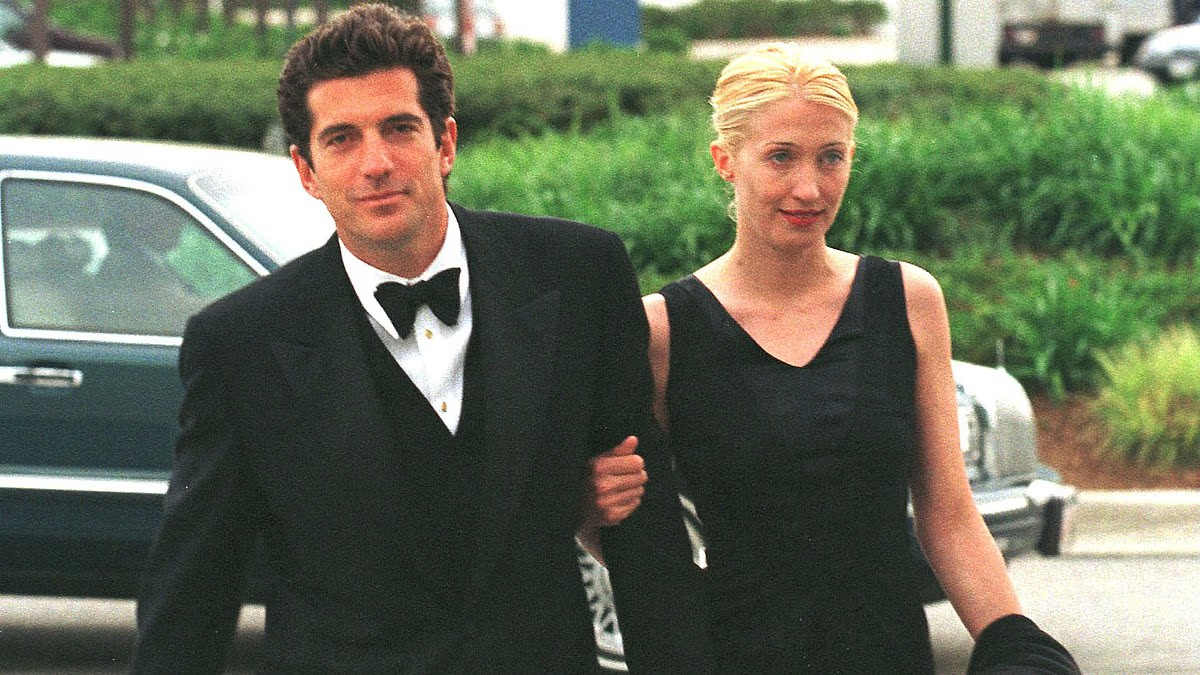
The recovery team battled tides and weather to bring up the son of a slain president and his passengers (pictured: John and Carolyn in January 1997)
The divers slowly force the seats backward and cut through the belts. In the murky water, they can distinguish the sisters only by their hair: Lauren is brunette, while Carolyn is unmistakably blonde.
Such injuries are an expected consequence of a collision of this force. Out of respect for the Kennedy and Bessette families, no further details are described here.
The first sister is freed from her seat. Her diver carries her over his shoulder in a fireman’s carry, moving carefully through the fuselage and back toward the salvage basket.
He places her remains inside a body bag.
The diver then returns to the basket and, with a colleague, brings out the second sister and places her in another bag.
The zipper is closed slowly and deliberately. At last, both sisters are secured together.
The Navy divers begin preparing for the ascent.
Before the basket reaches the surface, however, Navy officer Jeff Pauls tells Senator Kennedy about the suspected condition of his nephew’s remains.
The possibility troubles everyone. If the crash had severed JFK Jr’s body, would the remaining half still be on the seabed?
Then the divers and the basket rise into the daylight. All three victims are together, exactly as Senator Kennedy had requested. For the first time in several days, JFK Jr, Carolyn, and Lauren are above the waterline.
Several hours will pass before a second team descends to recover the fuselage and engine.
In Pocasset, north of Woods Hole, afternoon gives way to early evening.
Only three men are inside a small, cream-tiled room at the aging Barnstable County Hospital, where the medical examiner’s office is located.
A pathologist, a Massachusetts State Police photographer, and NTSB investigator Frank Ciaccio are present for the autopsies.
The medical examiner works methodically through the four-hour procedures. Conversation is sparse, limited to matters essential to the examination.

Captain Webster leads an exit-strategy meeting with Rear Admiral Richard M Larrabee, NTSB Chairman Jim Hall, and NTSB Managing Director Pete Goelz

Navy deep-sea divers prepare to descend 116 feet to recover John, Carolyn, and Lauren


Webster, left, served as Incident Commander for Operations as Coast Guard Commander of Group Woods Hole
‘There is no other conversation taking place in the room, unlike other cases I have worked on,’ Ciaccio recalls. ‘In all my years of performing autopsies and everything else, this was probably one of the most solemn I was ever part of.’
The examination determines that John, Carolyn, and Lauren died instantly from multiple traumatic injuries when the Saratoga struck the Atlantic.
Toxicology testing shows no alcohol or drugs in JFK Jr’s system.
‘You never want to make these things personal,’ Ciaccio says. ‘But I think what made this especially difficult for many of us was what we knew about the person. The two others in the room later told me they imagined the little boy saluting his father, the president, after he died. It was incredibly solemn. We knew our responsibility.’
The question surrounding the condition of Kennedy’s body has been answered, but conflicting accounts remain.
The account given to me after the crash was that JFK Jr’s legs had been folded into his chest cavity, something reportedly revealed during the medical examiner’s autopsy.
USS Grasp commander Eric Anderson offers a similar explanation. ‘The report I received was that he had been jammed up, basically compressed by the impact. But everything was there. It was simply mashed together,’ he says. The Grasp was the Navy rescue and salvage ship leading the recovery.
NTSB forensic anthropologist Frank Ciaccio, who witnessed the autopsies, rejects the claim that Kennedy’s legs were missing. ‘I will tell you 100 percent that [the report that Kennedy’s legs were missing] is false. His legs were not severed.
‘His legs were fragile and attached only by tendons and muscles. But they were not amputated.’
That conclusion conflicts with the recollection of Navy diver Josh Benjamins.
Benjamins was one of two divers who made the second descent, several hours after the three victims had been recovered.
During the safety briefing, the master diver assigned the pair to retrieve the aircraft wreckage and engine. But they also received an unofficial instruction: conduct ‘a quick search for the legs.’
Benjamins says the first team had made a brief search but reported seeing no body parts.
He and his partner went down and searched for human limbs first. Finding none, they began lifting the fuselage and, minutes later, the engine.

A flag flies at half-staff at the Kennedy compound in Hyannis Port on July 19, 1999

The public mourned the deaths with a makeshift shrine outside their New York apartment building

Family members embrace during the burial service
Even decades later, Benjamins maintains that he was told only Kennedy’s upper torso had been recovered before the body was placed in the bag.
‘They both had their hands on him, and each had handled numerous recoveries before. They went on record saying, “We know for sure that only his upper half was recovered,”‘ Benjamins recalls.
‘At some point, the story changed,’ he says.
From Tuesday through Thursday, Navy divers continue retrieving objects from the wreck site. Benjamins recalls that this is scheduled to be the Navy’s final recovery dive.
Working in pairs, the divers first bring up larger pieces, including sections of the wings. Once those are loaded into the salvage basket, they search the seabed for smaller objects in the dim, silt-filled water. They recover watchbands, CDs, and hats.
Then they find something else: a piece of scalp with long blonde hair wrapped tightly around an air-diving hose. Benjamins, only 23 at the time, is operating the communications microphone when the discovery is reported.
‘Topside, we have a substantial piece of scalp with long blonde hair wrapped around our umbilical—the communications hose that serves as a lifeline to the surface. What should we do?’
Benjamins says he turns to a senior diver and repeats the message.
‘No, you didn’t,’ the senior diver replies—in effect instructing him to disregard what he had seen.
The divers free the tissue and release the hair into the current.
‘In our thinking at the time, we decided, what difference did it make? A ceremony had been held, they had been committed to the sea, so we let it return to the sea.’
The last physical remnant of Carolyn left on Earth was therefore given its own burial at sea on the same day her ashes were carried to the nearby depths.
Taken from The Last Flight by Captain W Russell ‘Russ’ Webster and Theresa Mitchell Webster. Copyright © 2026 by William Russell Webster and Theresa Mitchell Webster. Used by permission of Harper Select, an imprint of HarperCollins Focus, LLC.