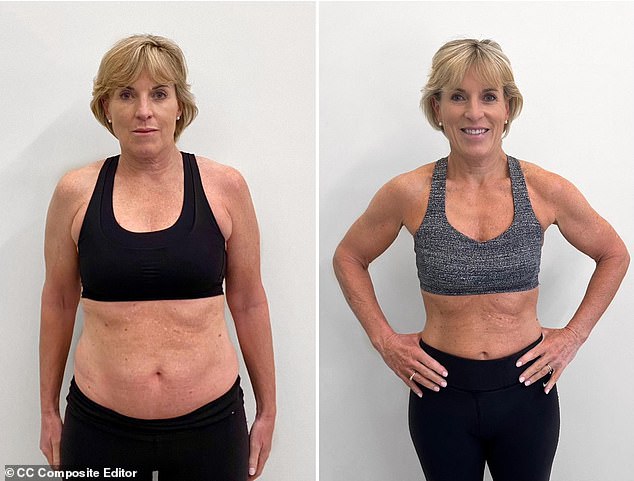

At 64, Hilary Clegg never imagined she would be lifting heavier weights than people decades younger than her. Like many women entering their 60s, she had spent years trying different forms of exercise, from running to fitness classes, always striving to stay healthy.
But after a serious leg injury ended her running habit and menopause had changed her body in ways she didn’t recognise, she found herself searching for something different.
Three-and-a-half years later, she’s not only managed to shift the excess weight and tone up, but has also solved perhaps the trickiest challenge of all: finding a sustainable diet and fitness regime that lasts far beyond any initial burst of enthusiasm, and that she can maintain for the long-term.
Here, Hilary reveals how she’s managed to stay motivated and live a healthy (but realistic) lifestyle in her sixties.
Ditching exercise that was no longer working
Hilary had always made time for exercise in her life, despite a busy career running her own events company (she now helps part-time with her husband’s consultancy business). However, she says the results of her fitness efforts were ‘varying’ at best.
Several years ago, Hilary broke her leg. ‘That really put the kibosh on my running, which was the main thing that I did, so I was looking for something else,’ she says. She tried classes and other forms of exercise, but never felt she was making significant progress.
Chatting to friends in London, Hilary discovered they had signed up for a transformation programme at Roar Fitness, and were excited about their results. ‘They really changed physically, and they were so enthusiastic,’ she recalls.
Around the same time, Hilary learned that the gym was about to launch in Dubai, where she lives, which felt serendipitous. She signed up in January 2023.

Hilary has achieved amazing results by using resistance training and tweaking her diet – and has managed to keep the weight off
One major motivator was the way her body had changed post-menopause.
‘I’d always been roughly the same weight since having my children,’ she says. ‘Then menopause arrived and the tone just went, especially around my middle. It was one part of my body I’d always felt proud of, and suddenly there seemed to be nothing I could do.’
Her experience is far from unusual. Research shows that women can lose significant amounts of muscle mass as they age, while hormonal changes during menopause can increase fat storage and make weight management more challenging.
Yet despite this, many women continue to rely primarily on cardio exercise, often unaware of the powerful role strength training can play.
For Hilary, discovering resistance training proved transformative. The fitness component of her Roar Fitness programme included a personalised plan centred on strength training. Plus, she was held accountable under the expert guidance of a personal trainer. Typical sessions involved sets of deadlifts, chest presses, split squats, shoulder presses and sled pushes (or pulls).
‘If it’s just me, I can always find another excuse,’ she admits. ‘What worked was having a programme designed for me and knowing someone was expecting me to turn up.’
That sense of accountability is often cited as one of the biggest reasons people stick with exercise. But beyond consistency, strength training offered something many people in later life struggle to experience: measurable progress. Rather than focusing on calories burned or miles run, success for Hilary became about increasing weights, mastering movements and building capability.
‘Running is one of those things where you naturally get slower as you age,’ Hilary says. ‘With strength training, I found I could keep progressing. I realised being older doesn’t have to hold you back.’
In fact, she is now stronger than many of the younger people training around her. ‘Age doesn’t matter when it comes to strength training,’ she says.
Given how much she enjoyed it, Hilary was happy to stick to the strength training well beyond the initial 12 weeks she’d signed up for – in fact, three-and-a-half years later, she still weight trains three times a week, which she finds more effective (and fun) than sweaty HIIT or cardio sessions for keeping in shape.
This type of exercise is particularly recommended for middle-aged and older adults, since after the age of 30, we gradually begin to lose muscle mass – a process that accelerates over the years.
For women, menopause can speed up this decline. Reduced muscle strength affects everything from mobility and balance to metabolic health and independence.
For Hilary, concerns about bone health were particularly significant. Her mother suffered from severe osteoporosis later in life, an experience that made her acutely aware of the importance of protecting her own health.
‘I didn’t really understand how important strength training was for bones until I started learning more about it,’ she says. ‘Watching what happened to my mother made me want to do everything I could to avoid going down the same path.’
Experts increasingly emphasise that resistance training is one of the most effective ways to stimulate bone growth and reduce the risk of osteoporosis-related fractures.
Having a diet overhaul (without going hungry)
Hilary says she already ate healthily before she began training. What she hadn’t anticipated was how much emphasis would be placed on protein intake.
‘The amount of protein was probably the biggest adjustment’ she says. ‘I think a lot of women [who embark on the fitness plan] find it difficult at first because you’re simply not used to eating that much.’
The diet generally includes around 30g of protein per meal – think four-egg omelettes, grilled tuna steak or pancakes made with protein powder – and is low on carbs and sugar. Alcohol is not allowed.
Initially, the dietary changes felt challenging. Hilary has always had a sweet tooth, and says she loved (and still enjoys) a glass of wine. Yet, over time, she has found a balance that means she can still occasionally indulge, while sticking to the core principles she’s learnt about nutrition – and has crucially managed to keep the weight off.

Three times a week, Hilary steps away from family responsibilities, work commitments and daily pressures to focus solely on her own health and fitness
Unlike restrictive diets that end the moment a target weight is reached, she describes her current approach as flexible and sustainable. Holidays still include indulgences, and social occasions still involve wine.
The difference is that she now understands how to return to healthier routines without guilt or panic – a few weeks back on the high-protein train and she’s back to normal.
Not obsessing over the scales
One of the most important lessons Hilary learnt was that progress isn’t always reflected by body weight.
In the early weeks of training, the scales often refused to cooperate. ‘I could feel things changing before I could see them,’ she says. ‘My clothes were fitting differently and I felt tighter and stronger, but the scales didn’t always move.’
Many women have spent decades equating success with weight loss, so focusing on different goals can require a significant mental adjustment. Strength training often leads to increases in muscle mass while body fat decreases. The result may be a stronger, leaner physique despite little change in overall weight.
Hilary remembers noticing her clothes becoming looser long before the numbers on the scale reflected her efforts. ‘‘I don’t wear jeans a lot in Dubai because it’s so warm, but I do put them on to fly back,’ she says. ‘And that was quite nice every few weeks – to put my jeans on for the plane and notice a very visible difference.’
Finding enjoyment in fitness
Perhaps the most surprising benefit of strength training has had little to do with appearance at all.
Hilary, like many others, finds the gym has become a place of mental restoration. Three times a week, she steps away from family responsibilities, work commitments and daily pressures to focus solely on her own health.
‘It’s very calming, it’s so good for your mental health,’ she says. ‘You’re away from phone calls and all the hurly-burly of normal life – you’re just focusing on you.’
Walking is another keystone of the Roar Fitness plan, with daily step goals, and this is something Hilary has been happy to carry on with – for her happiness as much as her health.
‘I’ve always enjoyed walking, and I really miss it if I don’t do it every day. When I go on holiday, I’ll always get up early and I’ll go for a walk before the family do anything,’ she says.
Many women in their 60s have spent decades working and caring for dependents, so exercise can become one of the few spaces where their own wellbeing takes priority.
Overall, Hilary has managed to find a routine that keeps her fit, motivated and most importantly happy. ‘I’ve transformed my whole way of thinking,’ she says. ‘It’s a fantastic feeling to be so much stronger.’