Losing weight in your 40s can feel like stepping into unfamiliar territory. Habits that once worked suddenly don’t. Energy fluctuates. Hormones shift. And for many women, the experience can feel not just physical, but deeply personal.
As Vicky D’Arcy, 52, explains ‘At 46 I suddenly experienced a huge amount of weight gain when the perimenopause started. It felt like it happened overnight. My body changed completely in the space of sort of six months, something that I wasn’t used to. It was horrible.’
It was particularly shocking for D’Arcy, who was far from unfit having spent two decades working as a personal trainer, and ate a healthy diet. ‘I tried all the tricks of the trade that I could think of and everything that I’d learned before, but nothing worked – I needed a new approach,’ she says.
This is one of the most common frustrations for women in their 40s and 50s: what used to be effective in maintaining a certain body shape and weight simply doesn’t anymore. Hormonal changes – particularly around the menopause – can affect fat storage, energy levels, sleep, and recovery.
‘I hadn’t changed anything in my diet,’ says D’Arcy. ‘It just goes to prove that hormones play a massive part in how our bodies work.’
The takeaway? If your old routine isn’t delivering results, it’s not a personal failure. It’s a sign your body needs a different strategy. Here two women share how they did it…
Structure beats guesswork
Kellie Mulvey, a consultant who lives in Dubai, described how years of sporadic exercise finally caught up with her as she approached her 50th birthday last year.
‘I’ve always been somebody that works out, but on more of an ad hoc basis, which does the job when you’re in your 30s, not so much when you get to your late 40s,’ she says.

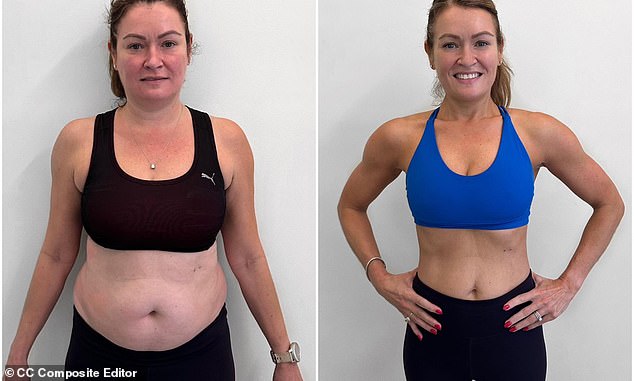
Kellie at the start of her Roar Fitness journey, and after 12 weeks. Her goal was to be under 60kg – she reached 57kg.
Like many, her lifestyle had quietly shifted, involving less consistent exercise, more convenience food. ‘We live in Dubai so you can get every takeaway under the sun delivered to your door in 30 minutes,’ she says.
For Mulvey, the weight gain was gradual rather than overnight – ‘I didn’t really notice, and then one day you put on your jeans that are meant to be your “fat jeans” and they’re really tight,’ she says.
What changed things for both women was introducing structure – in their case through coaching at Roar Fitness. The 12-week plan offers a high-intensity body transformation with three-weekly strength training sessions, tailored nutrition plans and regular monitoring and check-ins.
For D’Arcy the motivation was her upcoming birthday. ‘I wanted to go into my 50s having lost the weight, being stronger, fitter and happier again, and just finding my old self,’ she says.
Why strength training becomes essential
Both women highlighted one major shift: moving towards heavier weight training.
This can feel intimidating at first, especially for those used to cardio or lighter workouts. But the benefits are significant, especially in midlife.
Not only does it counteract age-related muscle loss (sarcopenia) but muscle tissue burns more energy than fat, even at rest. Building muscle supports a healthier metabolic rate, helping manage weight changes common in midlife.
Having the guidance of a personal trainer was a huge help for both women. ‘I think when you’ve got someone there, pushing you along and motivating you, you can go beyond where you expect,’ says D’Arcy.

Vicky D’Arcy shows the results of the 12-week programme, during which she lost 9kg.
According to Mulvey, the physical changes were apparent surprisingly quickly. After four weeks of weight training a friend remarked how amazing she was looking, and by the end of the three month programme ‘I felt like a completely different person,’ says Mulvey.
Her workouts included one lower body, one upper body and one full body workout a week, including everything from deadlifts to sled pushes. ‘I could tell that I was actually get stronger week by week,’ says Mulvey.
‘At first some things seem impossible, but then you’re suddenly doing a 40kg chest press or 140kg hip thrust. I got a bit addicted!’
Protein, portions, and the reality of ‘eating more’
One of the biggest surprises for both women was that weight loss didn’t involve starving themselves – but actually eating more.
At the beginning of the 12-week challenge they were given meal plans to follow. Far from being hungry ‘in the very beginning, I actually struggled with the amount that they were asking me to eat, especially from the protein side,’ says D’Arcy.
‘For the first four weeks I had to eat my breakfast and my lunch in two sittings – I thought I can’t eat this much food!’ says Mulvey.

Roar was founded by Sarah Lindsay, a former Olympian
Rather than massively limiting food, the demands of strength training mean the body needs fuel – particularly protein. ‘I had to make these four-egg omelettes,’ says Mulvey ‘I’d never really eaten more than one egg at a time before that!’
However, that’s not to say there weren’t rules, including cutting out sweet treats and alcohol. There’s no chocolate or cake – ‘if you want something sweet you’re allowed fruit,’ laughs Mulvey – and booze is off the cards. ‘That’s the thing I thought I would struggle with the most,’ says Mulvey, ‘but actually it was fine. Twelve weeks isn’t that long.’
The balance of her meals also changed during the weight loss plan. ‘I had a bigger breakfast and a bigger lunch, and then less calories for dinner, because it’s harder for you to process them in the evening,’ she explains.
The power of accountability
Another recurring theme was accountability – not just to a coach, but to a routine.
Rather than exercising sporadically, having set training days made consistency easier for Mulvey: ‘I knew every Tuesday, every Thursday, every Saturday, at 9am I would be strength training.’ Routines were carefully planned by the PTs to ensure progress, which as anyone who has spent months on end faffing around at the gym will know is not always the case if you’re left to your own devices.
‘You go for a consultation at the beginning, where you pour your heart out and share your goals, dreams and so on,’ explains D’Arcy. ‘They record measurements using calipers and take pictures,’ she says, which forms a baseline from which you can record progress.

D’Arcy keeping track of her progress.
Daily habits also played a role. Walking, for example, became a cornerstone, with a daily step count goal of at least 10-12k. Both women say they’ve kept this up since finishing the plan. ‘I walk every day, in the morning – that’s my little bit of calm and joy to start the day off,’ says D’Arcy.
Accountability also came via check-ins every three weeks with a nutritionist. ‘There’s nothing better than walking out of a check-in and seeing your fat measurements have gone down,’ says D’Arcy. ‘It make you feel empowered.’
Realistic expectations (and real-life flexibility)
Neither woman followed a ‘perfect’ journey. Travel, social events, and life still happened. And while strict phases were part of the initial process, they’ve managed to maintain the results through achieving balance.
The sustainable habits both D’arcy and Mulvey pinpoint including prioritising protein (‘it turns out it’s true, it does keep you fuller for longer,’ says Mulvey), maintaining daily activity (except on dedicated rest days) and allowing occasional treats.
‘You are a completely different person at the end of the 12 weeks, not just physically but mentally too,’ says Mulvey. One of the biggest changes for her was that she now always eats breakfast, having skipped it in the past.
‘Now I always have a salmon or egg-based breakfast, which has really helped,’ she says. She continues to focus her workouts on strength training. Her advice to other women her age looking to get fitter? ‘Don’t be scared – just go for it!’
As for D’Arcy, she says finding a way to keep fit that you actually enjoy is key. ‘It’s very important to find things you love doing,’ she says. ‘Be consistent, don’t over-complicate things and always be kind to yourself.’