
With a 1am kick-off (if we’re lucky) Monday, July 6 is going to be the day – no matter what the result is – when the nation battles with tequila hangovers and collective sleep deprivation.
This will not be a good day to perform – or undergo – heart surgery, or to be in charge of a Moon landing. Most of us will just have to muddle through Monday on four hours of sleep or less.
As a former professional insomniac, I’m here to tell you: you can get through it. And when I say ‘professional’, I’m talking Harry-Kane-in-the-box-proficient. I even wrote a book about it, called The Insomnia Diaries.
For several years in the 2010s, after a difficult marriage break-up, I had endless nights where I didn’t sleep at all. For some of this period, I was completely incapacitated. I was suffering severe insomnia, anxiety and depression after the end of my first marriage: I was so unwell, I eventually lost my job and temporarily went back to live with my father.
But when I eventually started to recover after a horrendous eight years, my sleep didn’t come back all at once – instead, it increased in stages. I rebuilt and was able to run my life as a divorced mother of two young children working full time for months on four or five hours a night. I’m here to say that with some adjustment, it can be done.
The most encouraging thing is that there’s a difference between the lonely, isolated insomnia I suffered for the best part of a decade, and the communal sleep debt that the country will be feeding in the morning. We’re all in this together, like Saka, Madueke and Eze: and scrape through we shall.
It’s also fair to say that during my insomnia years, I probably ate fewer crisps and drank fewer 1am beers than I will do tonight but I was no stranger to the whirring of an overstimulated mind.
So what do the experts have to say about getting through on just four hours of shut-eye?
Maryanne Taylor is a certified sleep consultant, and founder of thesleepworks.co.uk. ‘Even if you go to bed as soon as the match finished, your body may not have been ready to drop off,’ she says. ‘After all the ups and downs, your sympathetic nervous system may still be activated and adrenaline keeping your brain alert.’
Scientists call this hyper-arousal.

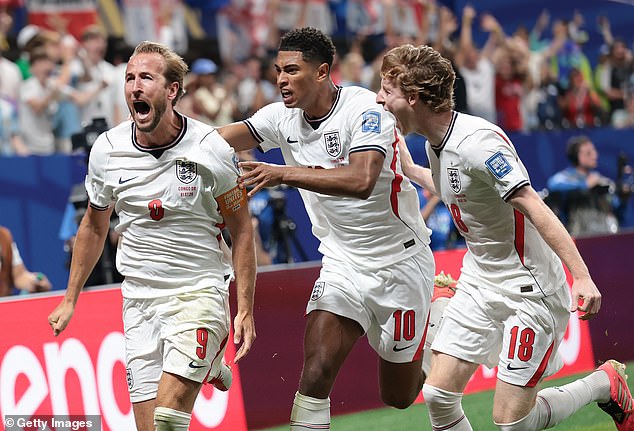
Harry Kane celebrates with Jude Bellingham and Anthony Gordon after scoring in the last round against DR Congo in Atlanta

For several years, I had endless nights where I didn’t sleep at all, writes Miranda Levy. When I eventually started to recover, my sleep didn’t come back all at once – but in stages
Then there is the booze. ‘The consumption of alcohol might contribute to you feeling rough in the morning,’ says Ms Taylor. ‘You might feel sleepy when you first go to bed. But alcohol might disrupt sleep architecture, particularly the REM stage of the sleep cycle, and cause more fragmented sleep during the second half of the night.’
Bags of Kettle Chips will not help, nor stress-eating packs of Haribo. ‘Salty foods make you more dehydrated and sugary snacks, sluggish,’ says Ms Taylor.
But once you are awake, there are ways to modify the exhaustion. In my insomnia years, I used to haul myself out of the house at 6am in the summer months, to get some day-kickstarting sunlight into my eyes. It definitely set me up for the day, even when I remained tired.
All sleep experts support this strategy. ‘Even ten minutes outside can help,’ says Ms Taylor. ‘Morning light is one of the strongest regulators of our circadian rhythm, or body clock. It stops the production of melatonin, the sleep hormone and boosts alertness. Move your body, but don’t overdo it. A gentle stretch or short walk can help you feel more alert without adding more physical stress.’
Other sleepless survivors may prefer to reach for a double espresso or five.
‘The aim is to use caffeine to take the edge off the tiredness, not accidentally create a second bad night,’ says Ms Taylor. ‘Drink water before your first coffee to help with dehydration. A morning flat white can temporarily improve alertness by blocking adenosine, the chemical responsible for building “sleep pressure” throughout the day. However, caffeine has a half-life of around six hours, so avoid it later in the afternoon to avoid it impacting on your sleep later.’
According to thesleepscientist.com Sophie Bostock, the safe recommended limit for caffeine in a day is 6mg per kilogram of body weight, which is about four instant coffees or two large coffees from a high street chain – and ideally not after 2pm.
I wasn’t much of a coffee drinker: my own personal strategy was to reach for a croissant or a muffin. Not a good idea.
‘As your hunger and satiety hormones are disrupted and self control goes down, your brain will crave high-fat, high-calorie foods,’ says Ms Bostock. ‘The day after a short sleep we typically consume an extra 300 calories. Take a moment to plan what you intend to eat for the day, rather than relying on instinct.’
Ms Taylor suggests a breakfast with protein and slow-release carbohydrates such as eggs on toast, or porridge with nuts and seeds. ‘These will support your energy better than a very sugary breakfast that gives you a quick lift followed by a crash.’

After my short-sleep nights, I would often find myself to be moody, cross and prematurely accuse everyone of stealing my mobile phone charger, writes Miranda Levy

Maryanne Taylor (left) and Sophie Bostock… thankfully, the sleep experts say that one missed night’s sleep doesn’t really matter
If you’re getting into the car, or doing physical work tomorrow, take care. According to Ms Bostock, if you’ve been awake for 24 hours and you’re planning to just ‘push through’, your reaction time slows by more than 50 per cent. ‘There will be some tired drivers across the country.’
It’s not only your physical performance that might suffer. After my short-sleep nights, I would often find myself to be moody, cross and prematurely accuse everyone of stealing my mobile phone charger. But I soon developed strategies: if I felt myself getting into conflict, I would remove myself from the situation for a full 20 minutes until I was calmer.
Ms Bostock agrees this is wise. ‘Sleep deprivation puts the brain into a state of vigilance, making you more irritable or impatient than usual,’ she says. ‘Try to build in a pause before you react. One useful strategy to calm the nervous system is the physiological sigh – a quick inhale, topped up with another inhale to fill your lungs, then a slow steady breath out. This will help to lower the heart rate so that you can respond from a more grounded place.’
And when – as is bound to happen – you hit that post-lunch slump? Personally, I was never a napper: I preferred to power through. But if you’re someone who’s able to sleep during the day – and you work from home – you might want to take forty winks.
‘The effects of a sleepless night typically hit in the early afternoon between, say, 1pm and 3pm, when we have a natural dip in our alertness,’ says Ms Bostock. ‘This is a great time for a nap – from 20 minutes to 90 minutes will be helpful. If you can’t nap, try and get outside into natural light again – sunlight is very alerting for the brain.’
Ms Taylor warns against longer or later naps: ‘These reduce homeostatic sleep pressure, making it harder to fall asleep at your usual bedtime.’
The most important thing, say the scientists, is to reset your usual sleep pattern. ‘Most people can cope with one night of short sleep without too many ill-effects,’ says Ms Bostock. ‘But we want to avoid a build-up of sleep debt. A tired brain has lower self-control than usual so it’s also worth deciding on your bedtime now, and switch off your phone 30 minutes before so you don’t lose sleep to mindless scrolling.’ Or match replays.
Ms Taylor counsels against going to bed dramatically early tomorrow to compensate for tonight. ‘If you then lie awake, it can make the night feel more stressful,’ she says. ‘Both your homeostatic sleep drive and your circadian rhythm are designed to recover naturally if you return to your usual routine rather than trying to compensate with lie-ins or very early bedtimes.’
Because ultimately, one missed night’s sleep doesn’t really matter. ‘Half the country will be struggling, so don’t catastrophise it,’ says Ms Taylor.
In the end, it was learning how not to ’catastrophise’ – or imagine the world was going to explode if I missed a few hours’ sleep – that helped to end my insomniac years.
Learning the principles of CBT (cognitive behavioural therapy) which is a set of strategies to reprogramme the way you think and act, helped me drop off peacefully. It took a few months of practice, but I told myself that it really didn’t matter if I felt a bit tired the next day. Taking the pressure off myself like this paradoxically helped me to drop off more quickly. One minute it was 4am, and the next, my alarm was beeping at 7.30.
Like the result, there is always another season/ World Cup/ penalty shoot-out night to perfect your sleep survival technique.