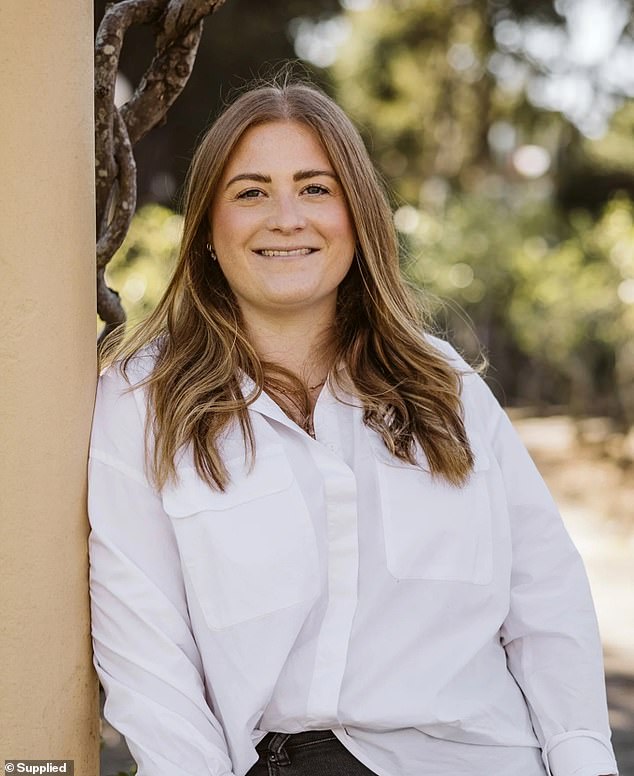
In the thick, orange haze of Australia’s devastating 2019-2020 bushfires, Sydney jeweller Meg Maskell remembers her world narrowing – quite literally.
Trapped on the NSW South Coast over Christmas with her husband as flames closed in and roads were cut off, the 30-year-old found herself surrounded by dense smoke that seeped into everything.
The air burned, visibility dropped, and like so many Australians during that summer, she assumed any physical discomfort came down to the conditions.
So when her vision began to blur in one eye – refusing to clear no matter how often she blinked – she didn’t panic.
‘I thought it was just the smoke,’ Meg, who was diagnosed with multiple sclerosis months later, told the Daily Mail.
‘It was so intense, and we couldn’t escape it. I just assumed my eyes were reacting to that.’
With smoke thick in the air and irritation expected, her symptoms didn’t seem urgent – just another side effect of an extraordinary environmental crisis.
But when she returned to Sydney a week later, something didn’t sit right. Her vision hadn’t improved.

In the thick, orange haze of Australia’s devastating 2019-2020 bushfires, Sydney jeweller Meg Maskell remembers her world narrowing – quite literally

Trapped on the NSW South Coast over Christmas with her husband as flames closed in and roads were cut off, the 30-year-old found herself surrounded by dense smoke that seeped into everything
‘I started to wonder if I’d actually damaged my eye. It just wasn’t going back to normal,’ she said.
Meg quickly booked an appointment with an optometrist the next week and was reassured there was nothing wrong. She was sent home with eye drops and told to monitor the situation.
But instead of settling, her symptoms worsened.
‘I felt like I wasn’t being taken seriously,’ she said.
‘I was a healthy 30-year-old woman. There was no reason for anyone to think something serious was going on.’
Still, her instincts told her otherwise.
In a moment she now credits with changing the course of her life, Meg decided to push further – checking herself into the emergency department at the Sydney Eye Hospital.
There, specialists began looking beyond the surface.

The air burned, visibility dropped, and like so many Australians during that summer, Meg assumed any physical discomfort came down to the conditions

While initial eye tests mirrored what she’d already experienced, further investigation – particularly of her optic nerve – raised red flags
While initial eye tests mirrored what she’d already experienced, further investigation – particularly of her optic nerve – raised red flags.
Doctors started to suspect the issue might not be in the eye itself, but somewhere deeper.
‘It was the first time anyone suggested it could be neurological,’ she said.
Suddenly, the possibilities shifted from minor irritation to something far more serious. She was told it could be a brain tumour, motor neurone disease, or multiple sclerosis.
‘It was terrifying. You go from thinking it’s just your eye to being told it could be something life-changing.’
What followed was a whirlwind of testing: MRIs, spinal taps, and weeks of waiting for answers.
By April 2020, the diagnosis was confirmed – Meg had multiple sclerosis, often referred to as MS, a chronic condition that affects the brain and central nervous system.
The timing made everything harder.

By April 2020, the diagnosis was confirmed – Meg had multiple sclerosis, often referred to as MS, a chronic condition that affects the brain and central nervous system
Australia – and the world – was entering the early stages of the COVID-19 pandemic.
Medical systems were stretched, telehealth was still in its infancy, and access to specialists became increasingly difficult.
Meg found herself in limbo.
‘I had the results, but I couldn’t get proper answers. The neurologist I was seeing stopped taking patients because of COVID, and suddenly I was left trying to navigate this on my own,’ she recalled.
Once again, she had to advocate for herself – pushing for referrals, seeking out specialists, and leaning on unexpected support networks.
Through connections with an MS charity – one she had previously supported through her jewellery business – she was eventually able to find a neurologist willing to take her on.
For Meg, the diagnosis was confronting on multiple levels.
As a handmade jeweller, her work depends on precision – long hours spent focusing on the smallest details, often under magnification. The idea that her vision, one of her most essential tools, could be compromised was deeply unsettling.
‘I thought I might have to stop working, or step away from the business,’ she said.
In addition, Meg said one of the most unexpected challenges was navigating the way others reacted to it.
Friends and family were deeply concerned, but often unsure how to behave.
‘Some people were talking to me like I was about to die,’ she said.
While the concern came from a place of care, Meg said it highlighted how little many Australians know about the condition – and how quickly assumptions can take over.
‘It made me realise that people hear “MS” and immediately think the worst,’ she said.
For Meg, it meant not only processing her own diagnosis, but also managing the fears of those around her – all while trying to hold onto a sense of normalcy.
Beyond that, there was the emotional weight of the unknown.

At 30, healthy and active, she had never imagined facing a lifelong neurological condition
At 30, healthy and active, she had never imagined facing a lifelong neurological condition.
And like many Australians, her understanding of MS was limited – shaped by vague awareness campaigns and misconceptions about severe disability.
‘A lot of negative thoughts go through your head. You think, “Am I going to be in a wheelchair in a year?”‘
In reality, MS presents differently for everyone.
Meg was later diagnosed with relapsing-remitting MS – the most common form – which is characterised by periods of flare-ups followed by remission.
While there is no cure, treatments and lifestyle adjustments can help manage the condition and slow its progression.
Today, six years on from her diagnosis, Meg is still running her business, still creating intricate, custom jewellery pieces – and still navigating life on her own terms.
Her symptoms are manageable but present.

Today, six years on from her diagnosis, Meg is still running her business, still creating intricate, custom jewellery pieces – and still navigating life on her own terms
Fatigue is one of the biggest challenges, shaping how she structures her day. Her eyesight requires constant care, often supported by high-powered magnification tools at her workbench.
At times, she experiences tingling in her fingers – small but significant reminders of the condition she lives with.
‘It’s about adapting. Knowing your body, knowing your limits, and working with them. For example, I know that I’m going to get the most out of my days in the mornings that that I’ll be sluggish by the afternoon.’
Meg has also adapted her diet and exercise routine to help slow the progress of her illness.
‘MS is quite inflammatory – so I’ve stopped drinking alcohol and limit eating onion, tomatoes, garlic – anything that causes inflammation. I still have a cup of coffee every now and then, but it’s just about managing it the best you can.’
If there’s one message she hopes others take from her experience, it’s the importance of trusting your instincts – even when symptoms seem minor or easily explained.
‘I could have ignored it for longer,’ she said.
‘A lot of people do, because MS doesn’t always hit you in a way that stops you in your tracks straight away, or something that shuts down your whole lifestyle.
‘Many people have problems with their eyes, or numbness and tingling in their fingers. They just push it to the side for years and years or try to manage it yourself.
‘But my biggest advice is to advocate for yourself. You know yourself, and if you feel like something is wrong, really have to jump up and down to get some answers.’