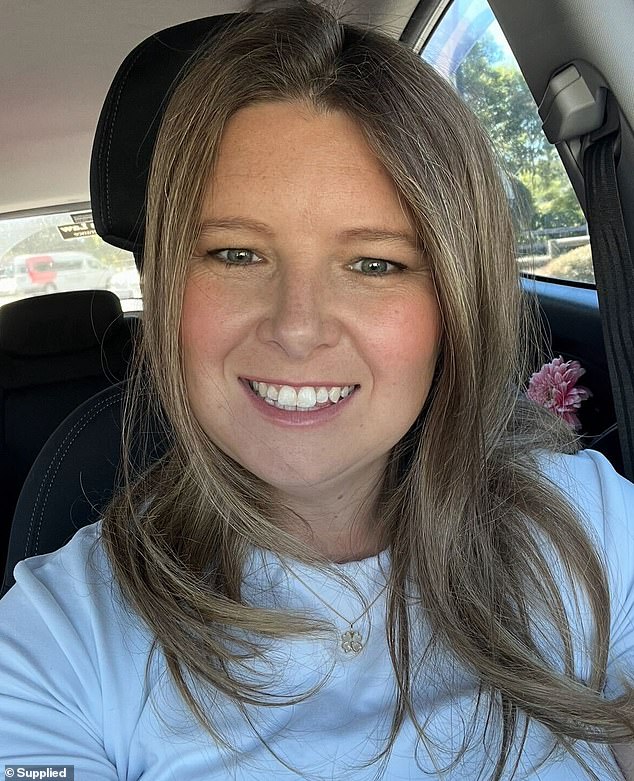

When Chontaine Adair woke in the middle of the night with excruciating pain shooting through her ribs and back, she assumed something must be seriously wrong.
The then-31-year-old mother-of-two from Wollondilly, south-west of Sydney, could barely roll over in bed. By morning, she struggled to stand. Walking hurt. Bending ached. Even hugging her young daughters became painful.
Yet despite multiple trips to hospital and repeated visits to doctors over the following 12 months, Chontaine was continually reassured that the pain was muscular.
A year later, scans revealed the real cause: four tumours and stage 4 hormone receptor-positive breast cancer that had already spread to her bones.
Now 33, Chontaine is sharing her story in the hope it encourages others to trust their instincts when something doesn’t feel right.
‘It wasn’t normal pain,’ she told the Daily Mail.
‘I was only 31. Pain’s not normal at my age unless you’ve physically hurt yourself. I went to bed completely fine and woke up in the middle of the night in agony.’
The first episode struck in October 2024.

When Chontaine Adair woke in the middle of the night with excruciating pain shooting through her ribs and back, she assumed something must be seriously wrong
Her husband took time off work and rushed her to hospital, where she was prescribed pain medication and sent home.
‘The Endone didn’t work, but the pain kept going,’ Chontaine said.
‘After a couple of days, I felt a stabbing sensation and ended up back in hospital. They told me it was muscular and gave me more Endone. I told them it didn’t work the first time.
‘I kept saying that I hadn’t pulled a muscle. I hadn’t injured myself. It had just started out of nowhere in the middle of the night.
‘It hurt to move. I had to lie still or sit still. It was excruciating to roll over, get up, move around or bend over. I essentially had to get myself into a comfortable position and stay there.’
What made the situation even more difficult was trying to care for her two young daughters, who were five and six at the time.
‘If they wrapped their arms around me and hugged me too tightly, it hurt,’ she said.
‘I couldn’t bend down properly. I couldn’t pick them up.’

The then-31-year-old mother-of-two from Wollondilly, south-west of Sydney , could barely roll over in bed. By morning, she struggled to stand. Walking hurt. Bending hurt. Even hugging her young daughters became painful

Chontaine’s pain would linger for weeks at a time before disappearing, only to return again without warning
The pain would linger for weeks before disappearing, only to return again without warning.
‘I kept asking my doctors about it, and I kept getting told it was muscular and that these things can take time to heal,’ she said.
Eventually, she stopped seeking help.
‘After a while, I kind of gave up,’ she said.
‘I thought, “The doctors aren’t going to do anything. There’s no point going back”.’
But in October 2025, the pain returned yet again – and this time it didn’t fade away. Instead, it became progressively worse.
When Chontaine returned to her GP, the doctor could immediately see how much pain she was in and referred her for a CT scan – and the results changed everything.
‘They found secondary tumours in my spine and my rib,’ she said.

When Chontaine returned to her GP, the doctor could immediately see how much pain she was in and referred her for a CT scan – and the results changed everything
‘At that point, they could confirm it was cancer, but they didn’t know what type or where it was coming from.’
The news arrived while Chontaine was dressed in her petrol station uniform and preparing to leave for work.
Her doctor had asked her to come into the clinic urgently, but because she was due to start a shift, she requested the results over the phone.
‘I was standing there waiting for the call when my doctor told me it was tumours, which meant it was most likely cancer,’ she said.
‘I asked if there was any chance it wasn’t cancer, and she said it was pretty certain that it was, they just didn’t know what type yet.’
The following fortnight became a whirlwind of biopsies, scans, blood tests, and specialist appointments.
‘My husband was there every step of the way,’ she said.
‘It was the biggest emotional rollercoaster. Every day there was another appointment, another scan, another place we had to be.’

Throughout it all, she credits her husband, family, friends, daughters’ school and medical team for helping her navigate the toughest period of her life
Doctors were particularly concerned about one tumour near her spine and admitted her to hospital while they investigated whether it was placing pressure on her spinal cord.
‘If it was impinging on my spine, I could potentially lose the ability to walk. But thankfully, all of that came back clear,’ she said.
Two weeks later, she received her final diagnosis: stage 4 hormone receptor-positive breast cancer with bone metastases.
Doctors believe the cancer was likely already stage 4 when the pain first began.
‘My oncologist said that because the pain was in the exact areas where the tumours were found, it was most likely already stage 4 when those symptoms started,’ she said.
The diagnosis brought a flood of fears, but one concern immediately overshadowed all others. After learning she had incurable cancer, Chontaine’s thoughts turned straight to her daughters.
‘I remember just crying,’ she said.
‘I was thinking, how long have I got? Am I going to make it? Is there treatment? Is it terminal?
‘But mostly I was thinking about my girls. I need to be here for them. That was the one thing I kept thinking about.’
Today, her daughters still don’t know their mother has cancer.
Because Chontaine’s treatment has not involved chemotherapy and she has not experienced the visible changes many people associate with cancer treatment, she and her husband have chosen to keep conversations simple and age-appropriate.
‘We’ve told them that mummy has a sore back and that I have appointments to help make it better so I can play with them again,’ she said.
‘When I was in hospital for nine days, that was how we explained it as well.
‘They don’t know it’s cancer. They don’t know it’s stage 4 and that it will be something I live with for the rest of my life. They’re still very young.’
While there is currently no cure for her cancer, treatment has successfully reduced the tumours and stopped the disease from progressing.
Chontaine underwent radiotherapy and now receives four injections every 28 days, including hormone therapies that place her into medical menopause and treatment to strengthen her bones.

The diagnosis brought a flood of fears, but one concern immediately overshadowed all others. After learning she had incurable cancer, Chontaine’s thoughts turned straight to her daughters
Her latest PET scan showed the cancer was no longer actively growing.
‘The cancer cells weren’t spreading and they weren’t growing, which was fantastic.’
Still, the treatment has not been without challenges.
Hot flushes, fatigue, reflux and severe joint pain have all affected her quality of life, while some medications had to be changed because of debilitating side effects.
‘There were times I felt like a very crippled elderly lady,’ she said.
‘I’d get off the lounge and hobble around bent over because everything hurt.’
Throughout it all, she credits her husband, family, friends, daughters’ school and medical team for helping her navigate the toughest period of her life.
‘My husband reminds me to slow down when I push myself too hard. He’ll run me a bath or tell me to lie down and rest because I find it really hard to put myself first.’

Chontaine hopes her story encourages people – particularly younger women whose symptoms may not fit expectations – to continue seeking answers when something feels wrong
Despite everything she has endured, Chontaine is determined to use her experience to help others.
She hopes her story encourages people – particularly younger women whose symptoms may not fit expectations – to continue seeking answers when something feels wrong.
‘I’m trying to take all the negativity that’s happened and turn it into something positive,’ she said.
‘Hopefully if my story gets out there, it might help somebody else who’s in pain and getting brushed off.
‘They can look at my experience and think, maybe it’s something more than muscle pain. I just want to do something good with it. I don’t want to let it beat me.
‘And I want to be a role model for my girls. As they get older, I’ll tell them everything that’s happened so they never end up in the same situation.’
To fund further breast cancer clinical trials, aimed at improving the lives of patients with all types of breast cancer, people can donate to Breast Cancer Trials’ Tax Appeal at www.breastcancertrials.org.au/tax-appeal