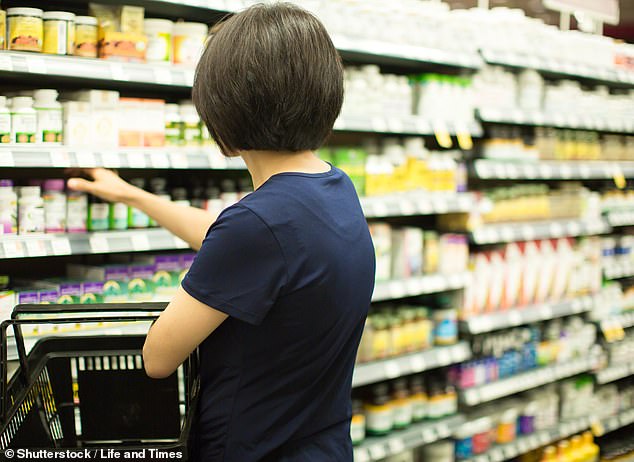
There are certain labels that most of us look out for when supermarket shopping, believing it means we’re getting a better offering.
Yet experts have suggested that some buzzwords, like ‘artisanal’, ‘ceremonial-grade’ and ‘made with real fruit’, can be ‘misleading’ and interpreted in a myriad of ways.
Speaking to the Daily Mail, celebrity nutritionist Gabriela Peacock and Richard Bowcott, a brand and marketing expert from RSPCA Assured, explained that some phrases exist purely for marketing, and don’t actually confirm anything about the contents of your groceries.
So whilst some terms, such as ‘plant-based’, ‘organic’, ‘cruelty-free’ or ‘responsibly sourced’, fall under precise regulation standards with quotas of ingredients to fulfil, not all labels have such specifications.
Read on to discover the experts’ verdicts on the phrases that are the most ‘misleading’ – and what they really mean…

While many of such terms may seem confusing and samey, they usually fall under specific regulation standards with quotas of ingredients to fulfill – but not all of them. Stock image used
‘CEREMONIAL-GRADE’ MATCHA
It’s the trendy drink every coffee shop whisks up these days, with supermarkets lining their shelves with promises of authentic ‘ceremonial-grade’ matcha powders.
And while the term sounds like a mark of authority, each company can set its own standard of what is required.
‘While “ceremonial-grade” suggests quality, it isn’t tightly regulated in the UK,’ Gabriela revealed.
‘Higher-quality matcha can offer more antioxidants, but the label alone isn’t a guarantee. Colour, freshness and sourcing matter just as much.’
Authentic and high quality matcha tea is made from the finely ground powder of green tea leaves specially grown in shade.
The texture of high-quality matcha powder is also noticeably fine and silky smooth between the fingers.
‘LOCAL’ HONEY
Experts say that no matter where you buy your honey, there is a good chance the product you’ve paid for has been bulked out with cheap sugar syrups.
On social media, the staggering size of the ‘honey fraud’ problem has kicked up a swarm of supposed tests designed to help spot the real deal.
However, from swirling water over your honey to reveal its ‘genetic memory’, to lighting your honey on fire, experts warn that most of these tests don’t stand up to scrutiny.
Gabriela explained: ‘Local’ has no strict definition in the UK, and nutritionally, honey is still sugar.
‘It may have environmental or taste benefits, but it should still be consumed in moderation.’
‘FRESHLY-BAKED’
Past years have seen supermarkets slammed for ‘misleading’ customers with inaccurate claims that its baked goods have been made fresh in store.
In 2024, the Real Bread Campaign (RBC) claimed that Tesco had falsely claimed in some of its stores that its bread is baked fresh onsite on both its signs and packaging – but the goods have actually been baked earlier in a factory and brought in.
The organisation alleged that many Tesco locations receive the bread pre-made from a factory and then defrost the loaves in ovens on-site, or as the RBC call them, ‘tanning loaves machines’.
The RBC additionally claimed that Tesco states its bread is ‘expertly baked’ on packaging – despite branches hiring low-skilled staff with minimum baking expertise to reheat the loaves in stores.
A spokesperson for Tesco said at the time: ‘We’re proud of our colleagues who freshly bake great quality, affordable bread in hundreds of our stores – and have done so since we opened our first in-store bakery in 1968.
‘In some stores where we don’t have the space to bake everything from scratch, we work closely with our bakery suppliers who prepare dough for us that trained colleagues bake every day in store.
‘The signage we use in each individual store reflects the different ways we prepare bread, and our approach has been agreed with our Trading Standards Primary Authority.’
And Gabriela added that no matter what, the label can still make food seem ‘healthier’ than it is.
‘Freshly-baked’ doesn’t always mean healthier,’ she explained. ‘Many products can still be high in refined carbs, sugar and fats, regardless of where or how they’re baked.
‘It is always better to know where your food comes from, of course, but as mentioned it doesn’t make it a healthier alternative.’
‘MADE WITH REAL FRUIT’
‘Made with real fruit’ suggests that the snack you’re buying is going to be super-packed with nutrients, but all it really means is that real fruit is used in the process.
Hence, it makes it hard to gauge how much there really is.
‘This sounds healthy, but it doesn’t indicate how much fruit is included,’ Gabriela said.
‘Products can still be high in added sugars, so it’s worth checking the ingredient list.’
‘MADE WITH WHOLE GRAINS’
‘As a nutritionist, I gravitate towards whole grain products, but this claim doesn’t mean they’re the main ingredient,’ Gabriela explained.
‘For real nutritional value, they should be listed first.’
Indeed, much like ‘made with real fruits’, all this really suggests is that whole grains are used – not how much they are.
And according to the Real Bread Campaign (RBC), as the 2007 UK Whole Grain Guidance Note admitted, ‘there is no agreed UK definition for whole grain.’ This was still the case in November 2024.
‘The term generally refers to the entire edible grain (including the germ, endosperm and bran) from cereals and related plants,’ the note added.
RBC also shared: ‘Manufacturers can (and do, or at least did) use the term to market products that have startlingly small amounts: as low as 6 per cent of the declared ingredients in one product we found.
‘As the UK Whole Grain Guidance Note pointed out: ‘In line with EU labelling legislation 2, highlighting the inclusion of whole grain on a food package (e.g. by stating ‘with whole grain’ or ‘made with whole grains’) will automatically trigger the requirement to provide a Quantitative Ingredient Declaration (QUID).
‘This provides a mechanism for consumers and other interested parties to assess the level of whole grain present.’
‘In short – if a loaf is marketed using the term wholegrain, the ingredients list should state them and their percentage by weight.’
‘TRUSTED FARM’
Gabriela said that ‘trusted farm’ is ‘a marketing phrase rather than a nutritional standard’.
‘It’s more important to focus on the overall ingredients and nutrient profile,’ she shared.
And Richard said: ‘There are so many slogans, phrases and logos on packaging which may make you think that the meat, fish, dairy or eggs you’re buying are more ethical than they really are.
‘If you choose to eat these products, make sure all marketing claims on packaging, like ‘farm fresh’ or ‘trusted farm’ are backed up by an accredited certification label like RSPCA Assured.
‘RSPCA Assured is the only UK certification scheme solely dedicated to animal welfare, so the label means the product you’re buying has come from a farm following strict welfare standards designed by the RSPCA. It also means that those farms have been checked every year by an RSPCA Assured assessor to make sure they’re following those standards.’
Speaking to the BBC, Clare Wood, director of Food Labelling Services confirmed that the authenticity of the term ‘trusted farm’ is hard to trace.
‘It’s marketeers trying to sell their products,’ she shared.
‘It might be that their farms are ‘trusted’ because they have a sole supplier, but who knows? I think a lot of these terms are opaque and it’s marketeers bending rules.
‘These terms have to be able to be substantiated but they’re not necessarily regulated.’
‘ARTISANAL’
While often used in marketing materials to get across a curated and hand-made positioning, there is nothing that really ‘means’ artisanal regulations wise.
A 2018 European Consumer Organisation (BEUC) report called for the ‘toughening up’ of labelling, claiming that foods being labelled ‘traditional’, ‘artisanal’ or ‘natural’ suggest that things are made on a small scale when in reality they could be created in a factory.
‘Recipes which contain industrial dyes or additives which could not be reasonably considered as traditional are nonetheless labelled as such,’ it shared.
‘Artisanal’ may suggest quality, but it doesn’t mean healthier,’ Gabriela also added.
‘These products can still be high in sugar, salt or fat – premium doesn’t always equal nutritious.’
Speaking to the Guardian, a Sustain in the UK charity spokesperson also shared: ‘We know that consumers in this country are being conned by phony products, and as a nation getting nowhere near its five a day, exaggerated claims about fruit or veg content are deeply irresponsible.
‘Vague marketing terms like ‘artisanal’ and ‘farmhouse’ fool us into thinking we’re buying higher quality products and we’re routinely charged more for the privilege.’
‘ENRICHED CAGES’
Many supermarkets are now also touting ‘eggs from hens in enriched cages’.
While the term ‘enriched cages’ may sound innocent enough, the truth is these cramped cages provide each hen with space equal to an A4 piece of paper to spend their lives.
‘It’s no life at all for hens stuck in enriched cages and they are likely to suffer high levels of stress and frustration,’ said RSPCA Assured farming expert Charlotte Thomas.
‘Cages limit hens’ ability to walk, nest, perch, scratch the ground, stretch their wings, dustbathe and forage.
‘What always shocks me is that so many hens are still living like this, despite old-style battery cages being banned in 2012. In fact, there are more than 7 million egg-laying hens living in cages in the UK.
‘If you’re buying eggs, the best way to ensure they’re from hens which are free to move, stretch, perch and play is to look for the RSPCA Assured label on packaging,’ explains Charlotte.
‘This label means they’ve come from farms that are checked every year by an RSPCA Assured assessor to ensure they’re meeting hundreds of strict higher welfare standards so hens have a good quality of life.’