Asteroid disaster movies tap into one of humanity’s oldest fears: extinction-level annihilation. Nothing raises the stakes in a movie quite like a countdown to planetary extinction. For decades, filmmakers have imagined what would happen if a massive space rock suddenly appeared on a collision course with Earth. Instead of focusing only on destruction, many of these stories spotlight bold rescue attempts.
Since most filmmakers rarely settle for simple solutions when the fate of the world hangs in the balance, they dream up elaborate, risky, and sometimes scientifically questionable plans to stop the asteroids. Cinematic strategies often combine real scientific concepts with exaggerated heroics to keep audiences glued to their seats. Here are six movies that showcase some of the wildest and most memorable asteroid-stopping plans ever put on screen.
Meteor (1979) — Cold War Rivals Launch Nuclear Missiles Together
This late-1970s Sean Connery-led sci-fi thriller imagines a rare moment of unity between geopolitical enemies. When scientists discover a massive asteroid fragment heading toward Earth, the United States and the Soviet Union join forces. Both nations secretly possess orbiting nuclear platforms originally designed as weapons against each other. However, they decide to aim those missiles at the incoming space rock instead.
The plan involves coordinated launches from space-based arsenals, turning instruments of war into tools of planetary defense. Although the film dramatizes Cold War tensions, its central idea reflects real historical fears about weaponizing space. During that era, both superpowers researched anti-satellite and orbital weapons systems. The movie transforms those anxieties into a high-stakes scenario where cooperation becomes humanity’s only hope.
Deep Impact (1998) — Splitting a Comet With Nuclear Bomb and a Human-Piloted Spacecraft
Released the same year as Armageddon, this film took a more restrained but still daring approach. In the story, the United States government secretly builds a spacecraft called Messiah and sends astronauts to intercept a seven-mile-wide comet. Their mission requires landing on the object’s surface and planting nuclear charges to break it apart. The goal is not total destruction but changing the fragments’ paths so most miss Earth. The plan partially succeeds when the astronauts detonate the bombs, splitting the comet into two pieces.
However, the mission fails, as both pieces continue on their way to Earth. Although one crashes, the surviving crew of the Messiah sacrifice themselves to detonate and destroy the other. The film drew praise from some scientists for its portrayal of orbital mechanics and international cooperation, which it depicted more realistically than most disaster movies. Even so, landing humans on a comet remains far beyond current technological capability, which keeps the movie’s solution firmly in the realm of cinematic ambition.
Armageddon (1998) — Drilling Into an Asteroid With a Nuclear Bomb
About a month later, Michael Bay’s blockbuster Armageddon was released. The movie centers on a plan, quite similar to Deep Impact, to use nuclear bombs on the asteroids. NASA recruits oil drillers to land on a Texas-sized asteroid and bore deep into its surface. The team intends to plant a nuclear warhead inside the rock rather than detonating it on the outside. Scientists in the film explain that an internal blast would split the asteroid into two pieces that would miss Earth.
The mission unfolds amid multiple shuttle missions, spacewalk accidents, and a race against time. While the film exaggerates the feasibility of drilling and nuclear deflection, its core concept reflects a real scientific idea: subsurface nuclear explosions could, in theory, alter an asteroid’s trajectory. Experts have noted that the movie dramatizes the physics and logistics, yet the basic premise comes from genuine planetary-defense discussions. It is this blend of fact and spectacle that makes the plan both outrageous and oddly plausible.
Ice Age: Collision Course (2016) — Herds Unite to Deflect a Meteor With Electromagnetic Crystals
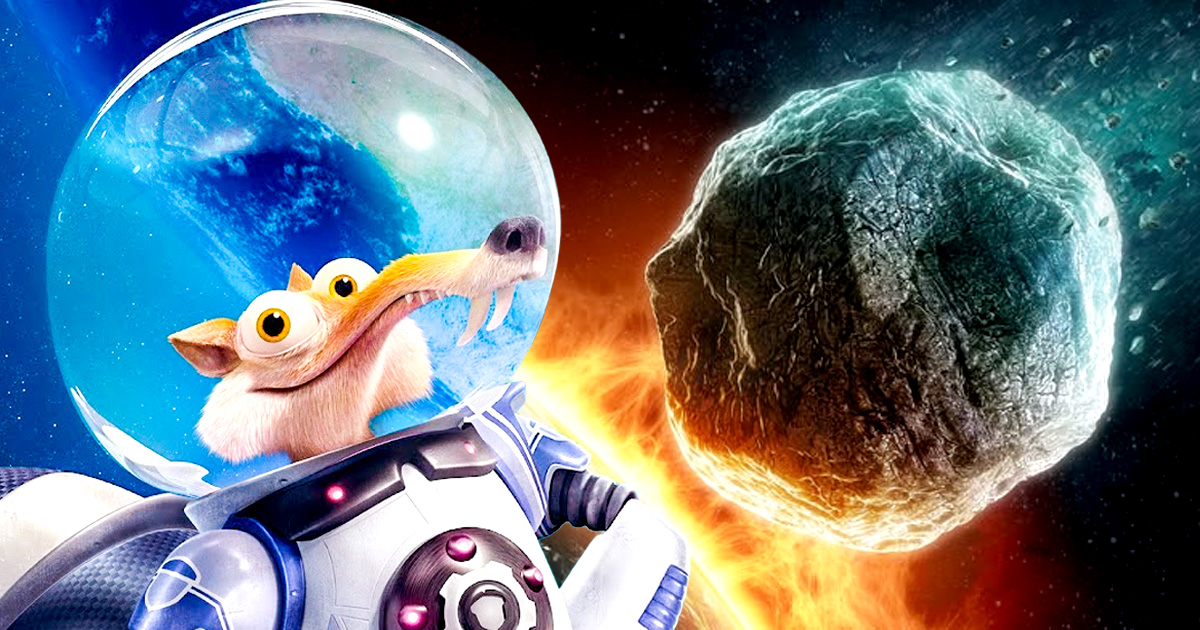
In this animated adventure, Ice Age: Collision Course, Scrat’s relentless pursuit of his acorn accidentally sends a massive asteroid hurtling toward Earth. Manny’s herd travels to a hidden land called Geotopia, where they discover enormous crystals with strong electromagnetic properties. Realizing these crystals can attract the asteroid, the animals stack them into a towering spire that serves as a giant cosmic magnet.
As the asteroid approaches, it is pulled toward the crystal tower rather than the planet. The attraction alters its path and ultimately causes it to collide with the crystal structure, shattering the space rock and preventing global destruction. The solution has no real scientific basis, but it fits the film’s cartoon physics and emphasizes teamwork, quick thinking, and over-the-top spectacle.
Don’t Look Up (2021) — Aborted Nuclear Option, Drones, and Mining the Comet Instead of Destroying It
Adam McKay’s satire uses absurdity to critique politics and media culture, but its asteroid-deflection attempts still stem from real scientific proposals. At first, after downplaying the threat, President Janie Orlean (Meryl Streep) approves a mission to destroy the incoming comet with nuclear weapons. Moments after launch, however, she aborts the strike because a tech billionaire convinces them he can mine the comet’s rare minerals instead. His company proposes sending a fleet of autonomous drones to break the object into smaller, harvestable pieces.
The scheme collapses spectacularly when the drones malfunction and fail to fragment the comet. Scientists in the film warn that altering an asteroid’s structure without fully redirecting it could make the situation worse, a concern echoed by real experts. Planetary defense researchers often stress that deflection is more effective than fragmentation because smaller fragments can still devastate Earth. By blending satire with legitimate scientific debate, the movie presents one of the wildest yet oddly grounded asteroid-stopping strategies in modern cinema.
Doomsday Meteor (2023) — Lasers First, Rocket Engines Later
Representing every low-budget attempt at producing asteroid movies is Noah Luke’s Doomsday Meteor. In the film, astronomers detect a colossal meteor roughly three times the size of Mount Everest hurtling toward Earth with less than a week before impact. The object approaches from the direction of the Sun, making early detection difficult and leaving world governments scrambling to respond before extinction becomes inevitable.
Scientists calculate that the iron-rich body would cause global annihilation if it struck, triggering an emergency “Doomsday Protocol” that unites nations in a desperate planetary defense effort. The film’s wild prevention strategy unfolds in escalating phases. First, international teams fire multiple high-powered lasers at the meteor, hoping combined energy blasts will knock it off course.
However, the dense metallic composition resists the assault. As a last resort, a crew of astronauts launches into space to land directly on the rock and install a powerful rocket engine designed to push it onto a safer trajectory away from Earth. If anything, this crowns it all as the wildest asteroid-deflection idea any filmmaker has come up with.