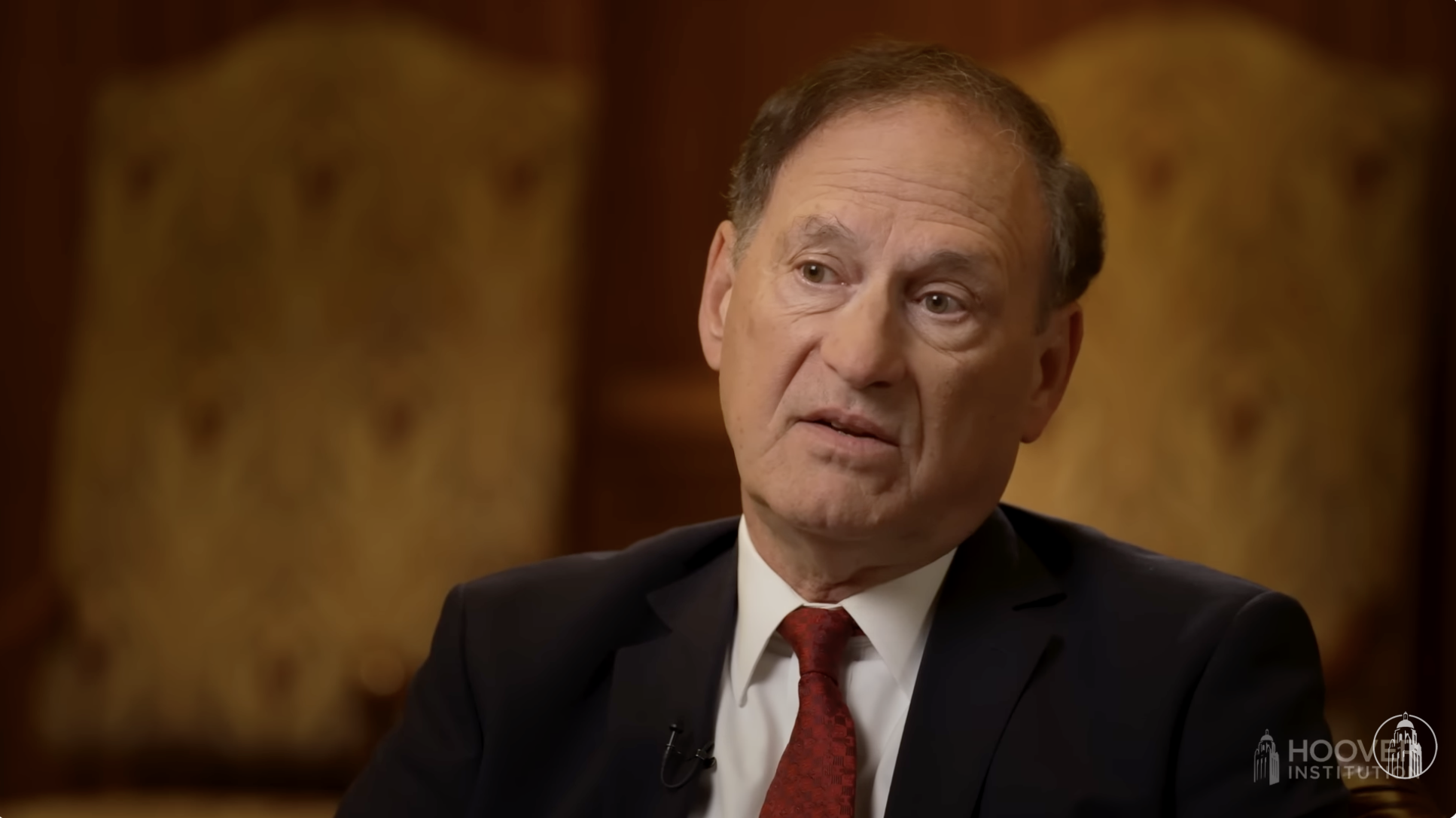

Justice Samuel Alito marks his 20th year on the Supreme Court, a milestone that coincides with the release of my new book this month, Alito: The Justice Who Reshaped the Supreme Court and Restored the Constitution. The timing feels right. America needs reminding of what a real judge looks like in an era when the court faces relentless attacks from those who prefer activist robes to actual jurisprudence. Alito embodies the quiet courage that has delivered some of the most important victories for constitutional liberty in generations.
Since one of Alito’s colleagues was nearly assassinated by a deranged gunman who turned up at his house, life hasn’t been easy for conservative Supreme Court justices. But back when conservative justices could still be seen in public without being attacked by left-wing activists, Alito and his wife attempted to get brunch in New Haven, Connecticut. Turned away because of a long line, they walked away and went down the street. An eyewitness called it “a very graceful moment,” noting he could have invoked his status.
This is vintage Alito. When he attends functions in Washington, a city of inflated egos, he can be found in the corner, quietly talking to a few people, and making them feel comfortable. If someone else starts talking, he stops. He does not get energy from holding a glass of wine and having people pay homage to him but from reading law review articles.
His humility can be a problem, too. There is a tradition that Supreme Court police stand every time a justice walks by. Alito’s copy machine used to be in the hallway outside his chambers. Rather than asking his aides, he would make his own copies — until the Supreme Court police asked his staff to make the copies so that they wouldn’t have to stand while he performed the routine task.
There is no question Justices Antonin Scalia and Clarence Thomas have been the fan favorites of many conservative court watchers. But for a certain type of conservative, Alito’s valiant cheering for a better, previous version of America, even if it’s a losing prospect, is deeply attractive.
Social critic Albert Jay Nock recounted how God sent Isaiah to preach repentance but warned him, “it won’t do any good.” When Isaiah asked what the point was, he was told, “There is a Remnant here that you know nothing about … They need to be encouraged and braced up because when everything has gone completely to the dogs, they are the ones who will come back and build up a new society.” It’s a good description of Alito’s role.
He represents the best of mid-20th-century America, a country that is disappearing. He laments how wealthy elites have never had to deal with urban dystopias that have affected middle- and lower-class Americans. He takes criminal prosecutions more seriously than his colleagues. He is stalwart in his defense of a moral code that until recently was universally recognized in America.
“You get the sense with other justices that they think the country is going to get better because the court is issuing decisions that are good and they have a great job,” one highly placed court observer told me. “Alito recognizes that even if the court is doing great things, it’s much harder, if not impossible, to put the toothpaste back in the tube.”
That’s not to say that he takes losses well or hides his feelings. He’s not a melancholy warrior, but not exactly a happy one either. He cares deeply about the law and getting the big issues correct, and he is affected by what the court does. Clerks can tell how a conference has gone from his facial expressions and body language. At the end of each Supreme Court term, clerks from all the chambers organize and perform a variety show. One year they made fun of Alito’s inability to hide his emotions by portraying him in the World Series of Poker. When he was dealt a good hand, he would beam and everyone would fold.
Alito likes to tease people and his sense of humor is so dry and subtle that sometimes clerks have not known if he was joking or not. One year he took them to see a Magna Carta exhibit, which included the Jay-Z rap album “Magna Carta Holy Grail.” The justice looked at the docent and asked, completely deadpan, “What is a rapper?” He let the question sit for five seconds before cracking a smile.
His clerks — one-year assistants from top law schools — revere him, in part for how accommodating he is of them and their families. One clerk’s young daughter made a bracelet for him out of pipe cleaner and beads. Months later, when the family visited his chambers, he emerged from his office wearing the bracelet, not mentioning it but giving the little girl the delight of discovering her gift on his wrist.
His clerks joke about how little he needs them. “Justice Alito needs clerks like a mother needs a toddler to help bake cookies. He doesn’t need you there, but it is fun to lick the spoon,” joked one.
Alito is an improbable justice. Unlike so many people in power, he arrived at his position solely because of his intellect and hard work. He is not a politician or glad-hander. His personality and way of life are shockingly normal. His public schools, liberal college, and liberal law school did not weaken his convictions. He does not care what people think of him, and indeed the most common word his fellow justices use to describe him is “courageous.” One colleague referred to him as “off the charts brilliant.”
He knows that the greatest of man’s accomplishments are fleeting, and in his humility, he does not regard himself as an inspiring figure. But as he once said, he hopes other Americans will share his passion for preserving the Constitution and the free and prosperous way of life it has made possible:
[A] lot of good work has been done to protect freedom of speech, religious liberty, and the structures of government created by the Constitution. All of this is important. But in the end, there is only so much that the judiciary can do to preserve our Constitution and the liberty it was adopted to protect. As Learned Hand famously wrote, ‘Liberty lies in the hearts of men and women; when it dies there, no constitution, no law, no court … can do much to help it.’ For all Americans, standing up for our Constitution and our freedom is work that lies ahead.
This excerpt has been adapted from Alito: The Justice Who Reshaped the Supreme Court and Restored the Constitution, which will be released on April 21 and is available now.